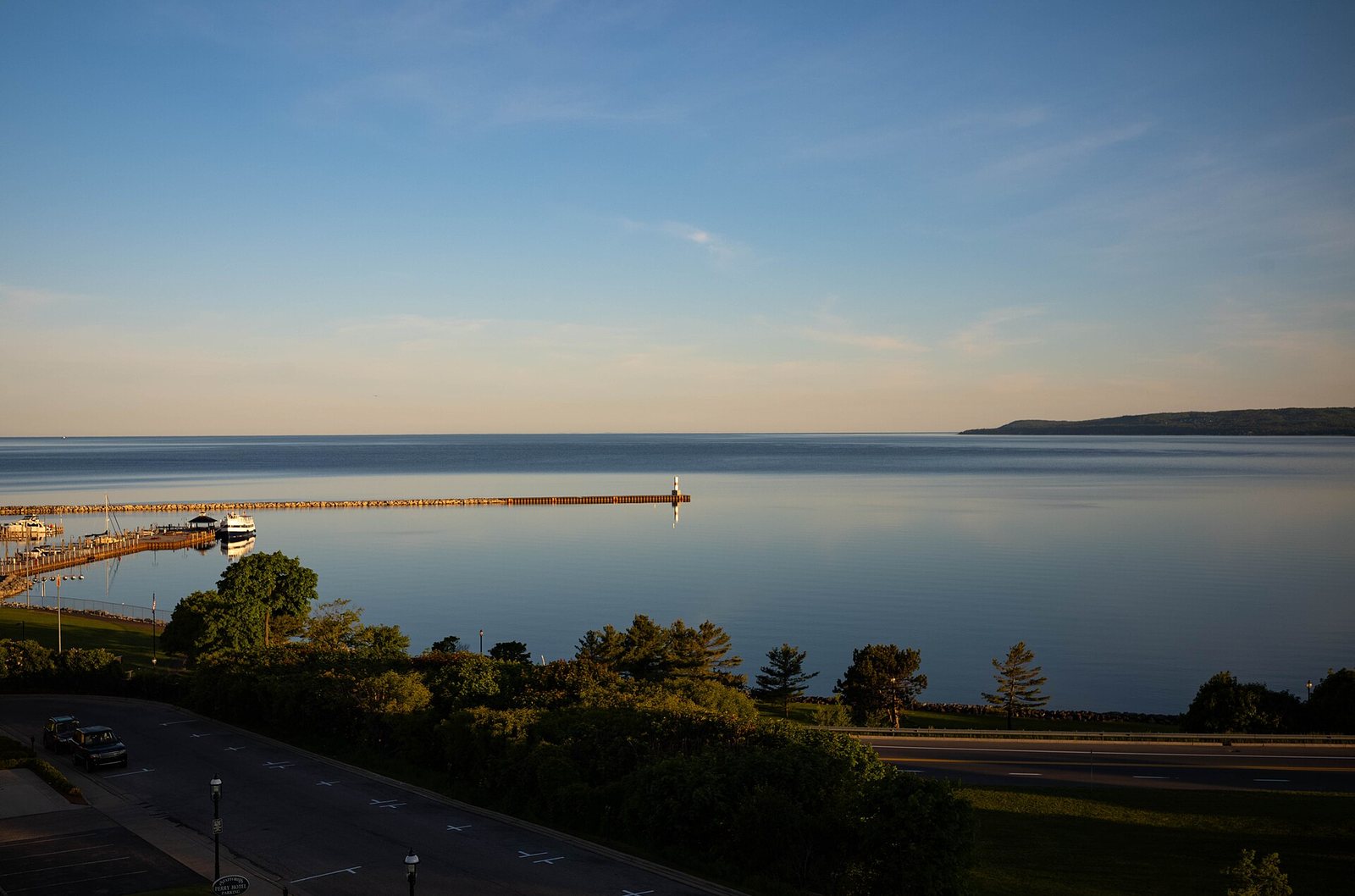
Walk to the end of the breakwall below downtown Petoskey on a summer evening and most of this trip is in view at once. Harbor Springs sits across Little Traverse Bay to the north, Bay View’s Victorian cottages climb the bluff to the east, and the bay opens west toward Lake Michigan and the sunset. Charlevoix is 17 miles down the shore, Boyne City is over the hill on Lake Charlevoix, and Beaver Island is a two-hour ferry ride out on the lake. Locals treat the whole bay as one place, and so should you.
The short answer: base yourself in Petoskey, a walkable small city with the widest choice of rooms and restaurants, and spend two or three nights. Harbor Springs is 12 minutes away and the quieter, pricier base; Charlevoix, 19 minutes away, is the town for boats, stone “mushroom houses” and the Beaver Island ferry. July is the peak, early October is the best month for color and room rates, and the ski hills near Harbor Springs and Boyne carry the winter.
Fares, fees, hours and road closures below were checked on September 23, 2026 against the operators’ and agencies’ own websites. The biggest change this year is on M-119, the Tunnel of Trees, where two sections are closed to through traffic; the section on the drive has the detours.
On this page: At a glance · Getting there · Where to base yourself · Things to do in Petoskey · Harbor Springs · Tunnel of Trees · Charlevoix · Boyne City · Beaver Island · Petoskey stones · Outdoors · Food and rainy days · With kids · When to go · State parks and passes · 3-day itinerary · What to skip · FAQ
Little Traverse Bay at a glance
Little Traverse Bay is the round bay near the top of the Lower Peninsula’s west coast, in Emmet and Charlevoix counties. Its towns are close together; distances below are from downtown Petoskey.
| Place | Where | From Petoskey | Go for |
|---|---|---|---|
| Petoskey | South shore of the bay, where the Bear River comes in | – | Downtown shops and restaurants, the waterfront, Hemingway history, the best range of rooms |
| Bay View | On the bluff just northeast of downtown | About 5 minutes | A 19th-century summer colony of Victorian cottages and a summer program of music and lectures |
| Bay Harbor | West of Petoskey on US-31 | About 5 minutes | A planned resort village and marina built on an old cement plant site; upscale hotel and shops |
| Harbor Springs | North shore of the bay | About 12 minutes (10 miles) | A deep natural harbor, a walkable Main Street, Odawa history, the start of the Tunnel of Trees and two ski hills nearby |
| Good Hart and Cross Village | North along M-119 on the Lake Michigan shore | About 35 minutes via Harbor Springs; longer with the 2026 detours | The Tunnel of Trees drive and Legs Inn |
| Charlevoix | Southwest, on the channel between Lake Michigan and Lake Charlevoix | About 19 minutes (17 miles) | Earl Young’s stone houses, the South Pier Light, boating, the Beaver Island ferry, the Venetian Festival |
| Boyne City | Southeast, at the east end of Lake Charlevoix | About 18 minutes (15 miles) | A lakefront small town, Young State Park and Boyne Mountain nearby |
| Beaver Island | In Lake Michigan, northwest of Charlevoix | About 2 hours by ferry from Charlevoix | Quiet roads, beaches, Mormon and Irish history, dark skies |
How to get to Petoskey, Michigan
Almost everyone drives. From Detroit, take I-75 north and cut west toward the bay around Gaylord. From Grand Rapids, US-131 runs all the way to Petoskey, where it ends at US-31. From Chicago, go around the south end of Lake Michigan and north through Grand Rapids. Times below are free-flow, without traffic. On summer Fridays and holiday weekends, add 30 to 60 minutes for the slowdowns north of Grand Rapids and on I-75.
| Town | From Detroit | From Grand Rapids | From Chicago |
|---|---|---|---|
| Petoskey | About 4 h 05 (268 mi) | About 2 h 55 (185 mi) | About 5 h 45 (364 mi) |
| Harbor Springs | About 4 h 15 (278 mi) | About 3 h 10 (195 mi) | About 5 h 55 (373 mi) |
| Charlevoix | About 4 h 10 (275 mi) | About 2 h 55 (180 mi) | About 5 h 45 (359 mi) |
| Boyne City | About 3 h 55 (258 mi) | About 2 h 45 (175 mi) | About 5 h 35 (354 mi) |
From Traverse City it’s about 55 minutes to Charlevoix (50 miles), 1 hour 15 minutes to Petoskey (67 miles) and 1 hour 25 minutes to Harbor Springs, all on US-31 along the shore. From Petoskey it’s about 42 minutes north to the Mackinaw City ferry docks.
Flying in
The closest airport is Pellston Regional (PLN), north of Petoskey on US-31, about 35 to 40 minutes’ drive from both Petoskey and Harbor Springs. It’s small: 31,060 passengers boarded there in 2024, and its daily flights are Delta connections to Detroit, operated by SkyWest. Cherry Capital Airport in Traverse City has more flights and more seasonal nonstops, and it’s worth pricing even with the longer drive, about 1 hour 15 minutes to Petoskey. Rental cars are at both airports; there’s no useful public transit around the bay, so you will want one.
Getting around the bay
US-31 ties the bay together, running from Charlevoix through Bay Harbor and Petoskey and on toward Pellston and Mackinaw City. M-119 branches off it for Harbor Springs and the Tunnel of Trees, and US-131 heads south from Petoskey to Boyne Falls. In July and August, downtown parking in Petoskey and Charlevoix fills by early afternoon, so arrive early or park a few blocks out and walk. The Little Traverse Wheelway makes it realistic to ride between towns: Petoskey to Harbor Springs is about 10 miles and Petoskey to Charlevoix about 17, mostly on a paved path away from traffic.
Where to base yourself: Petoskey, Harbor Springs, Charlevoix or Boyne City
The towns are close enough that you can base in one and see all of them, so choose on atmosphere and budget. We don’t quote nightly rates because they swing so much with the season, but the order below holds year to year.
| Base | Feel | Lodging cost | Beaches | Walkability | Best for |
|---|---|---|---|---|---|
| Petoskey | A real small city: year-round shops, a hospital, a working downtown | Mid; the widest range, from chain motels on US-31 to downtown inns | Bayfront Park in town; Petoskey State Park 10 minutes north | Good downtown and along the waterfront trail | First visits, mixed groups, anyone who wants choice |
| Bay View and Bay Harbor | Bay View: Victorian summer colony. Bay Harbor: polished resort village | Mid to high in Bay View’s inns; highest at Bay Harbor | Bay shore walks; Bay Harbor has its own lakefront | Bay View is walkable to downtown Petoskey on the trail | Couples, a quiet stay, a splurge |
| Harbor Springs | Old-money harbor town; very quiet after 9 p.m. | High, and limited | Small town beach; Petoskey State Park 10 minutes south | Excellent: everything is within a few blocks | Couples, boaters, skiers at the nearby hills |
| Charlevoix | Busy boating town between two lakes | Mid to high; July weekends fill early | Lake Michigan and Lake Charlevoix beaches in town | Excellent around Bridge Street and the harbor | Families, boaters, Beaver Island trips |
| Boyne City | Unfussy lake town with a working main street | Lower to mid | Lake Charlevoix; Young State Park nearby | Good downtown | Budgets, Boyne Mountain stays, anglers |
What drives the price: July and August weekends cost the most, followed by fall-color weekends in early October and ski weekends at the resorts. Rates drop sharply from late October to mid-May, but so do the options, since many small inns and restaurants close for the winter. Three nights is the sweet spot; one night doesn’t do the bay justice once you’ve spent four hours driving up from Detroit.
What kind of place to book
The bay has five kinds of lodging. Historic inns in Bay View, Harbor Springs and downtown Petoskey trade space for character, and many serve breakfast. Resort hotels and condos cluster at Bay Harbor and at The Highlands and Boyne Mountain, both four-season resorts that also rent rooms in summer. Motels and chain hotels on the edges of Petoskey, along US-31 and US-131, are the value choice. Weekly cottage rentals on Walloon Lake, Lake Charlevoix and the bay shore often run Saturday to Saturday in July and August, so a midweek arrival can be hard to find. And the state park campgrounds at Petoskey, Young and Fisherman’s Island are the cheapest beds near the water if you book early.
Things to do in Petoskey
Petoskey is the county seat of Emmet County and, with 5,877 people at the 2020 census, the biggest town on the bay. It grew up after the railroad arrived in 1874 and filled with summer visitors from Chicago, Detroit and the Ohio River cities, and its brick downtown still looks the part. The name comes from Ignatius Petosegay, a 19th-century Odawa trader and landowner whose name is usually translated as “rising sun.”
Downtown and the waterfront
Downtown sits on a hill above the bay, with the Gaslight District’s shops, bookstores, galleries and restaurants along Lake and Howard streets. A pedestrian tunnel under US-31 leads down to Bayfront Park, the marina and the breakwall with its small red light at the end; the breakwall is the town’s sunset walk, and it’s no place to be when waves break over it. The Bear River runs through a gorge right beside downtown, and the Bear River Valley Recreation Area has trails along it and a whitewater stretch that kayakers use in spring. The paved Little Traverse Wheelway, a bike path along the bay, links Petoskey with Bay Harbor and Charlevoix to the west and Harbor Springs to the north.
Hemingway’s Petoskey and the history museum
Ernest Hemingway spent his boyhood summers at his family’s cottage on Walloon Lake, a few miles south, and the winter of 1919-20 in a Petoskey rooming house after he came home from the First World War. The area turns up in his Nick Adams stories and in The Torrents of Spring, and he married his first wife, Hadley Richardson, in Horton Bay near Boyne City in 1921. The Little Traverse History Museum, in the restored Pere Marquette railroad depot on the waterfront, holds a Hemingway collection that recently added a piano belonging to his mother, Grace Hall Hemingway. In 2026 the museum opened for the season on June 9, Monday to Saturday from 10 a.m. to 4 p.m., with adult admission $5 and children free; check its site for the fall closing date before you plan a visit after Labor Day.
Bay View
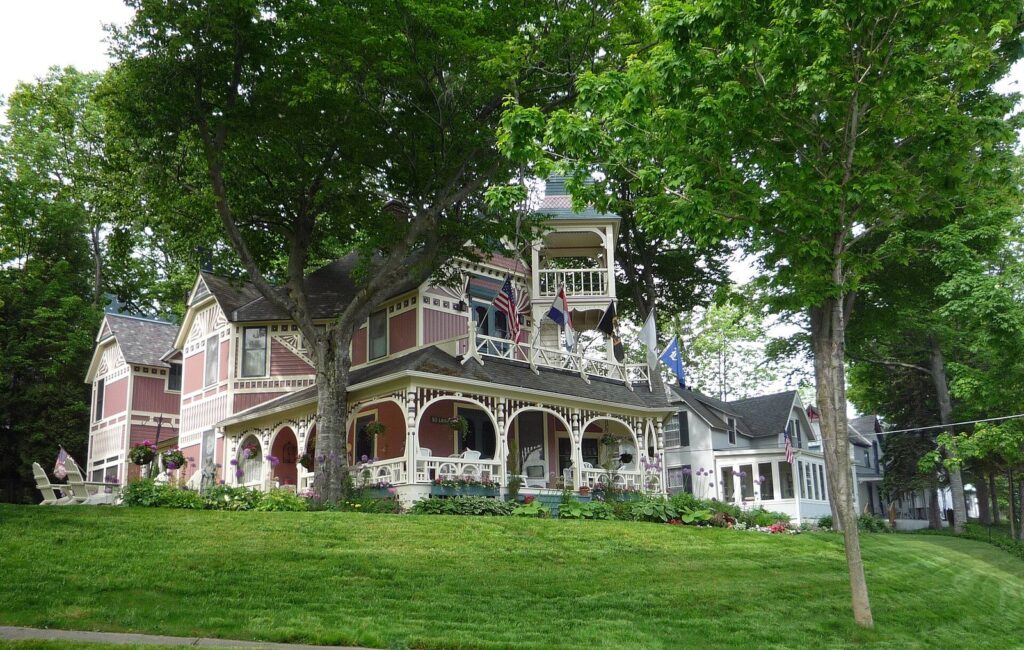
Bay View began in 1875 as a Methodist camp meeting on the bluff northeast of downtown and grew into a Chautauqua, the kind of 19th-century summer colony that mixed lectures, music and religion with lake air. More than 400 Victorian cottages with deep porches and gingerbread trim still stand on its curving lanes, and the association still runs a summer program of concerts, lectures and services, much of it open to the public. It’s a National Historic Landmark. The cottages are private homes, so walk or bike the lanes, admire from the street and don’t wander onto porches. A couple of historic inns in Bay View take overnight guests in season.
Petoskey State Park and the beaches
Petoskey State Park, at the east end of the bay between Petoskey and Harbor Springs, has about a mile of sandy beach, two campgrounds and wooded dune trails, and it’s the most popular spot on the bay for hunting Petoskey stones. It’s a state park, so every vehicle needs a Recreation Passport (non-residents: $12 a day or $42 a year in 2026). The campgrounds book out months ahead for July. In town, Bayfront Park has a small beach. The Old Baldy trail in the park climbs a dune for a view over the bay.
Bay Harbor
Bay Harbor, a few minutes west of downtown, is a planned resort village built from the 1990s on the site of a former cement plant and its lakeside quarry, which became a deep-water marina. It has a large hotel, upscale shops and restaurants around the marina, and a stretch of Lake Michigan shoreline. It’s worth a stroll and a drink on the water even if you’re not staying there, and it’s the most expensive address on the bay if you are.
Harbor Springs
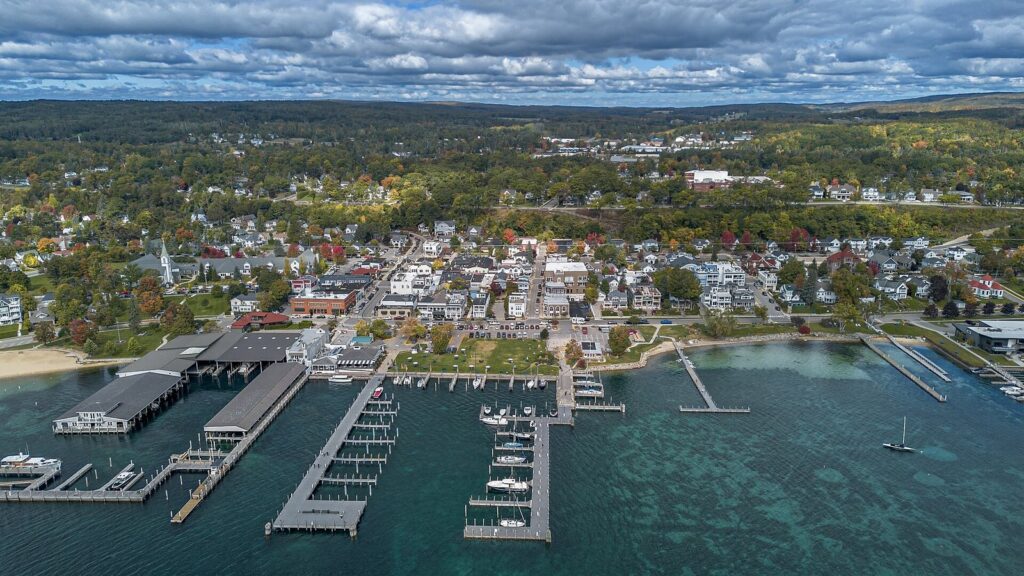
Harbor Springs sits on the north shore of the bay, 12 minutes from Petoskey, around one of the deepest natural harbors on the Great Lakes. Its Main Street is a few blocks of shops, galleries and restaurants in white clapboard buildings, and the bluffs above it hold some of the oldest summer money in the Midwest; the private summer associations at Harbor Point and Wequetonsing have been there since the 1870s and 1880s. The town is quiet in the best sense: most people come to walk, sail, eat and look at the water.
This shore is the homeland of the Odawa, whose name for it, Waganakising, refers to a bent tree that once stood above the bay; the French called it L’Arbre Croche. The Little Traverse Bay Bands of Odawa Indians are headquartered in Harbor Springs today, and the Andrew J. Blackbird Museum, in the home of the 19th-century Odawa historian, tells some of that history. Nature trails run through the Thorne Swift Nature Preserve on the lake, just outside town on Lower Shore Drive.
Harbor Springs also has one of the odder houses in Michigan: the six-sided Shay Hexagon House, built in the 1890s by Ephraim Shay, inventor of the geared Shay logging locomotive, who retired here. It’s worth a look from the street on your way along the harbor. In summer the harbor fills with sailboats and classic wooden runabouts, and the best free entertainment in town is a bench on the waterfront at the end of the day.
Two ski areas sit just outside Harbor Springs: Nub’s Nob and The Highlands, the bigger of the two and one of the Boyne resorts. They make Harbor Springs a winter base as well as a summer one. For how they compare with Boyne Mountain, Crystal and the U.P. hills, see our Michigan ski resorts ranked guide.
The Tunnel of Trees (M-119) in 2026
M-119 north of Harbor Springs is the drive most people come to this corner of Michigan for: about 20 miles of narrow, curving two-lane road through hardwood and cedar forest along the bluff above Lake Michigan, with no center line in places and the branches closing overhead. It runs through Good Hart to Cross Village and is at its best in early October, when the maples turn, and in late May, when the forest is bright green.
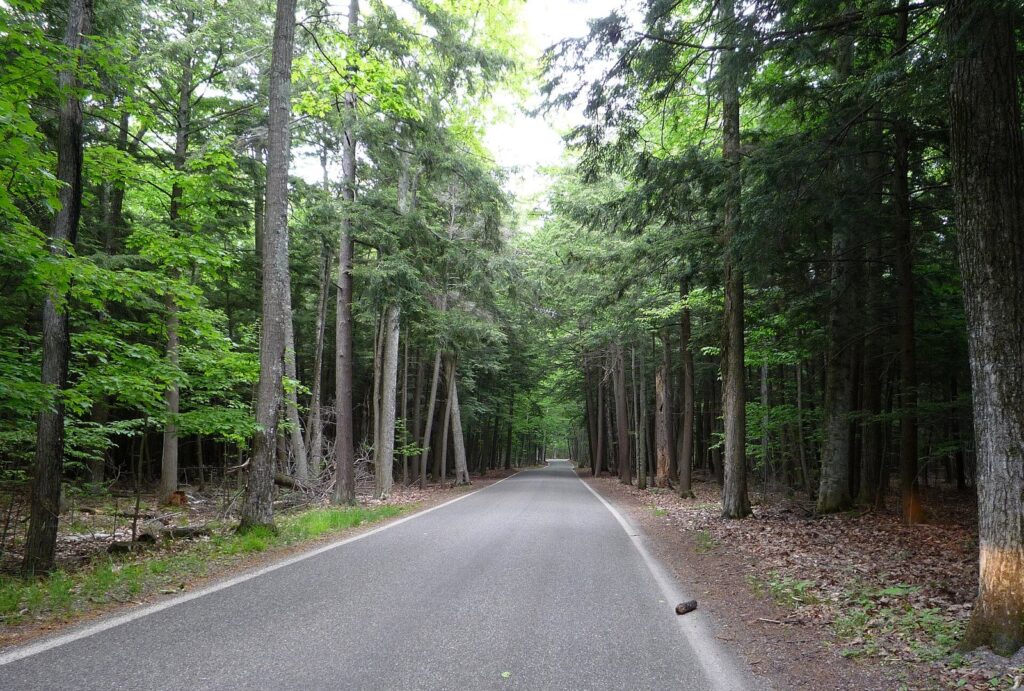
This year the drive comes with a caveat. Washouts in April and June 2026 took out two sections, and they’re closed to through traffic. Reports in September 2026 placed the closures at Devil’s Elbow, south of Good Hart, and near Division Road at the Harbor Springs end, with M-119 reopened near West Stutsmanville Road and at Ball Hill. Signed detours run on county roads: around Devil’s Elbow by West Stutsmanville, Townline, Church and Robinson roads into Good Hart, and around the Division Road section by Island View Road and North State Road. MDOT has said repairs will stretch into 2027; the Division Road section was expected to stay closed until summer 2027, and there was no firm date for Devil’s Elbow, where the damage runs far down the slope. Every business along the route is open.
What that means for a visit: you can still drive most of the tunnel, just not end to end. The simplest plan is to take State Road (County Road C-77) north from Harbor Springs to Cross Village, then drive the open stretches of M-119 south from Cross Village toward Good Hart and back, following the detour signs. Check MDOT’s Mi Drive map the morning you go, because reopenings and closures can change with the construction schedule. At the north end, Legs Inn in Cross Village, a Polish restaurant in a stone-and-driftwood building above the lake, was open in 2026 from May 22 to October 25, noon to 8 p.m., closed Tuesdays; with the detours in place, reach it on C-77 State Road or C-66 Levering Road. For other color drives across the state, our fall colors in Michigan guide has peak timing by region.
Charlevoix
Charlevoix sits on a narrow strip of land between Lake Michigan and Lake Charlevoix, with Round Lake, its harbor, in between. A short channel links all three, and the drawbridge on US-31 downtown lifts to let sailboats and cruisers through, which means everyone in town ends up watching boats. The town calls itself “Charlevoix the Beautiful,” and in July, with the harbor full and the flower boxes out, it’s hard to argue.
Earl Young’s mushroom houses
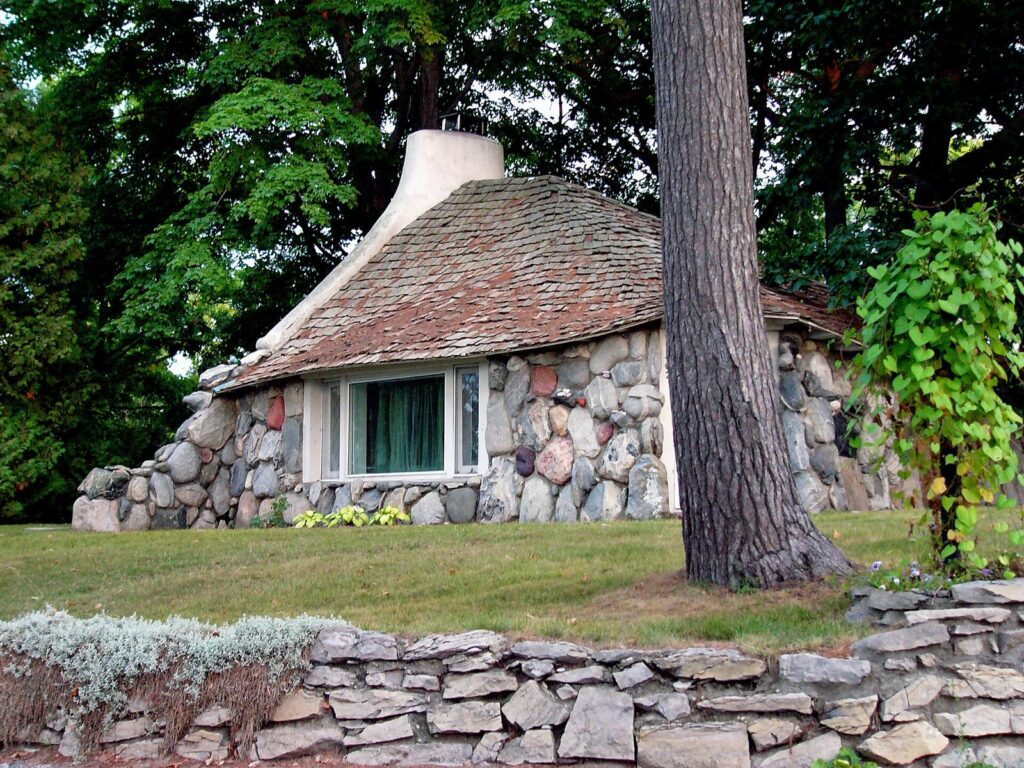
From the 1910s into the 1970s, a self-taught builder named Earl Young built a series of houses from local fieldstone and boulders, with curving roofs, low doorways and chimneys like stacked stones, and they’re what most visitors come to see. The best cluster is in the “Boulder Park” neighborhood near Lake Michigan, a short walk south of the channel, and more are near the harbor. They’re private homes: look from the street, keep off the lawns and don’t block driveways for photos. The local visitors bureau publishes a walking map.
The piers, beaches and Castle Farms
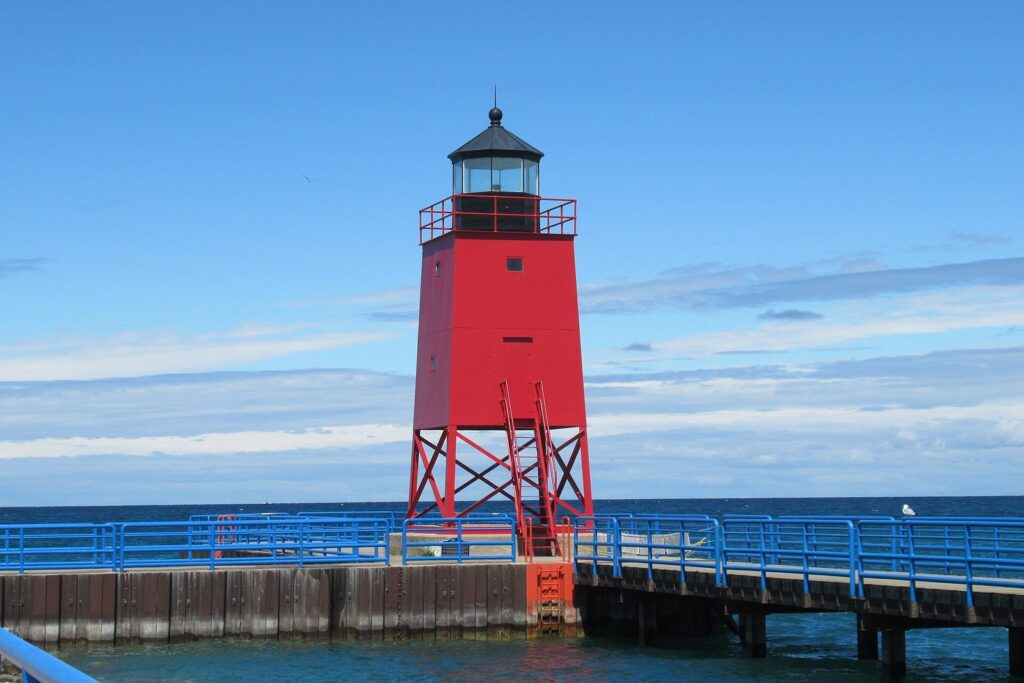
The red South Pier Light stands at the end of the channel pier, and the walk out gives you Lake Michigan on one side and boats coming through the channel on the other. Lake Michigan Beach is on the big lake just south of the pier; Depot Beach, on Lake Charlevoix, is shallower and warmer, which makes it the better choice for small children. South of town, Fisherman’s Island State Park protects miles of undeveloped Lake Michigan shore with a rustic campground, and it’s a good place to look for Petoskey stones. East of town, Castle Farms is a stone castle complex built in 1918 as a model dairy farm, now used for tours, events and weddings; check what’s open on the day before you go.
The Venetian Festival
Charlevoix’s big week is the Venetian Festival: eight days each July of concerts, fireworks, a carnival, street and boat parades and beach events, with the lighted boat parade on Round Lake as the centerpiece. The 2026 festival ran in mid-to-late July; check the festival’s website for the 2027 dates, and book rooms as soon as they post. The town is at its busiest and most expensive that week.
Boyne City and Lake Charlevoix
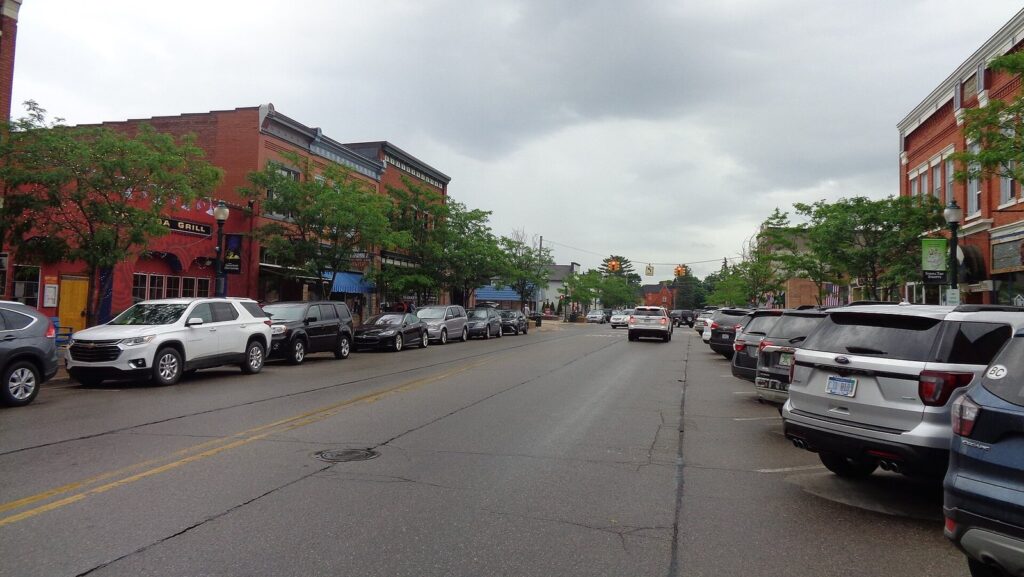
Boyne City sits at the east end of Lake Charlevoix, 18 minutes from Petoskey and 27 from Charlevoix, and it’s the most down-to-earth town on this list. Its Water Street downtown has breweries, a few restaurants and shops, and the lake is right there for swimming, paddling and fishing. Young State Park, on the lake just northwest of town, has a beach and a big campground (Recreation Passport required), and the Avalanche Preserve, a city-owned hill on the south side of town, has a long staircase and trails up to an overlook of the lake. Every May, the Boyne City Morel Festival celebrates the region’s spring mushroom hunt.
Lake Charlevoix itself is long, deep and clear, with two arms, and it’s the best boating lake in the area: the main arm runs west to Charlevoix and Lake Michigan, and the South Arm runs down to East Jordan. Horton Bay, where Hemingway married, is a few miles north of Boyne City on the lake. Boyne Mountain, the region’s best-known resort, is in Boyne Falls, about 18 minutes from Petoskey, with skiing in winter and a summer program built around its lodge and water park; ski details are in our guide to Michigan’s ski resorts.
Beaver Island
Beaver Island is the largest island in Lake Michigan and the quietest trip you can take from this coast. The Beaver Island Boat Company’s ferry leaves from Charlevoix and takes about two hours to St. James, the island’s harbor village. In 2026 an adult ticket was $33.50 one way or $67 round trip, children 5 to 12 paid $21 or $42, and children 4 and under rode free. Seniors 65 and older paid half fare for travel from April 8 to May 17 and from September 14 to December 18, 2026. Bicycles are $12 each way, e-bikes $20, kayaks and canoes $25 and pets $12, and cars need a reservation (from about $110 one way, by size). Tickets are good for a year from purchase. Small planes also fly from Charlevoix if you’d rather make it a 20-minute hop.
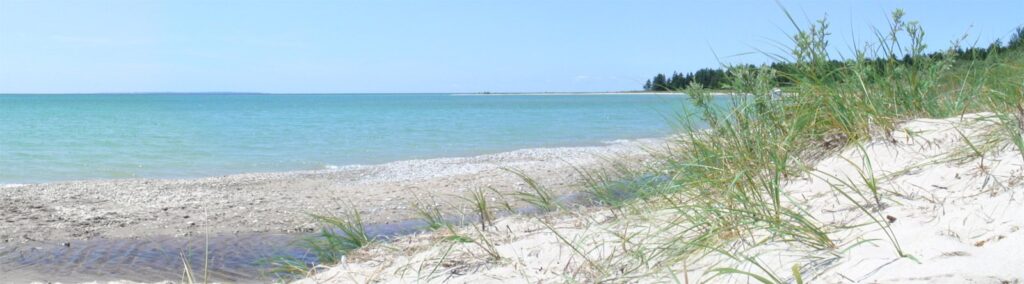
The island has an odd history. In the 1850s, James Jesse Strang, a breakaway Mormon leader, crowned himself king of a colony here, until he was shot in 1856 and his followers were driven off; the Old Mormon Print Shop in St. James is now a museum. Irish fishing families followed, and the island still calls itself America’s Emerald Isle. Today it’s a place for biking the dirt roads, walking empty beaches, paddling the inland lakes and looking at the stars: Beaver Island holds an International Dark Sky Sanctuary, one of the darkest places in the Midwest to see the Milky Way. A day trip works only when the ferry schedule allows an out-and-back, and even then it’s four hours on the boat; one or two nights is better.
Once you’re there, the island is big enough that you’ll want a bike or a car, and most roads beyond St. James are gravel. St. James has the harbor, a few inns and restaurants, the historical society’s museums (including a marine museum in an old net shed on the waterfront) and Whiskey Point Light at the harbor mouth. The Beaver Head Light stands at the island’s south end above the lake, and the interior has quiet inland lakes, such as Lake Geneserath and Barney’s Lake, for paddling and fishing. Bring your car only if you’re staying several days: the vehicle fares and reservations add up, and bikes cross for $12 each way.
Petoskey stones: where to look
The Petoskey stone is fossilized coral, a colony organism that lived in a warm, shallow sea here about 350 million years ago, and it’s Michigan’s state stone. Dry, it looks like a plain gray pebble; wet or polished, it shows the honeycomb pattern of the coral’s six-sided cells. The glaciers spread them along the northern Lake Michigan shore, and the best hunting is right here: Petoskey State Park, the beaches around Bay View and Harbor Springs, and Fisherman’s Island State Park south of Charlevoix.
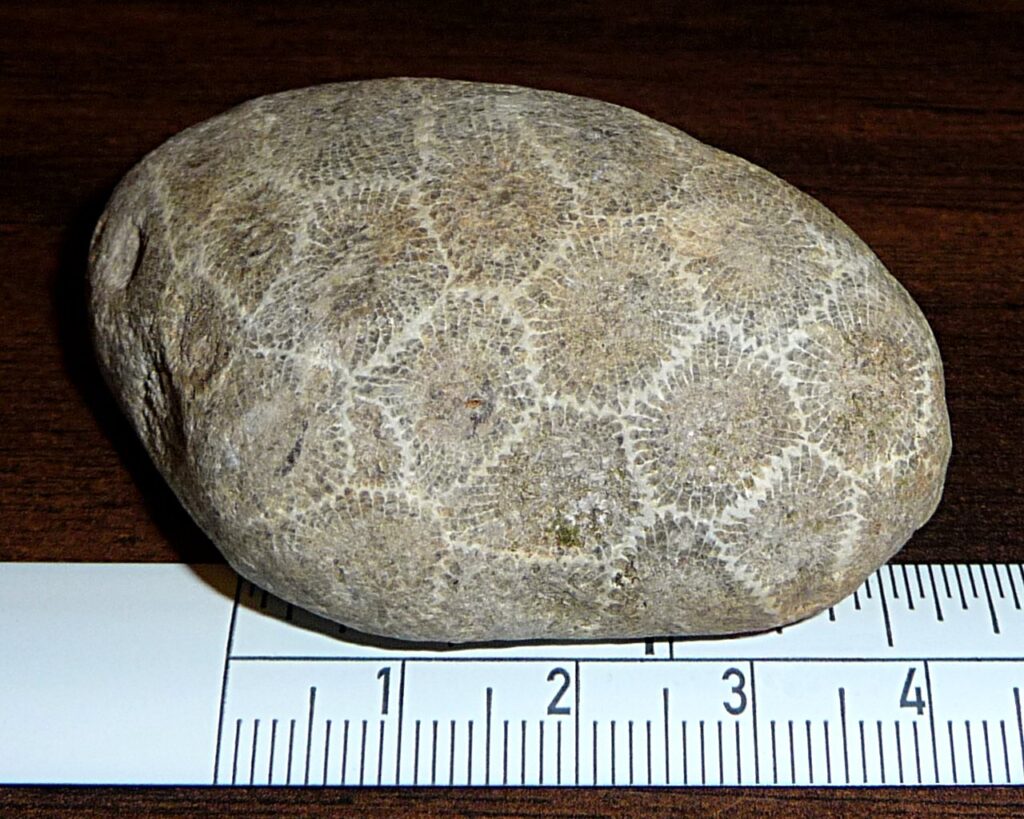
Go in spring, after the ice has churned the beaches, or after a storm; walk slowly at the waterline with the sun behind you and a bottle of water to wet likely candidates. Collecting rules differ between state land and federal land (collecting is banned in the national lakeshores), so check the rules for the beach you’re on. Our Michigan beaches guide covers the collecting rules and more places to hunt.
Trails, paddling and time on the water
The outdoors around Little Traverse Bay is gentle and easy to reach: nothing here needs a permit, a guide or a long drive, and most of it is free.
Biking and hiking
The Little Traverse Wheelway is the backbone, a paved path along the bay from Charlevoix through Bay Harbor and Petoskey to Harbor Springs, with long stretches beside the water. Bike shops in the towns rent by the hour or day in season. The North Country Trail, the long-distance footpath that crosses Michigan, passes through the Petoskey area on its way north to Mackinaw City. The Little Traverse Conservancy, the local land trust, keeps a large network of nature preserves open to the public at no charge, from bluff-top hardwoods to cedar swamps, and its preserve maps are the best way to find a quiet walk. In winter, the same trails serve snowshoers and cross-country skiers.
Paddling and boating
Lake Charlevoix’s South Arm and the shore around Boyne City are sheltered on most days and good for kayaks and paddleboards. South of the lake near East Jordan, the Jordan River, Michigan’s first state-designated Natural River, is a clear, cold stream popular with canoeists. Northeast of Petoskey, the Inland Waterway begins at Crooked Lake in Conway and links Crooked Lake, Burt Lake and Mullett Lake by rivers to Cheboygan and Lake Huron, a way for boaters to cross the tip of the mitten without going around by the Straits. Little Traverse Bay itself is big water: fine for a calm-evening paddle along the Petoskey or Harbor Springs shore, but a west wind builds real waves quickly, so watch the forecast and stay close to shore.
Swimming safely
The water is coldest in June and warmest in August, and it can change by several degrees overnight when the wind shifts. Most beaches here have no lifeguards. At state park beaches, check the flag (green, yellow or red), stay away from piers and breakwalls when waves are running, where rip currents form, and keep children within arm’s reach. If a current pulls you out, float, then swim parallel to shore before heading in.
Food, shopping and rainy days
Two Michigan food names started in Petoskey: Kilwins, the fudge and ice cream chain, opened its first shop here in 1947, and American Spoon, the preserves maker built on northern Michigan fruit, began here in the early 1980s. That tells you what to eat: fudge, cherries in July, blueberries in August and whitefish, the Great Lakes fish that turns up broiled, planked or smoked on menus around the bay. Petoskey’s Gaslight District has the most restaurants and the most that stay open year-round; Harbor Springs and Charlevoix have excellent but more seasonal dining; Boyne City’s brewpubs are the casual option. In July and August, book weekend dinners a few days ahead.
For rainy days, the Crooked Tree Arts Center in downtown Petoskey, in a former Methodist church, has galleries and a busy calendar of classes and performances; the Little Traverse History Museum covers the region’s Odawa, railroad and resort history in season; and the Odawa Casino, run by the Little Traverse Bay Bands, is just outside Petoskey. Shopping is the other rainy-day sport: the Gaslight District’s bookstores and outfitters, Harbor Springs’ galleries and Charlevoix’s Bridge Street all reward a slow wander.
Little Traverse Bay with kids
The bay is easy with children because the drives are short and the beaches are gentle. The shallow, warmer water at Depot Beach on Lake Charlevoix and the sand at Petoskey State Park suit small kids best; older ones will want the Old Baldy dune trail, the stairs up the Avalanche Preserve in Boyne City and a Petoskey stone hunt with a prize for the best find. The flat, paved Wheelway between Petoskey and Bay View is good for young cyclists, and the Charlevoix drawbridge lifting for a sailboat will hold anyone’s attention for ten minutes. On a rainy day, Boyne Mountain’s indoor water park is the big draw (check its rules for visitors who aren’t staying there), and Castle Farms near Charlevoix is worth a stop if a tour is running that day. Pack warm layers for evenings even in July, and build in a fudge stop; it’s expected.
When to visit Petoskey: seasons and events
| Season | What it’s like | Best for |
|---|---|---|
| Summer (late June to August) | Peak crowds and prices; long evenings with sunsets over the bay after 9:30 p.m.; the lake is warmest in August | Beaches, boating, Beaver Island, festivals |
| Fall (September to October) | Warm days in September, color usually in the first half of October, cheaper rooms midweek | The Tunnel of Trees (with detours), hiking, cider mills, a quieter Petoskey |
| Winter (December to March) | Lake-effect snow and the ski season; many seasonal businesses closed | Nub’s Nob, The Highlands, Boyne Mountain, cross-country skiing |
| Spring (April to early June) | Cold and quiet until late May; seasonal places reopen around Memorial Day | Morels, stone hunting, the lowest rates |
Summer
July is the peak, and the first two weeks of July, around the Fourth, are the busiest of the year. The Venetian Festival fills Charlevoix in mid-to-late July, Bay View’s summer program runs through the season, and the beaches, marinas and patios are full. Book rooms and state park campsites months ahead, and make dinner reservations on weekends. August is slightly calmer and has the warmest water.
Fall
Fall is the best time to visit. September is warm and uncrowded once school starts, and the color usually peaks across the northern Lower Peninsula in the first half of October, with the Tunnel of Trees, the drive along Lake Charlevoix and the view from Avalanche Preserve as the highlights. The 2026 caveat is M-119, so plan the detours described above. Our guide to Michigan fall colors tracks peak timing statewide, and many seasonal businesses close in late October.
Winter
Winter belongs to the ski hills. Nub’s Nob and The Highlands are on either side of Harbor Springs, and Boyne Mountain is at Boyne Falls, south of Petoskey; The Highlands and Boyne Mountain are both on the Ikon Pass for 2026-27. Lake-effect snow off Lake Michigan keeps the region white from December through March, and Petoskey’s downtown and the Harbor Springs shops stay open for skiers, though many summer restaurants don’t. Roads are well plowed, but carry a winter kit and expect whiteouts in lake-effect bands.
Spring
Spring is short and late. April is often still cold, and the region only really wakes up for Memorial Day weekend. May brings the morel season (and Boyne City’s festival), the best stone hunting of the year and the lowest rates, but also closed restaurants and cold water. It’s a good time for a quiet weekend if you’re flexible about where you eat.
State parks and passes
The bay’s state parks all need a Recreation Passport on your vehicle. Michigan residents buy it with their plate renewal ($15 in 2026); non-residents pay $12 a day or $42 for a pass valid through December 31, 2026. The annual pass pays for itself after four days.
| Park | Where | What’s there |
|---|---|---|
| Petoskey State Park | Between Petoskey and Harbor Springs | About a mile of sandy beach, two campgrounds, dune trails, stone hunting |
| Fisherman’s Island State Park | South of Charlevoix on Lake Michigan | Undeveloped shoreline, a rustic campground, stone hunting |
| Young State Park | Lake Charlevoix, just northwest of Boyne City | Swimming beach, campground, boat launch |
| Wilderness State Park | West of Mackinaw City, at the northwest tip of the Lower Peninsula | One of Michigan’s six state dark sky preserves, wild shoreline and trails, rustic cabins |
North of the bay, the Headlands International Dark Sky Park in Mackinaw City is open 24 hours a day, every day of the year, and it’s the easiest dark-sky stop for a night drive from Petoskey.
A 3-day Little Traverse Bay itinerary
Day 1: Petoskey and Bay View
Start downtown with coffee and the Gaslight District shops, then walk down through the tunnel to Bayfront Park and out the breakwall. In summer, spend an hour at the Little Traverse History Museum for the Hemingway collection. After lunch, drive 10 minutes to Petoskey State Park for the beach and an hour of stone hunting. Come back through Bay View for a walk or bike ride along the cottage lanes, and watch the sunset from the breakwall or from Sunset Park on the bluff.
Day 2: Harbor Springs and the Tunnel of Trees
Drive around the bay to Harbor Springs for breakfast and a walk along the harbor and Main Street. Then head north: in 2026, take State Road (C-77) to Cross Village and drive the open stretches of M-119 south toward Good Hart, following the detour signs. Eat at Legs Inn if it’s in season, or pack a picnic. In the evening, drive up to the Headlands near Mackinaw City or Wilderness State Park if the sky is clear.
Day 3: Charlevoix and Boyne City
Head to Charlevoix in the morning: walk the Earl Young houses, out the South Pier and along Round Lake, and watch the drawbridge lift. After lunch, follow the shore of Lake Charlevoix to Boyne City, climb the Avalanche Preserve stairs for the view and swim at Young State Park on the way back. Swap this day for Beaver Island if you can add a night, and take the morning ferry from Charlevoix.
Longer stays: Mackinac Island and Traverse City
With a fourth day, add Mackinac Island. The ferry docks in Mackinaw City are about 42 minutes north of Petoskey, and in 2026 an adult round trip cost $37 on Arnold Transit’s fast ferry or $39 on Shepler’s basic ticket; take an early boat and you’ll have a full day on the island. Our Mackinac Island, Michigan guide covers the ferries, the fort and the bike loop. Traverse City is 1 hour 15 minutes southwest by US-31, and the drive along the shore through Charlevoix is part of the point.
A fall color weekend
Coming for color in early October? Rearrange the days. Drive up on Friday and take the Lake Charlevoix shore road to Boyne City for the Avalanche Preserve overlook at sunset. On Saturday, go north early: State Road to Cross Village, the open stretches of M-119 back toward Good Hart, then a late lunch in Harbor Springs. On Sunday, stop at the Deadman’s Hill overlook above the Jordan River valley on the way south, one of the best color views in the northern Lower Peninsula. Book rooms by August for the first two weekends of October.
A winter ski weekend
For a ski weekend, stay in Harbor Springs or Petoskey and split the days between The Highlands and Nub’s Nob, a few minutes apart on the north side of the bay, or base at Boyne Mountain in Boyne Falls and add a day at The Highlands on the same Ikon Pass. Save an evening for downtown Petoskey, where the Gaslight District keeps going through the winter. Lake-effect snow can turn a clear road white in minutes, so carry a scraper and a blanket and allow extra time on US-31 and US-131 after dark.
What to skip, and what to do instead
Skip driving the Tunnel of Trees end to end this fall. Two sections are closed. Use State Road north from Harbor Springs, drive the open stretches from Cross Village, and check MDOT’s map before you go.
Skip the day trip from Detroit. It’s four hours each way. Stay at least two nights, three if you want Charlevoix and Harbor Springs as well as Petoskey.
Skip Charlevoix during the Venetian Festival unless you’ve come for it. Rooms and parking are at their hardest, and the rest of the bay is quieter that week.
Skip July if you can go in September. The water is still warm in early September, the towns are half as busy and rooms cost less.
Skip a Beaver Island day trip if it means four hours on the boat for three on the island. Stay a night, or put the time into Mackinac Island instead.
Skip Bay Harbor for a room unless the budget is no object. Petoskey and Bay View are minutes away and cost much less.
Frequently asked questions
Is Petoskey worth visiting?
Yes. Petoskey is one of the best small-city bases in northern Michigan: a walkable brick downtown above Little Traverse Bay, sunsets from the breakwall, Bay View’s Victorian cottages, Petoskey stones on the beaches and Harbor Springs, Charlevoix and Boyne City all within 20 minutes. It’s about four hours from Detroit, so give it two or three nights rather than a day trip.
What is Petoskey Michigan known for?
Petoskey stones first: the fossil coral named for the town is Michigan’s state stone and turns up on the local beaches. The town is also known for its sunsets over Little Traverse Bay, its Victorian downtown and the Bay View summer colony, and for Ernest Hemingway, who spent boyhood summers nearby and the winter of 1919-20 in a Petoskey rooming house.
Which is better, Petoskey or Charlevoix?
Petoskey is the better base: more rooms at more price levels, a bigger downtown that stays open year-round, and a central spot on the bay. Charlevoix is the better town for boats and beaches, with the channel, the drawbridge, two lakes, Earl Young’s stone houses and the Beaver Island ferry. They’re 19 minutes apart, so most visitors stay in one and spend a day in the other.
How far is Petoskey from Traverse City?
About 67 miles, or roughly 1 hour 15 minutes by car on US-31 with no traffic. The road follows the Lake Michigan shore through Elk Rapids and Charlevoix, so it’s a scenic drive rather than a chore. Summer weekends can add 20 to 30 minutes, especially through Charlevoix’s drawbridge and downtown traffic.
What airport is closest to Petoskey?
Pellston Regional Airport (PLN), north of Petoskey on US-31, is the closest, about 35 to 40 minutes’ drive. It’s small, with daily Delta connections to Detroit operated by SkyWest; 31,060 passengers boarded there in 2024. Cherry Capital Airport in Traverse City, about 1 hour 15 minutes away, has more flights and seasonal nonstops, so compare fares at both.
Is Harbor Springs close to Petoskey?
Very. Harbor Springs is across Little Traverse Bay, about 10 miles and 12 minutes by car from downtown Petoskey, past Petoskey State Park. You can also ride between them on the paved Little Traverse Wheelway. Many visitors stay in Petoskey for the choice of rooms and spend an afternoon and evening in Harbor Springs.
When is the best time to visit Petoskey?
For warm water and everything open, go from late June through August, knowing July is the most crowded and expensive month. The best balance is September and early October: warm days, fewer people, lower midweek rates and fall color that usually peaks in the first half of October. Skiers come from December to March for Nub’s Nob, The Highlands and Boyne Mountain.
Sources and verification
Everything on this page was checked on September 23, 2026 against the organizations listed here. This guide is compiled from those sources; it doesn’t claim first-hand visits.
- Beaver Island Boat Company: 2026 rates, plus its home page for the crossing time
- Little Traverse History Museum, plus its Hemingway collection page
- Petoskey Area Visitors Bureau, plus its things-to-do listings
- Charlevoix Area Chamber of Commerce, plus the Charlevoix Venetian Festival
- Michigan Department of Transportation for M-119, plus the DNR’s Recreation Passport and Petoskey State Park pages
Also checked: the Harbor Springs Area Chamber of Commerce; September 2026 reporting on the M-119 closures and detours; Legs Inn’s 2026 season listing; the FAA’s 2024 airport passenger counts; the Boyne and Nub’s Nob ski area listings; and drive times from a routing service.
Michigan Tourism Guide is an independent publication. It is not affiliated with Pure Michigan or any agency or business named here.
Photo credits
- Little Traverse Bay at Petoskey (featured image): photo by rboed*, Wikimedia Commons (CC BY 2.0)
- Bay View cottage: photo by Bobak Ha'Eri, Wikimedia Commons (CC BY 3.0)
- Harbor Springs from the air: photo by WMrapids, Wikimedia Commons (CC0)
- Tunnel of Trees (M-119): photo by Bobak Ha'Eri, Wikimedia Commons (CC BY 3.0)
- Earl Young house, Charlevoix: photo by Kathleen Conklin from Falls Church, USA, Wikimedia Commons (CC BY 2.0)
- Charlevoix South Pier Light: photo by Notorious4life (talk) (Uploads), Wikimedia Commons (CC0)
- Water Street, Boyne City: photo by Notorious4life (talk) (Uploads), Wikimedia Commons (CC0)
- Iron Ore Bay, Beaver Island: photo by Age234, Wikimedia Commons (public domain)
- Unpolished Petoskey stone: photo by David J. Fred (Dfred), Wikimedia Commons (CC BY 3.0)