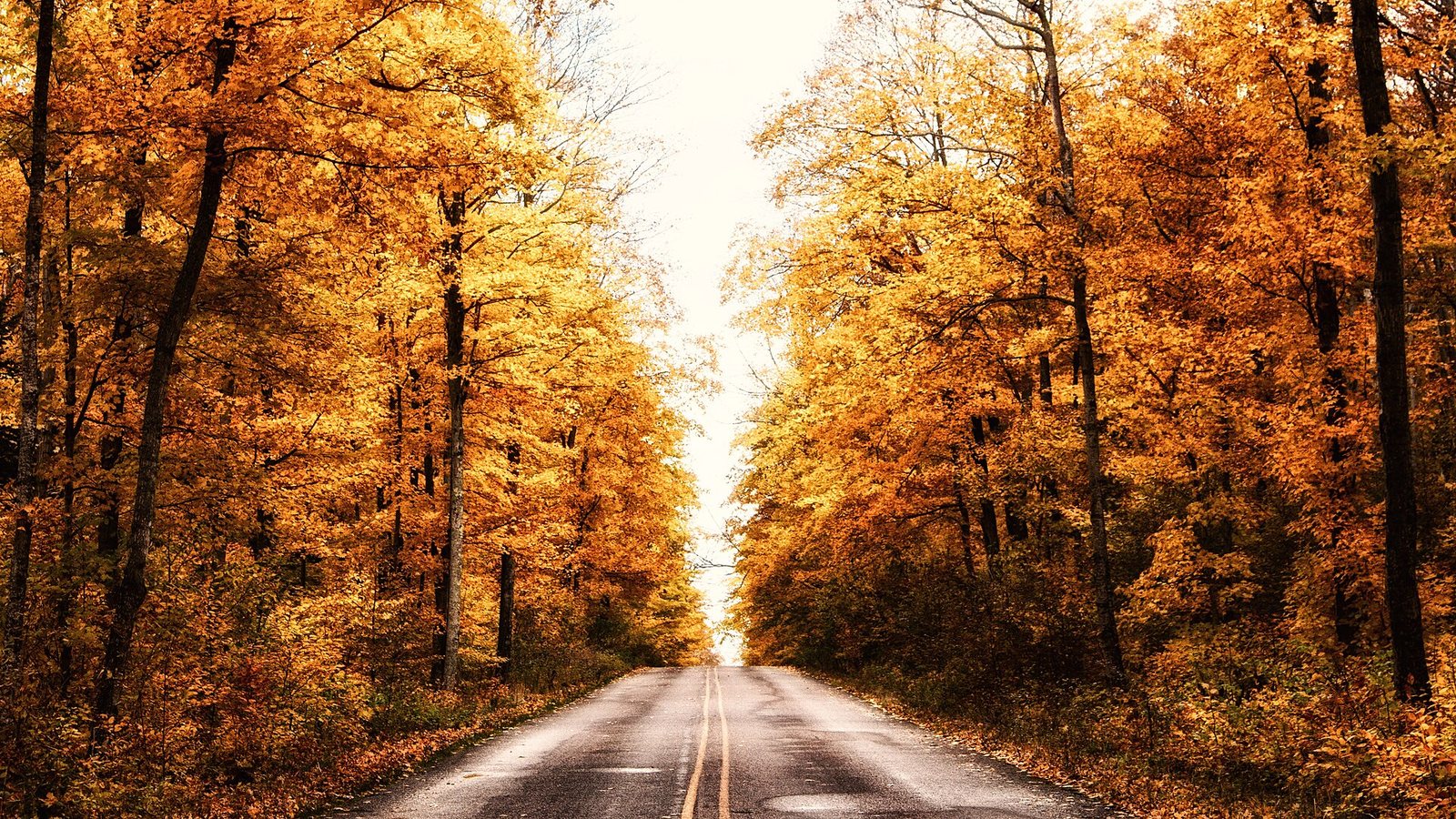
Michigan’s color season usually opens in the western Upper Peninsula, where the hardwood ridges inland from Lake Superior reach peak around the last week of September. It closes about six weeks later in the river valleys of southern Michigan, where the oaks around Ann Arbor and Kalamazoo can hang on to their rust-colored leaves into early November. In between, Michigan fall colors cross the state in a slow wave from northwest to southeast, and a good color trip comes down to one decision: being in the right region during the week the wave passes through.
The short answer: peak color typically reaches the Upper Peninsula between the last week of September and mid-October, the northern Lower Peninsula in early to mid-October, and Detroit, Grand Rapids and the rest of southern Michigan in mid to late October. If you can pick only one week for a northern trip, pick the first or second week of October; UP Travel’s September 23, 2026 report expects the central U.P. to peak in exactly that window this year.
The details below were checked September 23, 2026 against the operators’ and agencies’ own websites, including three changes that older color guides miss: two closed sections of the Tunnel of Trees, the closed Manitou Islands and the end of the Toonerville Trolley.
On this page: At a glance · When color peaks · Fall 2026 dates and closures · Why the north turns first · Region by region · Color maps and reports · Best drives · Boats and trains · Cider mills and orchards · Festivals · Getaways · Planning · What to skip · FAQ
At a glance: where color peaks, and when
| Region | Typical peak | Fall 2026 outlook | Where to base | Drive from Detroit / Chicago |
|---|---|---|---|---|
| Western U.P.: Keweenaw, Porcupine Mountains, Ironwood | Last week of September to first week of October | Same window (UP Travel, Sept. 23) | Houghton, Copper Harbor, Ironwood | Copper Harbor: about 9 h 50 min / 8 h 10 min |
| Central U.P.: Marquette, Munising, Pictured Rocks | First half of October | First and second weeks of October | Munising, Marquette | Munising: about 6 h 25 min / 6 h 25 min |
| Eastern U.P.: Tahquamenon, Sault Ste. Marie, St. Ignace | First half to middle of October | Second week of October | Paradise, Newberry, St. Ignace | Paradise: about 5 h 30 min / 7 h 40 min |
| Northern Lower Peninsula: Traverse City, Sleeping Bear, Petoskey, Gaylord, Oscoda | Early to mid-October, inland first | No official outlook; follow the weekly reports | Traverse City, Petoskey, Glen Arbor, Oscoda | Traverse City: about 4 h / 5 h |
| Mid-Michigan and the Lake Michigan shore: Ludington, Mount Pleasant, Frankenmuth, the Thumb | Mid-October | Follow the weekly reports | Ludington, Frankenmuth, Port Austin | Ludington: about 3 h 45 min / 4 h |
| Southern Michigan: Detroit, Ann Arbor, Lansing, Grand Rapids, Kalamazoo, the southwest | Mid to late October, oaks into early November | Follow the weekly reports | Ann Arbor, Grand Rapids, South Haven | Ann Arbor: about 45 min from Detroit; Sawyer: about 1 h 30 min from Chicago |
Drive times are typical free-flowing times; add more for two-lane roads on color weekends. Two costs come up on almost every trip: a non-resident Recreation Passport for Michigan state parks is $42 for the year or $12 a day, and Pictured Rocks National Lakeshore charges $25 per private vehicle for seven days (both 2026 prices).
When is peak fall color in Michigan?
Across the whole state, the color season runs from mid-September, when the first red maples flare in the U.P.’s swamps and road ditches, to early November, when the last oaks let go in the southern Lower Peninsula. UP Travel, the Upper Peninsula’s tourism association, says U.P. color usually begins in mid to late September and peaks during the first three weeks of October, starting in the western and interior counties and spreading east and toward the shorelines. The northern Lower Peninsula typically follows in early to mid-October, mid-Michigan around the middle of the month, and the southern third of the state from mid-October through the end of the month.
Two things turn any single date into a guess. First, one hillside is only at its best for about a week: sometimes 10 days in a calm, cool fall, sometimes three or four if a cold front arrives with a gale. Second, peak in one county can be a week apart from peak in the next county over, depending on elevation, soil, tree species and how close the Great Lakes are. That’s why this page gives windows rather than days, and why the most useful thing you can do the week before a trip is read a live color report.
Timing also decides how crowded your trip will be. Nationally, searches for Michigan fall color hit their high point in the week of about October 5 to 11, the same week the central and eastern U.P. and much of the northern Lower Peninsula are usually close to peak. The weekends on either side of that week are when color traffic is heaviest on roads like M-22 and at stops like Tahquamenon Falls. A Tuesday-to-Thursday trip in the same week gets you the same trees with a fraction of the traffic.
A simple way to pick your week
In a typical year, this is where the color is at or near peak:
- Last week of September: the Keweenaw, the Porcupine Mountains and the hills around Ironwood. Most of the state is still green.
- First week of October: the western and central U.P., plus the interior highlands of the northern Lower Peninsula around Gaylord and Grayling.
- Second week of October: the central and eastern U.P., the Straits of Mackinac, Petoskey, Traverse City and the Sunrise Coast. The single best week for a northern trip.
- Third week of October: Sleeping Bear and the rest of the Lake Michigan shoreline, Ludington, mid-Michigan and the Thumb, with early color around Grand Rapids and Detroit.
- Last week of October: Detroit, Ann Arbor, Lansing, Kalamazoo and Southwest Michigan. The U.P. is largely done.
- First week of November: in a warm year, oaks still hold in the southern Lower Peninsula. Up north, the gold of the tamaracks in the bogs is usually the last color left.
Fall 2026: dates, closures and last boats
This is the part of the page that changes every year. Everything in it was checked on September 23, 2026.
- U.P. outlook: UP Travel’s September 23 report expects the western U.P. to peak in the last week of September and the first week of October, the central U.P. in the first and second weeks of October, and the eastern U.P. in the second week (the first and second in some counties). The report is updated every Wednesday.
- Tunnel of Trees (M-119): after washouts in April and June, two sections of the road between Harbor Springs and Cross Village are closed to through traffic through the color season. Detours are posted, the businesses along the route are open, and MDOT says repairs will stretch into 2027.
- Manitou Islands: closed for all of 2026 while the National Park Service relocates the docks. The Leland ferry isn’t running.
- Toonerville Trolley: the narrow-gauge train and riverboat tour to Tahquamenon Falls from Soo Junction has closed for good after 96 seasons. Plenty of fall color lists still include it.
- Last boats: Pictured Rocks Cruises runs its Spray Falls Cruise through October 18 (the Classic Cruise ended September 6). The SS Badger car ferry between Ludington and Manitowoc makes its last 2026 crossings on October 11, and the Lake Express between Muskegon and Milwaukee runs through October 19.
- Mackinac: the Fall Fudge Festival is October 2-3. Colonial Michilimackinac and Old Mackinac Point Lighthouse in Mackinaw City close for the season on October 11, and the Grand Hotel closes in the third week of October.
- Frankenmuth Oktoberfest: the 2026 festival ran September 17-20. The next one is September 16-19, 2027.
- Passes: the 2026 Recreation Passport costs Michigan residents $15 at plate renewal; non-residents pay $42 for the year or $12 a day.
Why the north turns first, and the lakeshore turns last
Leaves change on a schedule set by shortening days and cooling nights. As late-summer days get shorter, trees slow and then stop making chlorophyll, the green fades, and the yellow and orange pigments that were in the leaf all summer show through. The reds and purples work differently. Maples make them fresh in the fall from sugars trapped in the leaf, and they make the most after sunny days followed by cool nights that stay above freezing. That’s the recipe for a strong red year, and it’s why a warm, cloudy fall leans yellow and brown.
Michigan stretches across about five degrees of latitude from Detroit to Copper Harbor, and the north cools much earlier: the U.P. gets its first frosts and its first run of cold nights weeks before Detroit does. Elevation adds to it. The highest ground in the state, in the Huron Mountains and the Porcupine Mountains, rises close to 2,000 feet, and the interior highlands of the northern Lower Peninsula around Gaylord and Grayling see some of the Lower Peninsula’s earliest frosts. Those places tend to color early.
The Great Lakes pull the other way. Big water stores summer heat and gives it back slowly, so a shoreline can run several days to a week behind an inland forest at the same latitude. The pattern shows up in most years’ color reports: the hills around Gaylord usually peak before the Leelanau Peninsula, and the interior U.P. usually turns before the Lake Superior shore at Pictured Rocks. If you arrive and the lakeshore is still green, drive 20 or 30 miles inland. If the inland hills are bare, head for the water.
The trees behind the colors
- Red maple: often the first red of the season, in wet ground, swamps and road ditches.
- Sugar maple: the orange, red and gold backbone of the northern hardwood forests in the U.P. and the northern Lower Peninsula.
- Aspen and paper birch: sheets of yellow across the north, where forests grew back after the logging era.
- American beech: bronze and pale gold, and slow to drop its leaves.
- Oaks: russet, burgundy and brown, late to turn and common in southern Michigan, which is why the south’s season runs into November.
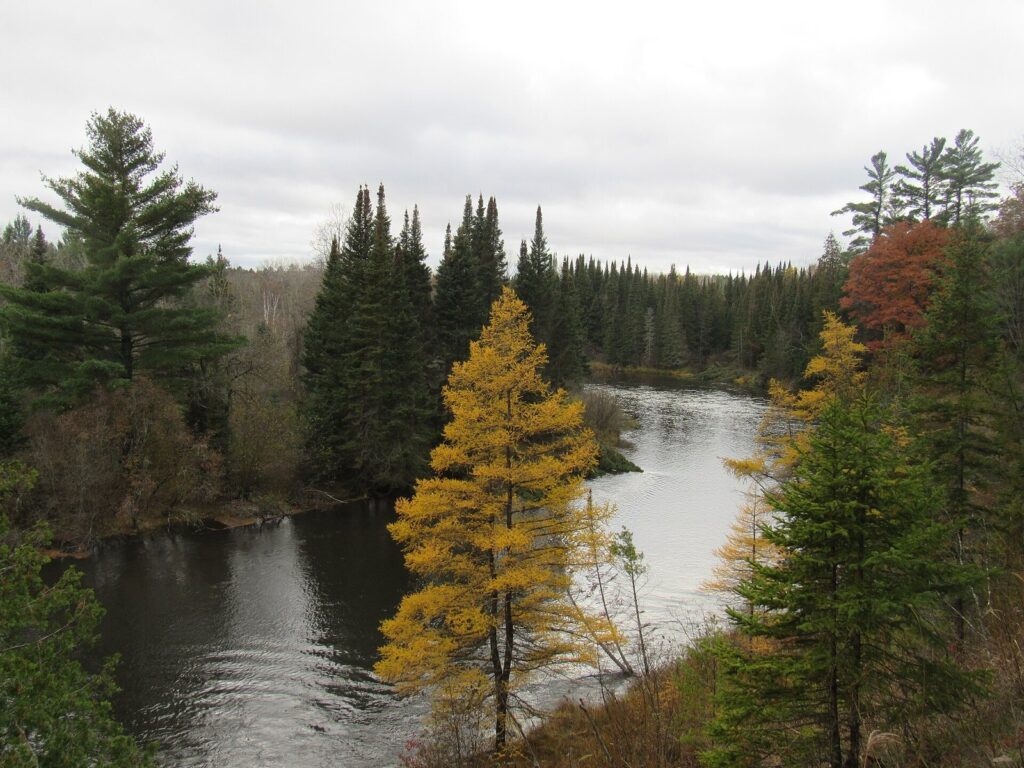
- Tamarack: a conifer that goes gold and drops its needles, usually the final show of the northern season in late October.
Weather can rearrange all of it. A dry late summer stresses trees into early browning and early leaf drop. A warm September can push everything back a week or more. One strong autumn storm can strip a hillside in an afternoon, which is the best argument for going as soon as a report says “near peak” rather than waiting for the weekend.
Michigan fall colors region by region
Six regions follow, in the order they usually turn. Each gives the typical peak, this year’s outlook where there is one, and the drive from Detroit, Grand Rapids and Chicago.
Western U.P.: the Keweenaw, the Porcupine Mountains and Ironwood
Typical peak: last week of September into the first week of October. 2026 outlook: the same, per UP Travel’s September 23 report.
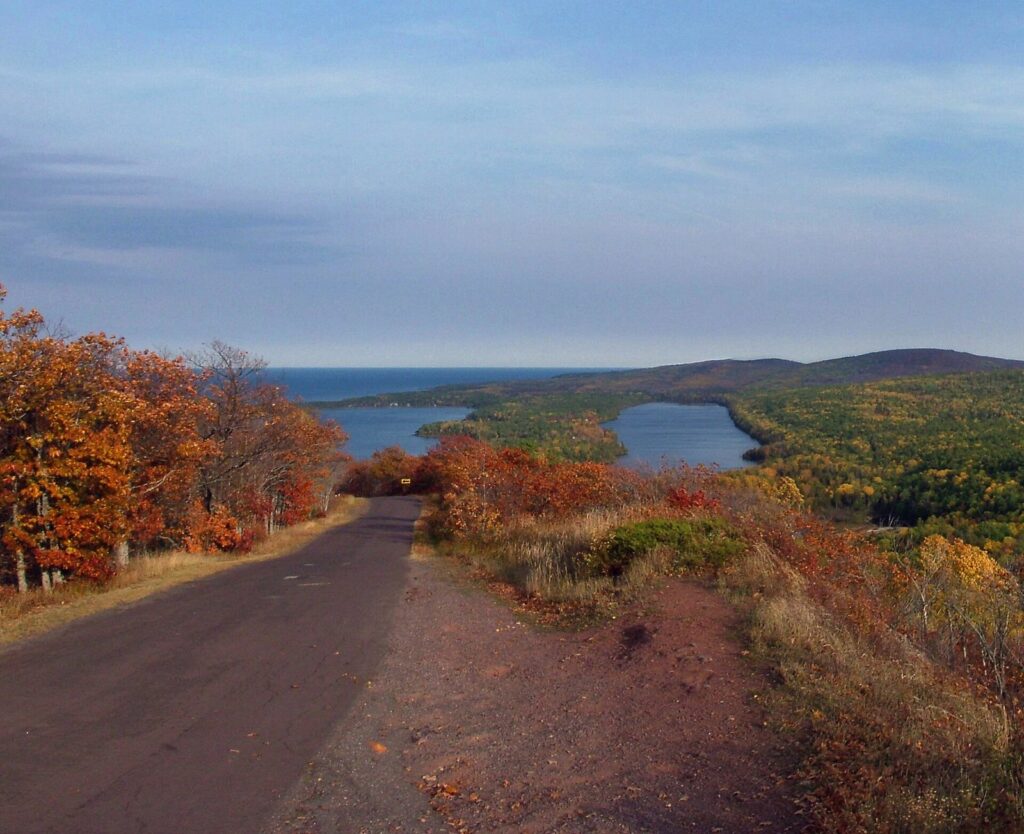
The Keweenaw Peninsula is the state’s first reliable peak and its most remote. US-41 runs up the spine from Houghton and Hancock through the old copper towns of Calumet and Mohawk, and M-26 follows the Lake Superior shore through Eagle River and Eagle Harbor. Near the tip, Brockway Mountain Drive climbs a ridge between Eagle Harbor and Copper Harbor with views down to inland lakes and out over Lake Superior, and it’s the Keweenaw’s signature color drive. The mix of red and sugar maple, birch and dark spruce is what gives Keweenaw color its contrast: bright crowns against nearly black conifers, with the lake behind.
Farther west, Porcupine Mountains Wilderness State Park covers 59,020 acres above Lake Superior, and its Lake of the Clouds overlook is the western U.P.’s best-known color view, a short walk from the parking lot. South of there, the Black River Scenic Byway runs north from Bessemer to Lake Superior past a string of waterfalls in the Ottawa National Forest. Gogebic County, which includes Ironwood and Bessemer, runs on Central time, as do Iron, Dickinson and Menominee counties, so your clock changes when you cross the line.
Getting there: Copper Harbor is about 9 hours 50 minutes from Detroit, 9 hours 10 minutes from Grand Rapids and 8 hours 10 minutes from Chicago. The Porcupine Mountains (Silver City) are about 7 hours from Chicago but 9.5 from Detroit, since Chicago drivers come up through Wisconsin. Verdict: the best bet for the last days of September, but it’s a four- or five-day trip from lower Michigan, not a weekend.
Central U.P.: Marquette, Munising and Pictured Rocks
Typical peak: first half of October. 2026 outlook: first and second weeks of October.
Pictured Rocks National Lakeshore is where the U.P.’s fall color and its most famous scenery meet. The sandstone cliffs rise about 200 feet above Lake Superior, and in early October the maples and birches along the top turn the whole wall into a band of color above mineral-streaked rock. It’s a fall destination as much as a summer one: 23% of the lakeshore’s 933,966 recreation visits in 2025 came in September and October, according to the National Park Service. From the water, Pictured Rocks Cruises’ two-hour Spray Falls Cruise runs until October 18 this year. On land, the road out to Miners Castle and County Road H-58 toward Grand Marais take you through the forest, and several of Munising’s waterfalls are short walks from the road.
Marquette, the largest city in the U.P., is the other base. Sugarloaf Mountain north of town and Presque Isle Park on the harbor both give you color above Lake Superior for very little climbing, and the city has the most restaurant and lodging choice in the region, which matters on a peak weekend.
Pictured Rocks charges $25 per private vehicle for a seven-day pass, or $45 for an annual pass (2026). Getting there: Munising is about 6 hours 25 minutes from both Detroit and Chicago and 5 hours 45 minutes from Grand Rapids; Marquette is about 7 hours 10 minutes from Detroit and 6.5 hours from Chicago. Verdict: the best all-round base for a first U.P. color trip, because the cliffs, the waterfalls and the boat tour all fit into the same two days.
Eastern U.P.: Tahquamenon Falls, Sault Ste. Marie and the Straits
Typical peak: first half to middle of October. 2026 outlook: the second week of October, or the first and second weeks in some counties.
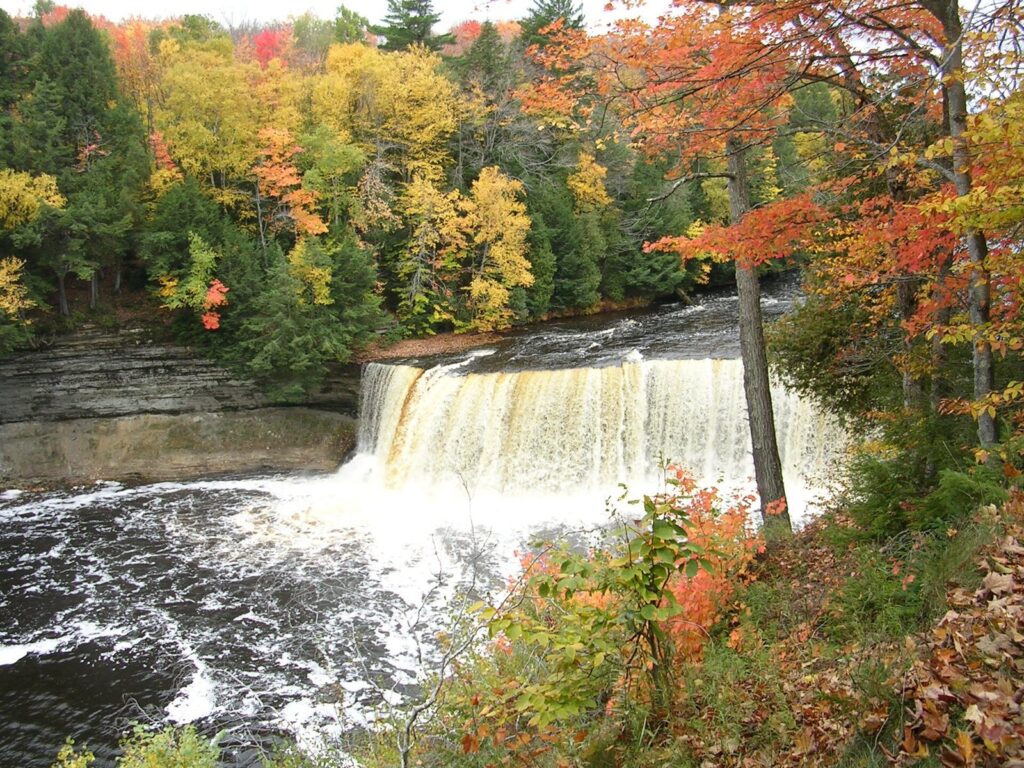
Tahquamenon Falls State Park is the eastern U.P.’s color anchor. The Upper Falls drops about 48 feet across a ledge more than 200 feet wide, and the river runs the color of strong tea from the tannins it picks up in the cedar and spruce swamps upstream, so an October view here is amber water under orange maples. The park covers 46,179 acres, the second-largest state park in Michigan, and a Recreation Passport is required. M-123 links Newberry, the Upper and Lower Falls and Paradise, and Whitefish Point sits a short drive north of Paradise on the Lake Superior shore.
The Toonerville Trolley, which carried visitors to the Upper Falls by narrow-gauge train and riverboat from Soo Junction for 96 seasons, has closed; its owners retired and couldn’t find a buyer. Drive to the state park instead, where short paths lead from the parking lot to the Upper Falls overlooks.
East of the park, Sault Ste. Marie’s Soo Locks and the St. Marys River make an easy half day, and the Straits of Mackinac usually peak at about the same time as Tahquamenon. Mackinac Island in early October is a quieter island than in July. The Fall Fudge Festival runs October 2-3 this year, and the carriage tours run until late October. Getting there: Paradise is about 5 hours 30 minutes from Detroit, 4 hours 50 minutes from Grand Rapids and 7 hours 40 minutes from Chicago; St. Ignace is about 4 hours 20 minutes from Detroit. Verdict: the closest U.P. color to Detroit, and the easiest to pair with Mackinac Island or Petoskey.
Northern Lower Peninsula: Traverse City, Sleeping Bear, Petoskey and the Sunrise Coast
Typical peak: early October in the interior highlands, mid-October along the Lake Michigan and Lake Huron shores. 2026 outlook: no official forecast; the weekly reports are the guide.
This is the color region most Michiganders actually drive to, because it’s four hours or less from Detroit and Grand Rapids and it packs lakes, dunes, orchards and small towns into a weekend. The interior turns first: the hardwood hills around Gaylord and the Pigeon River Country, then the oak and aspen among the jack pines around Grayling. The lakeshores follow a week or so later.
On the Lake Michigan side, the Leelanau Peninsula and Sleeping Bear Dunes put overlooks, orchards and wineries along M-22, and Old Mission Peninsula runs north from Traverse City between the two arms of Grand Traverse Bay. Fall is the quiet season at Sleeping Bear: 72% of its 1.6 million recreation visits in 2025 came in June, July and August. The Manitou Islands are closed for 2026, so plan your time on the mainland, where the Pierce Stocking Scenic Drive and the Empire Bluff Trail give you the big views.
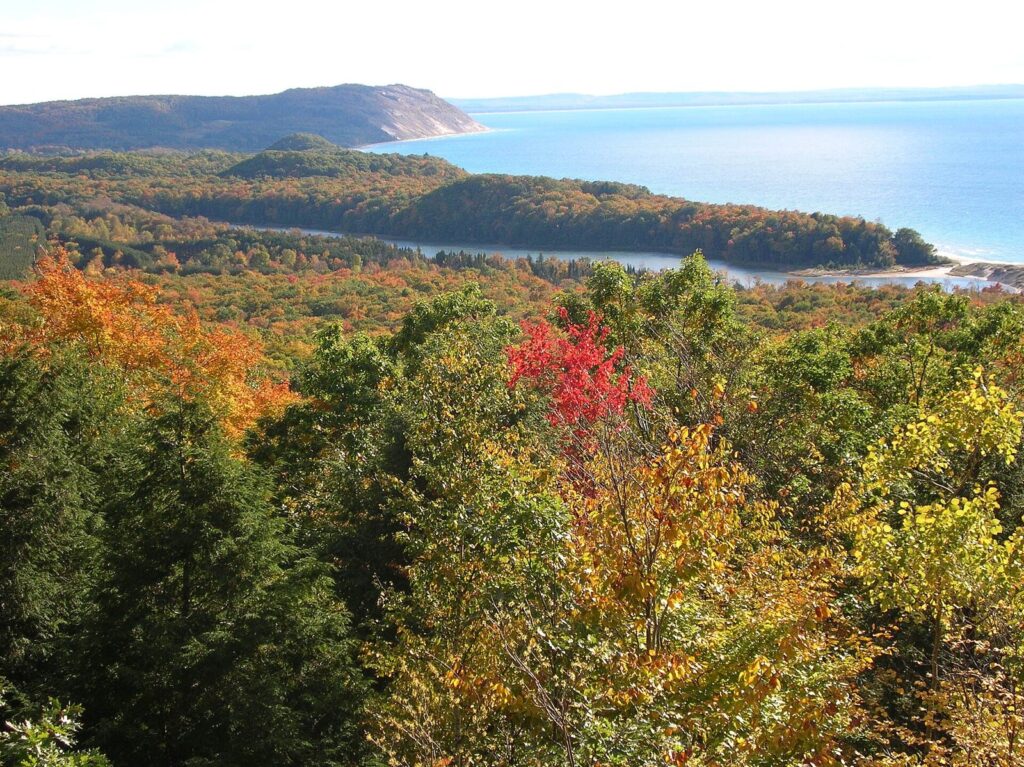
North of Petoskey, the Tunnel of Trees on M-119 is the region’s most famous canopy road, a narrow lane on a wooded bluff above Lake Michigan. Two sections are closed to through traffic this fall. Drive the open stretch out of Harbor Springs, follow the posted detours if you continue north toward Cross Village, and save the rest of the day for Petoskey, Harbor Springs and Charlevoix.
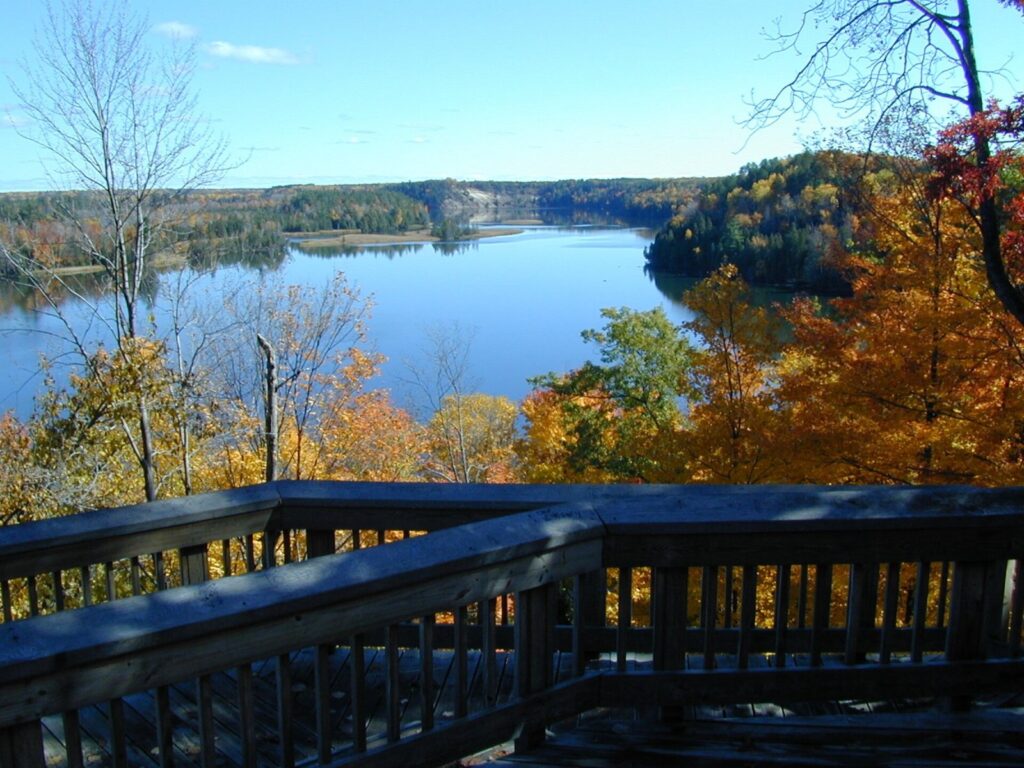
On the Lake Huron side, Oscoda is the start of the River Road National Scenic Byway, which follows the Au Sable River west through the Huron National Forest past high overlooks of the river’s hydro ponds, the Lumberman’s Monument and Iargo Springs. It’s about 3 hours from Detroit, closer than Traverse City, and a good alternative when the Lake Michigan side is crowded.
Getting there: Traverse City is about 4 hours from Detroit, 2 hours 15 minutes from Grand Rapids and 5 hours from Chicago. Glen Arbor, in the middle of Sleeping Bear, is about 4.5 hours from Detroit and 2 hours 45 minutes from Grand Rapids. Petoskey is about 4 hours from Detroit and 3 hours from Grand Rapids. Verdict: the most color per hour of driving in the state for anyone in lower Michigan. Go midweek if you can.
Mid-Michigan and the Lake Michigan shore: Ludington, Frankenmuth and the Thumb
Typical peak: mid-October.
The middle of the state is where color trips become day trips. On the Lake Michigan side, Ludington State Park and the Manistee National Forest put forested dunes, rivers and the big lake together, and the SS Badger sails from Ludington until October 11 this year for anyone coming across from Wisconsin. Inland, the farm country around Mount Pleasant and Midland colors up in mid-October, and Frankenmuth, the Bavarian-styled town about 1.5 hours north of Detroit, pairs a color drive with a chicken dinner. Its Oktoberfest has come and gone for 2026; the 2027 dates are September 16-19. The Thumb, with Port Austin at its tip about 2.5 hours from Detroit, gets you Lake Huron shoreline and harvest fields without the northern traffic.
Getting there: Ludington is about 3 hours 45 minutes from Detroit, 1.5 hours from Grand Rapids and 4 hours from Chicago; Frankenmuth is about 1.5 hours from Detroit and 2 hours from Grand Rapids. Verdict: the region to pick when the north is past peak and the south isn’t ready yet.
Southern Michigan: Detroit, Ann Arbor, Lansing, Grand Rapids and the southwest
Typical peak: mid to late October, with oaks holding into early November in a warm year.
The south peaks last, and it has two advantages over the north: the color comes to you, and it lasts longer, because oaks and hickories turn later than maples. Around Detroit, Hines Drive follows the Rouge River through a long strip of parkland from Northville toward Dearborn Heights, and the Huron-Clinton Metroparks ring the metro area with lakes and woods. In Ann Arbor, the Huron River and Nichols Arboretum are the easy walks, and Huron River Drive winds west toward Dexter. The cider mills are the other reason to stay close to home in October, and they have their own section below.
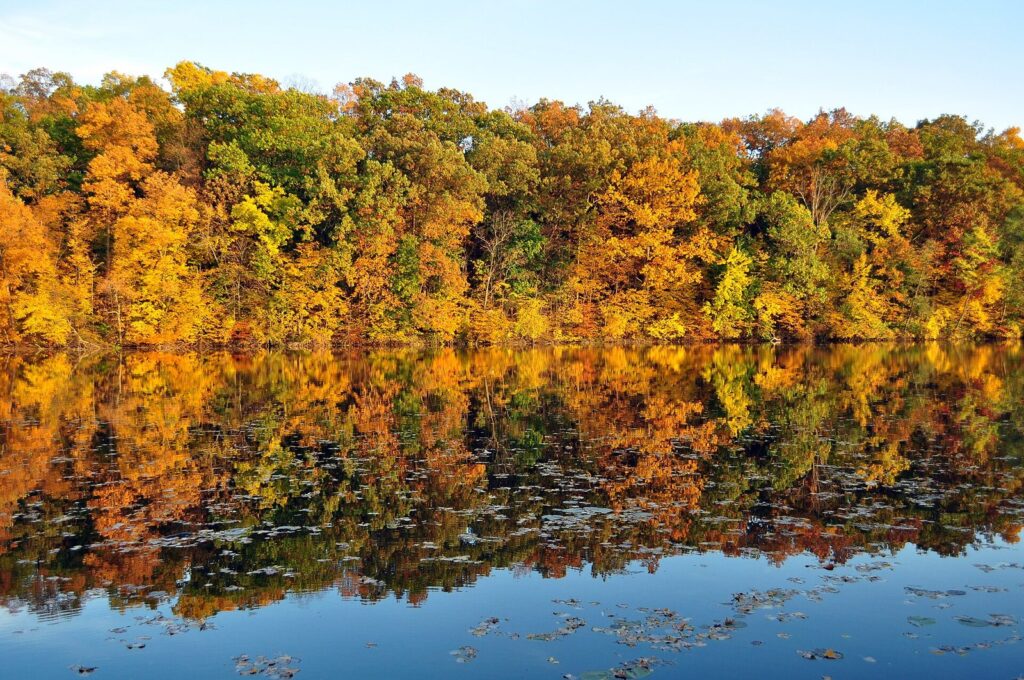
West Michigan runs on the same late schedule. Northwest of Grand Rapids, the orchards of the Fruit Ridge line the back roads in apple season, and in Southwest Michigan the dunes and beach towns from Sawyer to South Haven color up in the second half of October, an hour and a half to two hours from Chicago. Visit Southwest Michigan posts its own color report through the season.
Getting there: Ann Arbor is about 45 minutes from Detroit. Grand Rapids is about 2 hours 20 minutes from Detroit and 2 hours 55 minutes from Chicago. South Haven is about 2 hours from Chicago. Verdict: the best choice for a day trip or a last-minute weekend, and the only region worth planning around in the last week of October.
Is there a Michigan fall color map? The live reports to check
There are several, and none of them belongs in a trip plan a month ahead. Color reports are observations: someone looks at the trees and writes down what they see. Prediction maps are forecasts, useful for picking a week well in advance but no substitute for a report from the week you travel. These are the ones worth bookmarking:
- UP Travel’s fall color report: updated every Wednesday through the season, county by county in three regions (western, central and eastern U.P.), with notes on current color and when each region is expected to peak.
- Pure Michigan’s fall color map: the state tourism office’s statewide “real-time” map, with a fall color email newsletter you can sign up for on its fall page.
- Visit Southwest Michigan’s fall color report: the most direct way to judge the late-October color within reach of Chicago.
- National prediction maps: the foliage maps that top the search results, such as ExploreFall’s, estimate peak dates from forecasts across the whole country. Use them for a rough week, not a final call.
How to read a color report
Check the report 7 to 10 days before you leave and again on the Wednesday before. “Near peak” or “approaching peak” means go this week. “Peak” means go now and expect days, not weeks. “Past peak” in the U.P. is your cue to drop south to the northern Lower Peninsula, which usually runs a week or two behind. Book refundable rooms where you can, so you can shift a day or a region without losing money.
What is the best fall color drive in Michigan?
It depends on the week, which is the honest answer and the useful one. In the last days of September, it’s Brockway Mountain Drive above Copper Harbor. In the second and third weeks of October, it’s M-22 around the Leelanau Peninsula and Sleeping Bear Dunes, which has lakes, dunes, orchards and a town every few miles. In the last week of October, it’s Hines Drive or Huron River Drive near Detroit and Ann Arbor. The Tunnel of Trees on M-119 would top plenty of lists, but with two sections closed to through traffic this fall, it’s a partial drive in 2026.
| Drive | Where | Usual peak | Why it’s worth it | Note for fall 2026 |
|---|---|---|---|---|
| Brockway Mountain Drive | Eagle Harbor to Copper Harbor, Keweenaw | Late September to early October | Ridge-top views over forest, inland lakes and Lake Superior | Loop it with US-41 and M-26 |
| Black River Scenic Byway | Bessemer to Black River Harbor, Gogebic County | Late September to early October | Hardwood forest and a series of waterfalls near the road | Central time zone |
| H-58 | Munising to Grand Marais, behind Pictured Rocks | First half of October | Forest road with side trips to Miners Castle and the lakeshore | Park pass $25 per vehicle for 7 days (2026) |
| M-123 | Newberry to Paradise, eastern U.P. | First half to middle of October | Both Tahquamenon falls, then Whitefish Bay at Paradise | Recreation Passport for the state park; Toonerville Trolley closed |
| M-119, Tunnel of Trees | Harbor Springs to Cross Village | Mid-October | Narrow canopy road on a bluff above Lake Michigan | Two sections closed to through traffic; detours posted |
| M-22 | Leelanau Peninsula and Sleeping Bear Dunes | Mid-October | Lake views, dunes, orchards, wineries and small towns | Manitou Islands ferry not running |
| River Road National Scenic Byway | Oscoda west along the Au Sable River | Early to mid-October | River overlooks, Lumberman’s Monument, Iargo Springs | About 3 hours from Detroit |
| Hines Drive | Northville to Dearborn Heights, Wayne County | Late October | Parkway along the Rouge River inside metro Detroit | An easy half day from anywhere in the metro |
| Huron River Drive | Ann Arbor to Dexter | Late October | River bends, parks and a cider mill at the Dexter end | Dexter Cider Mill open for the 2026 season |
Three of these are single routes that each deserve a full day in their home destination. The Tunnel of Trees belongs to a Petoskey and Harbor Springs trip, M-22 and the Pierce Stocking Scenic Drive are the core of a Sleeping Bear Dunes visit, and Brockway Mountain Drive is the reason many people make the long run to Copper Harbor at all. For a statewide color tour, treat them as anchors and fill in with the quieter roads around them.
How to drive a color route well
- Go early or late in the day. Before 9 a.m. and after 3 p.m., low light makes the leaves glow and the pullouts are emptier.
- Don’t cancel for clouds. Soft overcast light often shows reds and yellows better than hard midday sun, and wet leaves look deeper.
- Pull all the way off. M-119 and M-22 have narrow shoulders and blind curves, and stopping in the lane for a photo is how fender-benders happen.
- Fill up in the bigger towns. Gas stations are few and far between along H-58, in the western U.P. and on the back roads of the northern Lower Peninsula.
- Watch for deer at dawn and dusk. October and November are prime months for deer on Michigan roads.
Fall color tours by boat and train
Seeing the color from the water is one of the best ways to do it in Michigan, and one of the most weather-dependent. Trains are a smaller story than they used to be.
By boat
Pictured Rocks Cruises in Munising is the big one, and its fall schedule is shorter than its summer one. The longer Classic Cruise stopped for 2026 on September 6, so in color season the boat to book is the Spray Falls Cruise, about 2 hours, which runs through October 18 at $56 per adult and $19 for ages 4 to 12 (2026 fares), with sunset departures in the early evening. The top of the cliffs is solid hardwood forest, so in the first half of October the color sits on a band of sandstone above green Lake Superior water. Cruises can be canceled for wind and waves, which are common on the big lake in October, so book early in your stay and keep a spare day.
The Mackinac Island ferries from Mackinaw City and St. Ignace are the shortest color cruise in the state: Arnold Transit and Shepler’s cross in 16 to 40 minutes depending on the boat, with the Mackinac Bridge and the island’s wooded bluffs in view the whole way.
The Lake Michigan car ferries are the other water option, mostly useful as a way in. The SS Badger crosses between Ludington and Manitowoc, Wisconsin, in about four hours and makes its last 2026 trips on October 11; Manitowoc is on Central time and Ludington on Eastern. The Lake Express high-speed ferry between Muskegon and Milwaukee runs through October 19. Both let Wisconsin drivers skip the long way around through Chicago.
Isle Royale doesn’t work for fall color. Its ferries and seaplanes stop in September, and the park closes to all visitors from November 1 to April 15.
By train
The best-known U.P. color ride is gone. The Toonerville Trolley and Tahquamenon Falls Riverboat Tours at Soo Junction, which combined a narrow-gauge train with a boat ride to the Upper Falls, closed after 96 seasons when its owners retired without a buyer.
What’s left is a handful of heritage railroads in the southern half of the Lower Peninsula, running short trips through farm country rather than big forest. The Southern Michigan Railroad has fall color tours on its 2026 calendar, according to regional listings, on a two-hour trip from downtown Tecumseh along the River Raisin valley to Clinton. West of Grand Rapids, the Coopersville & Marne Railway is known for its October pumpkin trains, about 90 minutes out to Marne and back. Neither replaces a forest drive, but both make a good half day with small kids. Confirm 2026 dates and fares on the railroads’ own sites.
Cider mills, orchards and pumpkin patches
In Michigan, a color trip without a cider mill is half a trip. The formula barely changes from mill to mill: cider pressed on site, warm cider donuts, a bag of apples, and at many places a pumpkin patch, a corn maze or orchard rows out back. Most mills open in late August or early September and run through October, so the mills near Detroit and Grand Rapids hit their stride in the same weeks the southern trees peak.
These five were confirmed open for the 2026 season:
- Yates Cider Mill, Rochester Hills: a red mill on the Clinton River in northern Oakland County, open daily this season.
- Franklin Cider Mill, Bloomfield Hills: a small, old-school mill in Detroit’s northern suburbs, open since September 5.
- Blake’s Orchard & Cider Mill, Armada: a large farm in northern Macomb County with orchards and fall activities, open Wednesday through Sunday this season.
- Dexter Cider Mill, Dexter: in the village of Dexter west of Ann Arbor, along the Huron River, open since August 28.
- Uncle John’s Cider Mill, St. Johns: on US-127 north of Lansing, with long fall hours.
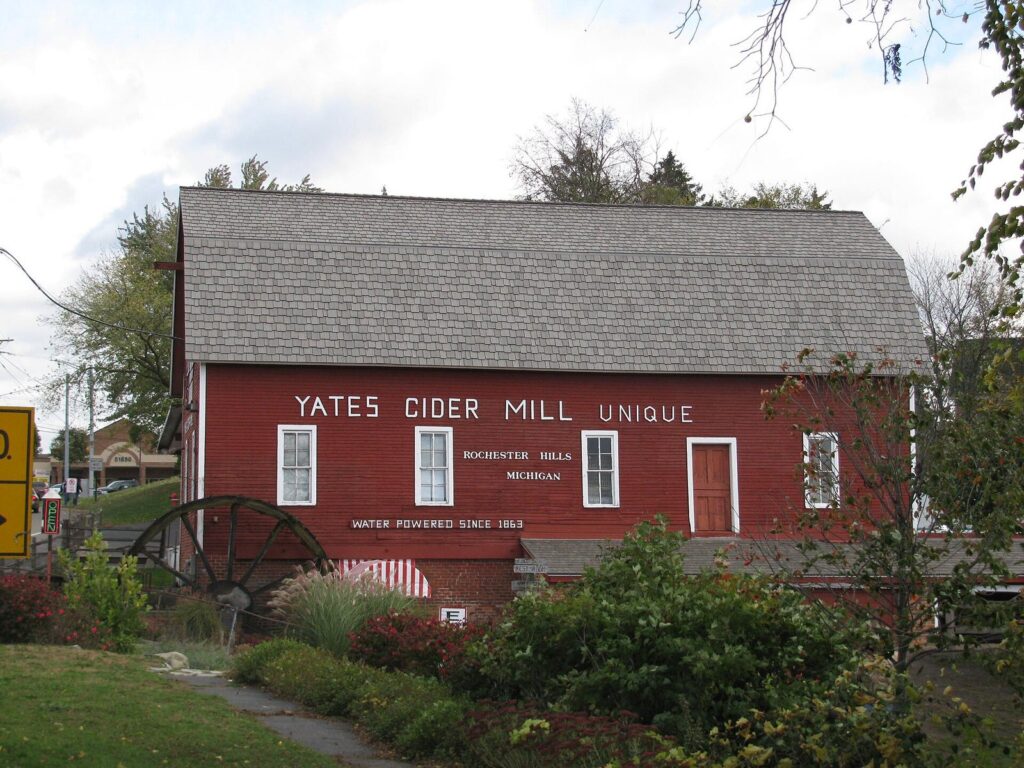
The best-known mills near Detroit draw crowds on October weekends. A weekday morning, or a Sunday right at opening, is the way around the lines, and it’s also when the donuts are freshest.
Orchards and farm markets up north
Up north, the orchards are part of the scenery. The Old Mission and Leelanau peninsulas near Traverse City are lined with farm markets selling apples, pears and cider in October, and the Fruit Ridge northwest of Grand Rapids is one of the state’s main apple-growing areas. For a color trip, a farm market stop along M-22 or M-37 gets you the same bag of apples without the picking.
Pumpkin patches
Pumpkin patches cluster around the big metro areas, where farms turn October weekends into hayrides, corn mazes and pick-your-own pumpkins. Some of the larger farms charge weekend admission or sell timed tickets, so check before you drive out. For the best choice of pumpkins, go in the first half of October; for the best color on the drive there, go in the second half.
Fall festivals and events
Michigan doesn’t have one big statewide fall festival. It has hundreds of small ones, from harvest days to Halloween weekends, and their dates move every year. A few worth planning around:
- Frankenmuth Oktoberfest: the 2026 festival ran September 17-20. The 2027 dates are September 16-19, and 2028 is September 14-17, so it lands before peak color everywhere but the far north.
- Mackinac Island Fall Fudge Festival: October 2-3, 2026, just ahead of the eastern U.P.’s usual peak.
- End-of-season weekends: Colonial Michilimackinac and Old Mackinac Point Lighthouse in Mackinaw City close for the season on October 11, and many seasonal businesses in the U.P. close soon after color season ends. If a place is on your list, go before mid-October.
- Harvest and Halloween events: cider mills, orchards and small-town main streets run them most October weekends. The local visitor bureau will have this year’s dates.
Fall getaways and things to do in color season
Fall getaways for couples
- Mackinac Island, early October: no cars, wooded bluffs over the Straits, and thinner crowds than summer. The Grand Hotel closes for the season in the third week of October, so go early in the month.
- Traverse City and its two peninsulas: Old Mission and Leelanau wineries at harvest time, with color on the drive between tasting rooms.
- Petoskey and Harbor Springs: walkable downtowns on Little Traverse Bay, and the open section of the Tunnel of Trees a few miles away.
- Marquette: Lake Superior on one side, hiking hills on the other, and a good base for Pictured Rocks.
- Copper Harbor: the end of the road in the Keweenaw, with one of the state’s earliest peaks. Go in the last days of September; by late October many businesses have closed for the season.
- Saugatuck and South Haven: the late-October option, about two hours from Chicago, with dunes, galleries and Lake Michigan sunsets.
Things to do beyond the drive
- Hike to a view: short climbs like Sugarloaf Mountain in Marquette, the Empire Bluff Trail at Sleeping Bear or the walk to the Lake of the Clouds overlook put you above the canopy for very little effort.
- Waterfalls: Tahquamenon, Munising’s falls and the Black River falls pair naturally with color.
- Paddle: inland rivers like the Au Sable and the Platte make calm color floats. The Great Lakes are cold in October, so wear a life jacket and stay off open water when the wind is up.
- Walk the beach, carefully: fall storms build big waves on Lake Michigan and Lake Superior. Stay off piers and breakwalls in high surf, read the beach flags where they’re posted, and remember that rip currents don’t take the off season off.
- Look up: longer nights mean earlier dark skies, and the Headlands International Dark Sky Park near Mackinaw City is open year-round.
- Keep a rainy-day town in reserve: Frankenmuth, Petoskey, Traverse City and Marquette all work when the weather doesn’t.
Planning a Michigan color tour: drive times, passes, lodging and weather
Drive times from Detroit, Grand Rapids and Chicago
| Destination | From Detroit | From Grand Rapids | From Chicago |
|---|---|---|---|
| Copper Harbor (Keweenaw) | about 9 h 50 min | about 9 h 10 min | about 8 h 10 min |
| Silver City (Porcupine Mountains) | about 9 h 30 min | about 8 h 55 min | about 7 h |
| Marquette | about 7 h 10 min | about 6 h 35 min | about 6 h 30 min |
| Munising (Pictured Rocks) | about 6 h 25 min | about 5 h 45 min | about 6 h 25 min |
| Paradise (Tahquamenon Falls) | about 5 h 30 min | about 4 h 50 min | about 7 h 40 min |
| Mackinaw City | about 4 h 15 min | about 3 h 35 min | about 6 h 25 min |
| Petoskey | about 4 h | about 3 h | about 5 h 45 min |
| Traverse City | about 4 h | about 2 h 15 min | about 5 h |
| Glen Arbor (Sleeping Bear) | about 4 h 30 min | about 2 h 45 min | about 5 h 30 min |
| Oscoda (River Road) | about 3 h | about 3 h 30 min | about 6 h 15 min |
| Ludington | about 3 h 45 min | about 1 h 30 min | about 4 h |
| Frankenmuth | about 1 h 30 min | about 2 h | about 4 h 40 min |
| Ann Arbor | about 45 min | about 2 h | about 3 h 50 min |
These are typical free-flowing times. On peak weekends, add time for two-lane roads through small towns, slow traffic at every overlook and road work that runs into the fall, and slow down after dark for deer. Most of the U.P. is on Eastern time, but Gogebic, Iron, Dickinson and Menominee counties use Central, so Chicago drivers keep their home time in Ironwood and lose an hour in the Keweenaw and Marquette.
Passes and fees
- Recreation Passport (2026): required for vehicles entering Michigan state parks and recreation areas, including Tahquamenon Falls, the Porcupine Mountains and Ludington. Michigan residents add it at plate renewal for $15; non-residents pay $42 for the calendar year or $12 a day.
- Pictured Rocks National Lakeshore (2026): $25 per private vehicle for seven days, $20 per motorcycle, $15 per person on foot or bike, or $45 for an annual pass.
- Sleeping Bear Dunes has its own entrance fee, so check the park’s site before you go.
Where to stay, and when to book
Pick one base per region and do day loops from it; you’ll spend less time packing and more time on the roads that matter. Munising or Marquette works for the central U.P., Houghton or Copper Harbor for the Keweenaw, Paradise, Newberry or St. Ignace for Tahquamenon and the Straits, Traverse City or Glen Arbor for Sleeping Bear, and Petoskey for the Tunnel of Trees and Charlevoix.
Book the first two weekends of October in the U.P. and around Traverse City and Petoskey as early as you can. The towns are small, room counts are limited, and some properties set minimum stays on peak weekends. Refundable rates give you room to follow the color. If you’re booking late, try weeknights, or stay in a bigger town like Traverse City or Marquette and drive out. Room rates follow demand more than the calendar: expect the highest prices on peak October weekends, lower rates midweek and the lowest once the color is gone.
Weather and what to pack
October in Michigan ranges from shirt-sleeve afternoons to the first snowflakes, sometimes on the same trip, and the U.P. runs colder than the south. Pack layers, a rain shell, a warm hat and waterproof shoes for waterfall trails. Days are short by mid-October, so plan to be off forest roads by dusk. Hunting seasons are open on public land through the fall, and firearm deer season starts in mid-November; wear something bright if you hike state forest land late in the season.
The weekday strategy
The single best way to improve a color trip is to shift it by two days. Leave on a Monday or Tuesday, spend the middle of the week on the roads everyone else drives on Saturday, and come home before the Friday rush. You’ll get emptier overlooks, easier parking at Tahquamenon and Pictured Rocks, and your pick of rooms at lower prices. If you can only go on a weekend, drive the famous roads early on Saturday and Sunday mornings and save the afternoons for places off the main routes.
What to skip
Skip a straight run of the Tunnel of Trees this fall. Two sections are closed to through traffic. Drive the open stretch from Harbor Springs, then spend the rest of the day on M-22 or Old Mission Peninsula.
Skip the Manitou Islands. They’re closed for all of 2026, and the Leland ferry isn’t running.
Skip the Toonerville Trolley. It has closed. Drive to Tahquamenon Falls State Park and walk to the Upper Falls instead.
Skip Isle Royale for fall color. The boats stop in September.
Skip the far U.P. in late October. The color is usually done and many seasonal businesses are closed. Southern Michigan is at its best that week.
Skip the whole-state-in-one-weekend tour. The Keweenaw and Detroit peak about four weeks apart. Pick one region and go deep.
Skip Saturday afternoons at the famous overlooks. Go on a weekday, or before 10 a.m.
Skip long-range forecasts as a final answer. Use the Wednesday reports in the week you travel.
Frequently asked questions
When is peak fall color in Michigan?
Peak moves from north to south over about six weeks. The western Upper Peninsula usually peaks in the last week of September and the first week of October, the rest of the U.P. and the northern Lower Peninsula in the first half to middle of October, and southern Michigan from mid to late October. If you can pick only one week for a northern trip, make it the first or second week of October.
Where are the best fall colors in Michigan?
For scale and scenery, the Upper Peninsula: the Keweenaw, the Porcupine Mountains, Pictured Rocks and Tahquamenon Falls. For the best color within four hours of Detroit or Grand Rapids, the northern Lower Peninsula around Traverse City, Sleeping Bear Dunes and Petoskey. For a late-October day trip, the Huron River valley around Ann Arbor, Hines Drive and the cider mill country north of Detroit.
When do leaves change in the Upper Peninsula?
Color starts in mid to late September and peaks during the first three weeks of October, according to UP Travel. The western counties, including the Keweenaw and the Porcupine Mountains, usually go first, around the last week of September. The central U.P. around Munising and Marquette follows in the first half of October, and the eastern U.P. around Tahquamenon Falls peaks near the second week.
What is the best fall color drive in Michigan?
It depends on the week. Brockway Mountain Drive above Copper Harbor is the pick in late September, M-22 around the Leelanau Peninsula and Sleeping Bear Dunes in mid-October, and Hines Drive or Huron River Drive near Detroit and Ann Arbor in late October. The Tunnel of Trees on M-119 is the most famous, but two sections are closed to through traffic in fall 2026.
Is mid-October too late for fall colors in Michigan?
No. Mid-October is prime time for much of the state. The eastern U.P., the Straits of Mackinac, Petoskey, Traverse City, Sleeping Bear and the Sunrise Coast are usually at or near peak, and mid-Michigan is starting to turn. The western U.P. is typically past peak by then, so go earlier if the Keweenaw is your goal. Southern Michigan’s peak is still ahead.
How long do fall colors last in Michigan?
Statewide, about six weeks, from the first U.P. color in mid-September to the last oaks in early November. In any one place, peak lasts about a week, sometimes up to 10 days in calm, cool weather, and only a few days if a storm brings strong wind or heavy rain. That’s why a weekly color report beats booking a fixed date months ahead.
Is there a Michigan fall color map?
Yes. Pure Michigan, the state tourism office, runs a real-time fall color map on michigan.org, and UP Travel updates a county-by-county Upper Peninsula report every Wednesday. Visit Southwest Michigan publishes its own report for the southwest corner. National prediction maps estimate peak dates from forecasts; they’re useful for choosing a week in advance, but the weekly reports are better for the final call.
Sources and verification
Everything on this page was checked on September 23, 2026 against the organizations listed below. The guide is compiled from their published information and claims no first-hand visits.
- National Park Service: Pictured Rocks National Lakeshore (entrance fees and park facts; visit figures from NPS visitor use statistics)
- Michigan Department of Natural Resources (Recreation Passport and state parks)
- UpNorthLive: M-119 Tunnel of Trees closures (September 18, 2026, reporting MDOT’s repair timeline)
The regional peak windows and the 2026 U.P. outlook come from the Upper Peninsula Travel & Recreation Association’s fall color report, and the statewide map from Pure Michigan’s fall page; both are linked in the color map section above, along with Visit Southwest Michigan’s report. We also checked Pictured Rocks Cruises’ 2026 fares and season, the SS Badger and Lake Express 2026 schedules, Mackinac State Historic Parks, the Frankenmuth Oktoberfest calendar, the Newberry News on the Toonerville Trolley’s closure, 2026 cider mill opening dates reported by WXYZ-TV Detroit, and listings for the Southern Michigan Railroad and the Coopersville & Marne Railway.
Michigan Tourism Guide is an independent publication. It is not affiliated with Pure Michigan or any agency or business named here.
Photo credits
- Road through fall color, Pictured Rocks (featured image): photo by Stevenliuyi, Wikimedia Commons (CC BY-SA 4.0)
- Tamaracks on the Au Sable River: photo by usfs_Eastern_Region, Wikimedia Commons (public domain)
- Brockway Mountain Drive: photo by Nick Nolte, Wikimedia Commons (CC BY-SA 2.5)
- Upper Tahquamenon Falls: photo by Wfgc, Wikimedia Commons (public domain)
- North Bar Lake, Sleeping Bear Dunes: photo by NOAA Great Lakes Environmental Research Laboratory, Wikimedia Commons (CC BY-SA 2.0)
- Huron River, Ann Arbor: photo by AndrewHorne, Wikimedia Commons (CC BY 3.0)
- River Road Scenic Byway overlook: photo by Unknown authorUnknown author or not provided, Wikimedia Commons (public domain)
- Yates Cider Mill: photo by Ekardiff, Wikimedia Commons (CC BY-SA 3.0)