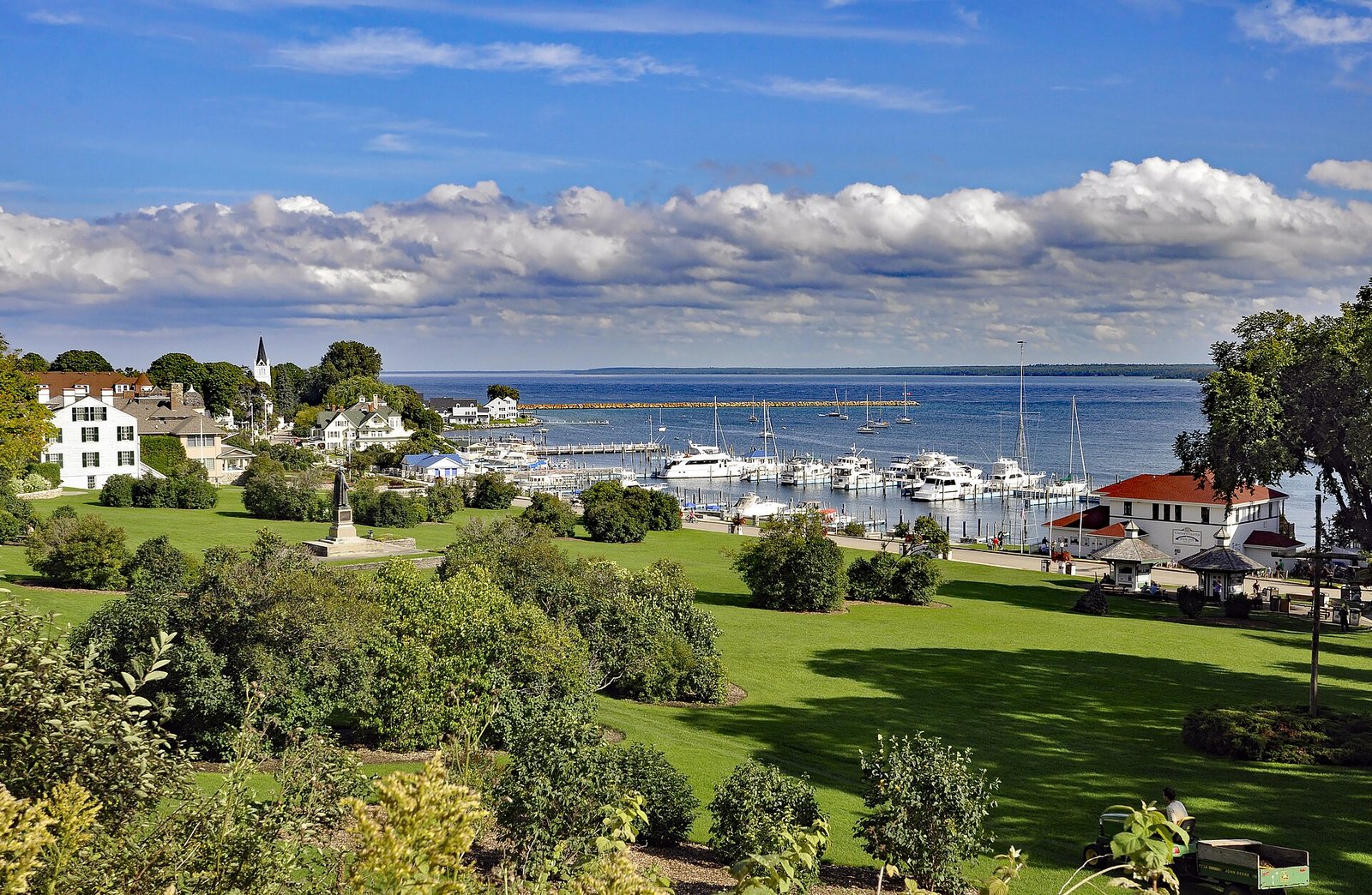
The first thing most people notice on Mackinac Island is the sound. Motor vehicles have been banned here since 1898, so what you hear walking off the ferry dock is hooves, bicycle bells and the boat horns behind you, and what you smell is a mix of horses and fudge. The island sits in Lake Huron at the Straits of Mackinac, between Michigan’s two peninsulas, and more than 80 percent of its 3.8 square miles is state park.
The short version: drive to Mackinaw City, or to St. Ignace on the Upper Peninsula side of the Mackinac Bridge, park at a ferry dock and take a 16- to 40-minute boat across. An adult round trip on the fast ferries cost $37 to $59 in 2026, depending on the line and how early you want to board. Once you’re there, you get around by bike, horse-drawn carriage or on foot. One day covers the highlights, and a night on the island buys you the quiet evening after the day-trippers leave. The season runs from early May to late October.
Every price, date and rule below was checked against the operators’ and agencies’ own websites on September 23, 2026. Ferry fares are 2026 rates, valid through October 31, 2026; neither ferry line listed 2027 fares when we checked. The mainland half of the Straits (Mackinaw City, St. Ignace and the bridge) has its own section near the end.
On this page: At a glance · What it’s known for · Getting there · Where to stay · Costs · What to do · Getting around · When to go · Mackinaw City, St. Ignace and the bridge · Mackinac or Mackinaw? · Verdict · FAQ
The essentials at a glance
| Question | Answer (checked September 2026) |
|---|---|
| Where is it? | In Lake Huron, just east of the Mackinac Bridge. The ferry docks are in Mackinaw City (Lower Peninsula) and St. Ignace (Upper Peninsula). |
| How do you get there? | Ferry with Shepler’s or Arnold Transit, 16 to 40 minutes depending on the boat, or a roughly 7-minute air taxi from St. Ignace. |
| Ferry fare, adult round trip (2026) | $37 Arnold Transit fast ferry; $39 Shepler’s basic ($59 Enhanced); $26 Arnold classic ferry from St. Ignace (May 23 to September 6, 2026) |
| Can you bring a car? | No. Motor vehicles have been banned since 1898, emergency vehicles aside. |
| How do you get around? | Bike (the tourism bureau counts 1,489 rental bikes), horse-drawn taxi or tour, or on foot |
| E-bikes? | Banned, except for riders with a mobility disability who hold a City permit |
| Season | Ferries’ summer service April 21 to October 31 (2026); the big attractions and most hotels run from early May to late October |
| Paid highlights, adult (2026) | Fort Mackinac $17.50; carriage tour $46; Grand Hotel porch and grounds $14 |
| Free highlights | Arch Rock, the 8.2-mile M-185 shoreline road, 70-plus miles of state park trails, Fort Holmes, Skull Cave, Sugar Loaf |
| Time needed | One full day for the highlights; one or two nights to see the island without the crowd |
| Best time | June for the lilacs (the 2027 Lilac Festival opens June 4); September, after Labor Day, for thinner crowds with nearly everything still open |
What is Mackinac Island known for?
Start with the car ban, because it shapes everything else. In 1898 the city outlawed “horseless carriages” after early automobiles spooked the horses, and in 1901 the Mackinac Island State Park Commission extended the ban to the rest of the island. More than a century later the rule still holds. Freight moves by horse-drawn dray and bicycle, the island’s roughly 600 working horses arrive for the summer, and visitors pedal or walk. It’s the reason the island feels like a different century, and also the reason everything on it costs a little more: every case of soda and bag of sugar crossed on a boat.
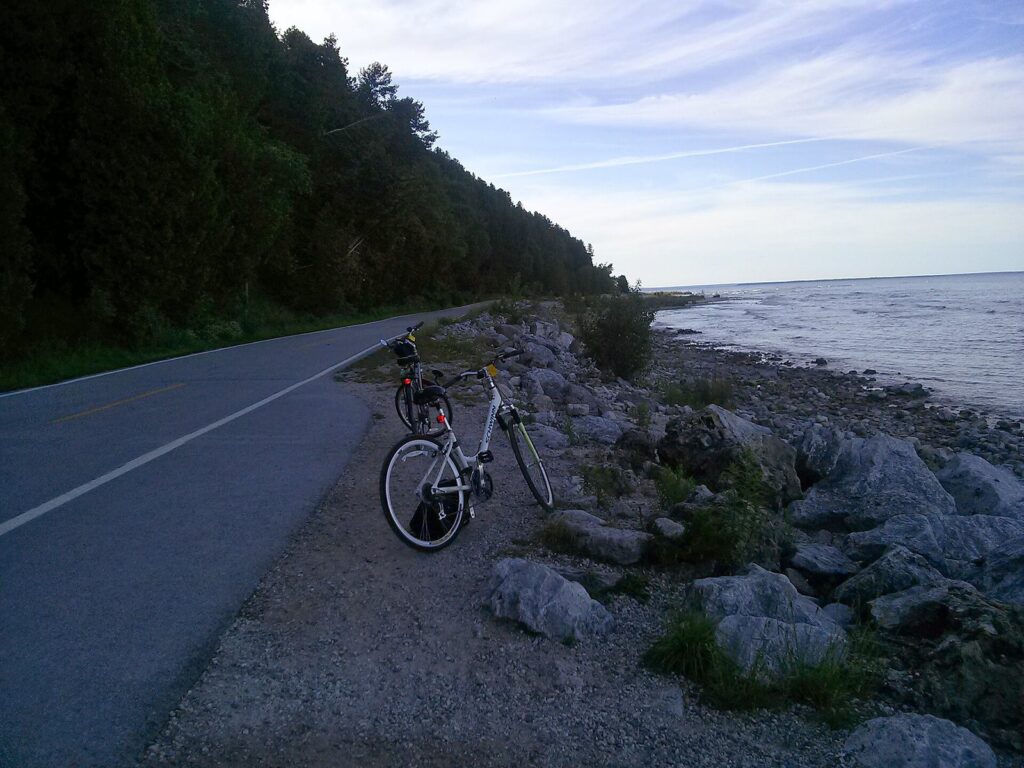
The second thing to know is how much of the island is park. Congress made much of it Mackinac National Park in 1875, the country’s second national park after Yellowstone, and the land passed to the state in 1895 as Mackinac Island State Park. Today the park covers more than 80 percent of the island and holds more than 70 miles of trails, which is why the interior is woods and limestone rather than houses. Around the edge runs M-185, an 8.2-mile shoreline road that is the only state highway in the country where motor vehicles aren’t allowed.
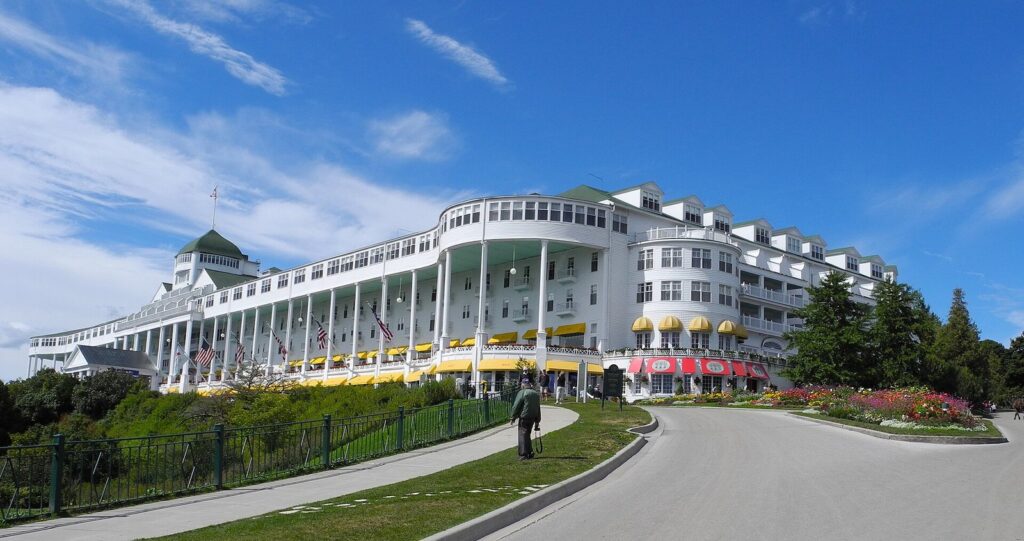
Then there’s the history. The British moved their garrison here from the mainland in 1780 and built Fort Mackinac on the bluff above the harbor. One of its buildings is the oldest in Michigan. The fur trade ran through the island for decades after that, and by the 1880s railroads and Great Lakes steamers were bringing summer visitors. The Grand Hotel, financed by railroad and steamship companies, opened in 1887, and its 660-foot front porch is still the island’s best-known view.
And there’s the fudge. Main Street’s fudge shops go through about 10 tons of sugar a week in peak season, according to the Mackinac Island Tourism Bureau, and samples are free, which does a lot to explain the foot traffic.
A few numbers help with scale. About 500 people live on the island year-round (the 2020 census counted 583). The tourism bureau puts annual visitors at around a million, most of them in summer. The island has about 1,600 hotel rooms and no chain hotels. The average July high is 76°F, which is part of the appeal when the rest of the Midwest is sweating.
How do you get to Mackinac Island?
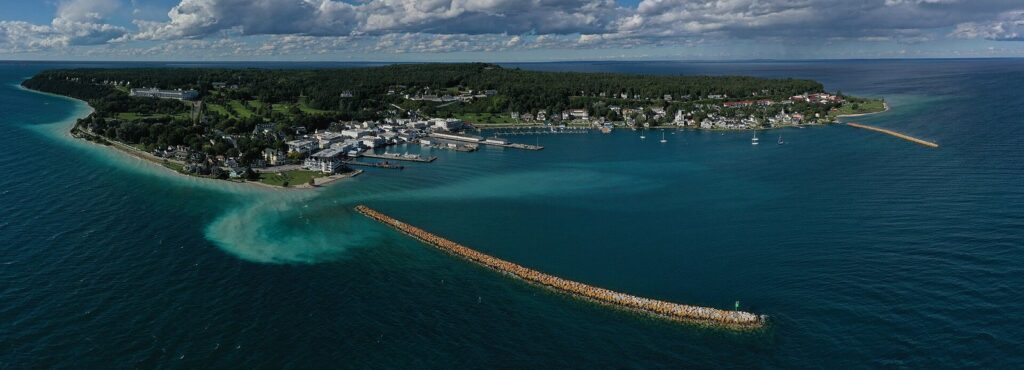
Nobody drives onto the island, so every trip has two legs: get yourself to a ferry town, then cross. Mackinaw City sits at the tip of the Lower Peninsula at the south end of the Mackinac Bridge. St. Ignace is five miles across the water at the north end, in the Upper Peninsula. Both ferry lines sail from both towns, and in peak summer boats leave as often as every 15 minutes.
Drive times to the ferry docks
These are drive times to the Mackinaw City docks in clear traffic, calculated with routing software in September 2026 and rounded. St. Ignace adds about six miles and the bridge toll if you’re coming from the south.
| Starting from | Distance | Drive time | Note |
|---|---|---|---|
| Grand Rapids | 237 miles | About 3 hours 35 minutes | The closest big-city start |
| Detroit | 290 miles | About 4 hours 15 minutes | I-75 north the whole way |
| Toledo | – | About 4.5 hours (tourism bureau estimate) | I-75 north through Detroit |
| Chicago | 415 miles | About 6 hours 25 minutes | Add an hour on the clock: Michigan is on Eastern time |
| Cleveland | 441 miles | About 6.5 hours | |
| Columbus | 463 miles | About 7 hours | |
| Toronto | 472 miles | About 7 hours 15 minutes | Plus the border crossing |
| Indianapolis | 484 miles | About 7 hours 15 minutes | |
| Cincinnati | – | About 8 hours (tourism bureau estimate) |
Treat those as best cases. Summer Friday afternoons and holiday weekends are slower on I-75 northbound, so build in a buffer. If you’re driving up for a day trip, leave early enough to be at the dock by mid-morning, or go up the night before.
Mackinaw City or St. Ignace: which dock?
If you’re coming from the south, use Mackinaw City. It’s the bigger ferry town, it saves you the $4.00 bridge toll, and it has more hotels, restaurants and parking. Use St. Ignace if you’re already in the Upper Peninsula, if you’re heading on into it afterward, if you want Arnold Transit’s slower classic ferry (the cheapest crossing, $26 round trip for adults in summer 2026), or if you’re going in winter, when St. Ignace is the only port with service.
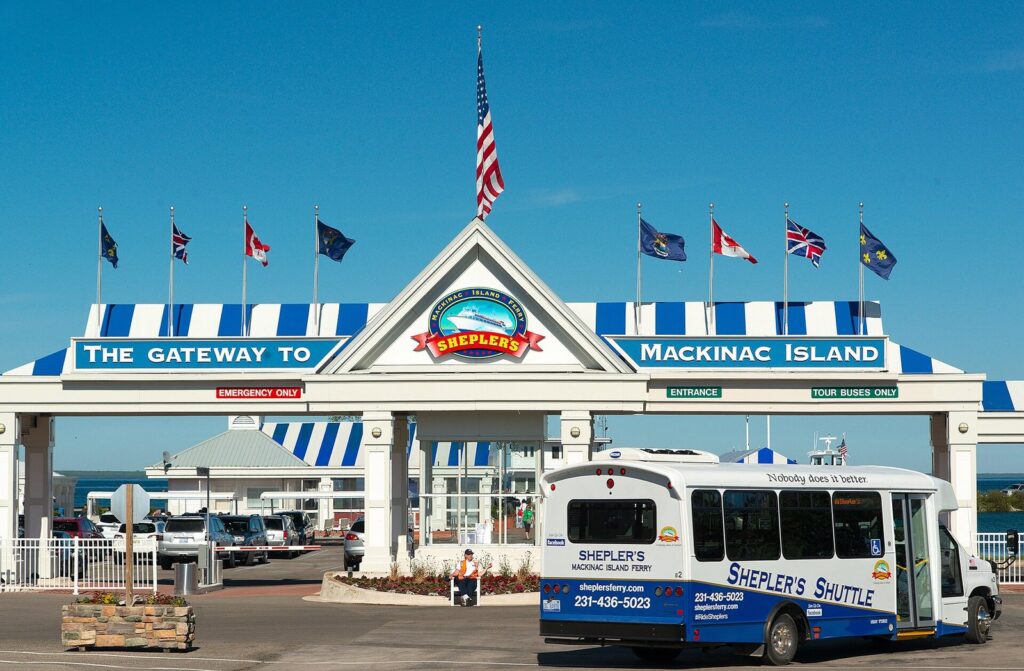
Both lines sell open tickets. A Shepler’s ticket is good on any departure from either town during the season, and Arnold Transit’s tickets are valid all season too, so you don’t book a sailing time. Shepler’s suggests arriving an hour before you want to leave.
Shepler’s vs Arnold Transit: 2026 fares compared
If you last looked at a ferry map a few years ago, one name has gone. The old Star Line ferries became the Mackinac Island Ferry Company, and in September 2024 the Hoffmann Family of Companies bought it and rebranded it Arnold Transit Company. Hoffmann also owns Shepler’s, so the two lines at the docks now share an owner. Reviews that compare three ferry lines are out of date.
| 2026 (checked September 23) | Shepler’s | Arnold Transit |
|---|---|---|
| Departs from | Mackinaw City and St. Ignace | Mackinaw City and St. Ignace; classic ferry from the St. Ignace Classic Dock |
| Adult round trip | $39 basic, $59 Enhanced, plus a $2 booking fee per ticket | $37 fast ferry, $52 priority boarding, $26 classic ferry |
| Child round trip (ages 5 to 12) | $27 basic, $47 Enhanced | $25 fast ferry, $40 priority, $19 classic |
| Young children | Under 5 free (still need a ticket) | Under 4 free |
| Crossing time | 16 minutes direct; about 25 on “Mighty Mac” departures that pass under the bridge | 20 to 25 minutes on the fast ferries; 30 to 40 on the classic ferry |
| Bike, round trip | $21 standard, $42 tandem | $19 |
| Dogs | Leashed or caged pets ride free | Leashed, well-behaved dogs allowed |
| Summer season | April 21 to October 31 | Fast ferry April 21 to October 31; classic ferry May 23 to September 6 |
Which should you pick? On price alone, Arnold Transit’s fast ferry is the cheapest quick crossing at $37, and its classic ferry from St. Ignace is cheaper still if you don’t mind a slower boat. Shepler’s is the fastest at 16 minutes and carries luggage to and from the island at no charge, which matters if you’re staying over with bags, although its tickets are non-refundable. Its Mighty Mac departures swing under the Mackinac Bridge for about ten extra minutes, a good trade on a first trip.
The upgrades are easier to judge. Shepler’s Enhanced and Arnold’s priority boarding get you on the boat ahead of basic ticket holders, and that’s all. Shepler’s says outright that Enhanced doesn’t guarantee a particular departure. On a July Saturday morning with a long line, it can save you a boat or two. On a weekday in May or September, you’d be paying $15 to $20 a head to stand at the front of a short line.
Parking at the ferry docks
You’ll leave the car on the mainland, and the lots aren’t free. These were the 2026 rates:
- Shepler’s (Mackinaw City and St. Ignace): $15 a day. Overnight, the standard lot is $25 a night with a shuttle to the dock, and the premium dock lot is $50 a night Sunday to Wednesday or $75 Thursday to Saturday. Parking can’t be bought online.
- Arnold Transit, Mackinaw City and the St. Ignace main dock: $10 a day or $20 a night in the standard lots, $40 a day for premium dockside spaces, and $65 a day or $130 a night for valet.
- Arnold Transit, St. Ignace Classic Dock: $15 a day or $25 a night.
Premium and valet parking are conveniences, not necessities. For a day trip, budget $10 to $15. For a night on the island, budget $20 to $25 in a standard lot and more if you want to walk straight from car to boat.
The Mackinac Bridge toll
You only pay it if you cross between the peninsulas: to reach St. Ignace from the south, or to come down to Mackinaw City from the Upper Peninsula. The toll was $4.00 per passenger vehicle in 2026, and it’s collected in both directions. The bridge is five miles long with a 3,800-foot main span and opened in November 1957. It has its own section below, along with the Labor Day Bridge Walk.
Flying in
The nearest airline service is Pellston Regional Airport, about 20 minutes south of Mackinaw City, which has daily Delta flights to and from Detroit. Chippewa County International is about 30 minutes north of St. Ignace, and Traverse City’s Cherry Capital Airport, with far more flights, is about two hours south. Plan how you’ll get from the airport to the ferry docks before you book.
You can also fly to the island itself. Fresh Air Aviation and Northwoods Aviation run air taxis from St. Ignace to the Mackinac Island Airport, a flight of about seven minutes, and charters fly in from farther away. It’s the only way across when winter ice stops the ferries.
Where to stay: on the island, in Mackinaw City or in St. Ignace
After the ferry, this is the decision that shapes the trip. The island is the experience; the mainland towns are the value. Here’s how the three bases compare.
| Mackinac Island | Mackinaw City | St. Ignace | |
|---|---|---|---|
| Price level | Highest. About 1,600 rooms, no chains, a short season, and some rates that bundle meals and add resort fees | Mid-range. Plenty of independent motels and national chains | Mid-range. A smaller mix of motels and hotels on the Upper Peninsula side |
| Ferry access | You walk off the boat | Both lines sail from town; parking $10 to $15 a day or $20 to $25 a night | Both lines sail from town, plus Arnold’s classic ferry; same parking rates |
| Evenings | The best part of the trip: the day crowd leaves and the island goes quiet | Restaurants and shops, bridge views, and a dark-sky park open 24 hours | The quietest, with views of the bridge lights across the water |
| Costs to add | Overnight parking in a mainland lot ($20 to $25 a night in the standard lots) | A ferry ticket for each day you visit the island | A ferry ticket, plus the $4.00 bridge toll whenever you cross |
| Best for | Couples, first-timers who can afford one night, anyone who wants the island without the crowd | Families on a budget, road-trippers, anyone who wants choice | Travelers continuing into the Upper Peninsula |
Room rates move a lot by date, so compare the same nights across all three towns before you decide. On the island, the tourism bureau notes that prices are lowest in spring and fall and highest between Memorial Day and Labor Day.
Staying on the island
The island’s lodging runs from bed-and-breakfasts in old cottages to full-service resorts. Downtown hotels along Main Street and the harbor are steps from the ferry and busy by day. Places set back from the harbor, on the hills above town or toward the interior, are quieter and usually uphill. Mission Point Resort sits on the island’s southeast shore, and the Grand Hotel sits on the bluff west of downtown.
The Grand Hotel works differently from most hotels, so read the fine print. Its flexible rate includes breakfast and dinner daily (there’s also a bed-and-breakfast package). On top of the room rate, the hotel listed a 6% Michigan sales tax, a 4% Mackinac Island assessment, a 19.5% resort fee and a $16 per person baggage-handling charge per stay when we checked, with a 30-day cancellation policy. It opens in early May, closes in the third week of October, and asks everyone in its main areas to wear what it calls “elevated evening attire” after 6:30 p.m. If you want a jacket-and-dinner night on the island, it delivers. If you want to wander into dinner in shorts, book elsewhere.
Whatever you book, ask how your bags get from the dock to the door. It’s a car-free island, and the answer is part of the price.
Staying in Mackinaw City
Mackinaw City is the practical base. Both ferry lines leave from town, there’s a wide range of rooms from motels to chain hotels, and the town has its own sights for a spare morning or evening: Colonial Michilimackinac and Old Mackinac Point Lighthouse sit right under the bridge (the fort’s summer hours ran to 7 p.m. in 2026), and Headlands International Dark Sky Park, west of town on the Lake Michigan shore, is open 24 hours a day. It’s also the easier base with young kids: you keep your car for the rest of the trip, you have more rooms to choose from, and nightly rates usually run below the island’s.
Staying in St. Ignace
St. Ignace is smaller and quieter, with views of the bridge. It suits you if you’re heading on to Tahquamenon Falls, Pictured Rocks or elsewhere in the Upper Peninsula, or if you want Arnold Transit’s classic ferry. From the south, remember that every trip across the bridge costs $4.00.
When to book
The island has about 1,600 rooms and, by the tourism bureau’s estimate, around a million visitors a year, so the math isn’t in your favor on the busiest dates. Book as early as you can for the Lilac Festival in June, the mid-July sailboat race weeks, August weekends and Labor Day. Midweek nights in late May, June and September are the easiest to find, and spring and fall rates are the lowest of the year.
Verdict: if you can afford one night on the island, spend it there, and put any other nights on the mainland. One evening on the island does more for the trip than three nights in a nicer mainland room.
What does a trip cost?
The island is not a cheap day out, but it’s a predictable one, because nearly every major cost is a posted price. Here are two versions of a day trip for one adult at 2026 prices.
| Per adult, 2026 prices | Lean day | Everything day |
|---|---|---|
| Ferry, round trip | $37 (Arnold Transit fast ferry) | $61 (Shepler’s Enhanced, $59 plus the $2 fee) |
| Bike rental, 2 hours | $24 (at $12 an hour) | $36 (at $18 an hour) |
| Fort Mackinac and the downtown historic buildings | $17.50 | $17.50 |
| Carriage tour (about 1 hour 45 minutes) | Skip | $46 |
| Grand Hotel porch and grounds | Skip | $14 |
| Total before food | $78.50 | $174.50 |
Add $10 to $15 per car for day parking, plus lunch and fudge. If you take Arnold’s classic ferry from St. Ignace in summer ($26), the lean day drops to $67.50.
A family of four (two adults, two children aged 6 to 12) taking Arnold’s fast ferry, visiting Fort Mackinac and riding the carriage tour pays $124 for the ferry, $56 for the fort and $126 for the tour at 2026 prices: $306, plus $10 to park. Add the Grand Hotel ($14 per adult, $7 per child aged 6 to 12) and it’s $348 before bikes and food.
Day trip or one night? Here’s the same trip for two adults both ways, at 2026 prices, using Arnold Transit’s fast ferry and its standard parking lot:
| Two adults, 2026 prices | Day trip | One night on the island |
|---|---|---|
| Ferry, round trip | $74 | $74 |
| Parking, one car | $10 (day) | $20 (overnight) |
| Bikes | $48 to $72 (2 hours each) | $120 to $196 (full-day rentals) |
| Fort Mackinac | $35 | $35 |
| Carriage tour | $92 | $92 |
| Grand Hotel porch and grounds | $28 | $28 |
| Room | None | Your rate: the big variable |
| Total before food | $287 to $311 | $369 to $445, plus the room |
The room is the number that decides it, and it swings by date more than anything else on this page, which is why we don’t quote one. If you park at Shepler’s instead, overnight parking runs $25 in the standard lot and up to $75 a night in its premium dock lot on Thursday to Saturday nights. With two days, you can also spread the paid stops out and skip Enhanced boarding altogether.
Plenty costs nothing. Mackinac Island State Park charges no entry fee, so Arch Rock, Sugar Loaf, Skull Cave, Fort Holmes, British Landing, the trails and the whole of M-185 are free. So are Marquette Park below the fort, the harbor and the view of the Grand Hotel from the road beneath its porch.
What to do on the island: the short list
Most first visits follow the same loop: a bike ride around the shore, the fort, Arch Rock, a look at the Grand Hotel and an hour on Main Street. That’s a full day, and it’s a good one. The order matters more than people expect. Take an early boat, rent bikes near the dock and ride M-185 while it’s quiet. Have lunch downtown, climb to the fort in the early afternoon, when Main Street is at its most crowded, then walk or ride up to the Grand Hotel. Come back down for fudge and the harbor before your boat. Here’s what each stop involves.
Ride the 8.2-mile M-185 loop
The shoreline road circles the whole island at lake level, which makes it mostly flat and easy to ride. At an easy pace it’s about an hour, longer with stops at the rocky beaches, at Arch Rock’s staircase on the east side and at British Landing on the northwest shore, where British troops came ashore in 1812 to take the fort. Early morning and early evening are the quietest times to ride.
Arch Rock
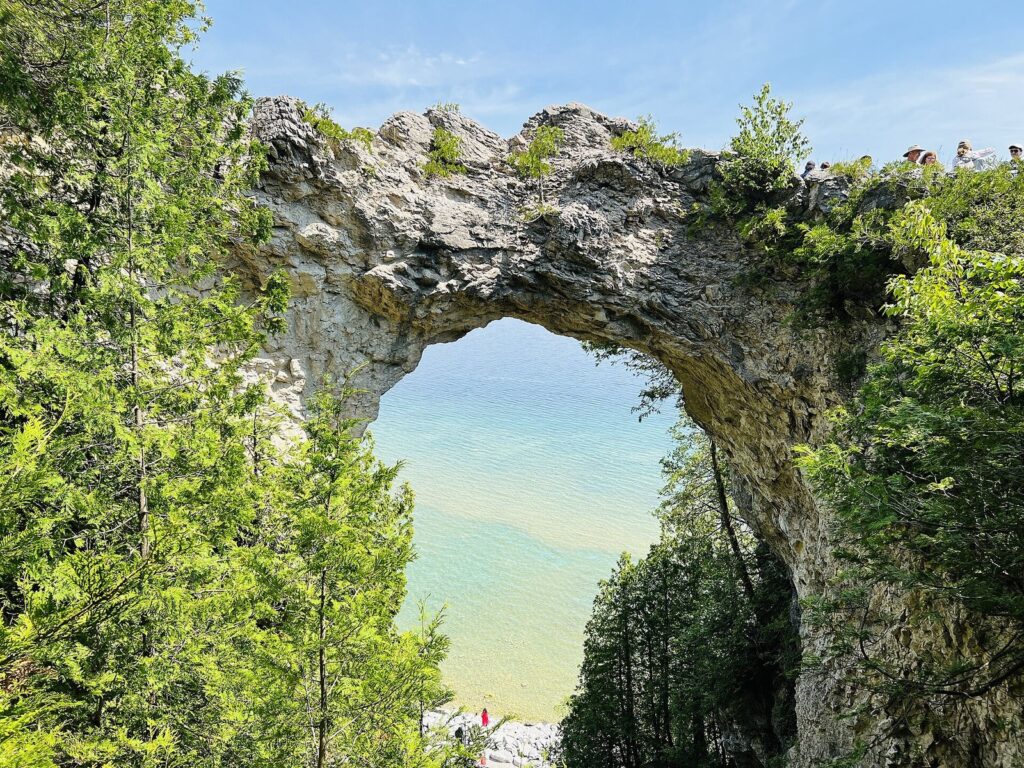
The island’s best-known natural feature is a limestone arch standing about 145 feet above the lake on the east shore. You can see it from above, at a viewing area on the interior road where carriage tours stop, or from M-185 below, where a staircase climbs toward it. Both are free.
Fort Mackinac
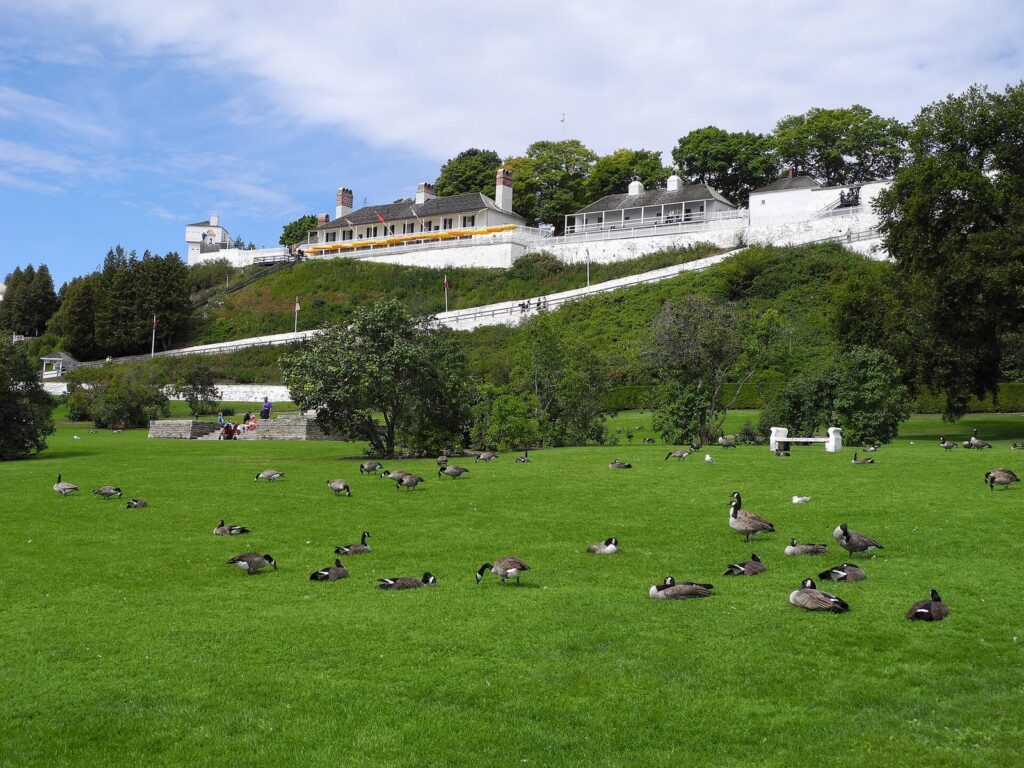
The fort on the bluff is the island’s big paid attraction and worth the money if you have any interest in history. It has 14 original buildings, including Michigan’s oldest, with costumed staff firing rifles and cannons through the day. Adult tickets were $17.50 in 2026 and children aged 5 to 12 paid $10.50, with under-5s free. The ticket also covers the Historic Downtown buildings run by Mackinac State Historic Parks: the Biddle House with the Mackinac Island Native American Museum, the Benjamin Blacksmith Shop, the American Fur Co. Store and Dr. Beaumont Museum, the McGulpin House and the Richard and Jane Manoogian Mackinac Art Museum. Summer hours ran 9:30 a.m. to 7 p.m. from June 6 to September 6, 2026, and the fort’s 2026 season ends October 24. Allow two hours.
The Grand Hotel
You don’t have to stay at the Grand Hotel to see it. Non-guests paid $14 (adults) or $7 (ages 6 to 12) in 2026 to go inside, walk the 660-foot porch and tour the gardens, with maps and a self-guided tour included; children 5 and under are free. Is it worth it? If you’ll sit on the porch for an hour with the Straits in front of you, yes. If you only want the photo, you can take it from the road below for nothing.
A carriage tour
If biking isn’t for you, the Mackinac Island Carriage Tours sightseeing tour is the easiest way to see the interior. It takes about 1 hour and 45 minutes and stops at the Surrey Hills Museum, Arch Rock and Fort Mackinac’s Avenue of Flags, with an optional drop-off at the Grand Hotel (admission extra). Its posted price was $46 for adults and $17 for children 5 to 12 in September 2026, and children under 4 ride free on a lap. The regular public tour doesn’t take reservations, so just show up at the ticket office on Main Street.
Fort Holmes, Skull Cave and Sugar Loaf
The interior has three free stops that most day-trippers never reach. Fort Holmes, on the island’s highest point, has the widest view. Sugar Loaf is a 75-foot limestone stack standing alone in the woods. Skull Cave is small but has a good story: the fur trader Alexander Henry hid there in 1763. All three are a short, uphill bike ride or a longer walk from downtown on state park roads.
Downtown, the harbor and the fudge
Main Street is where the ferries land, the fudge gets made and the crowds collect. Come early or late to enjoy it. The Mackinac Island State Park Visitor Center downtown is the place for trail maps. In the evening, once the last day boats have gone, the harbor and the park below the fort are the island at its best.
If it rains
Rain doesn’t close much on the island, but it changes the plan. Your Fort Mackinac ticket covers the indoor exhibits in the fort and the downtown historic buildings, including the Richard and Jane Manoogian Mackinac Art Museum (open through October 4 in 2026), and the Grand Hotel’s public rooms make a dry, if pricey, afternoon. Save the bike ride for the next clear morning: M-185 has almost no shelter once you leave town.
With kids or a dog
Kids tend to like the ferry, the fort’s cannon firing and anything involving a horse. Bike shops rent tag-alongs for kids who can’t ride far on their own, and the fort ticket for ages 5 to 12 was $10.50 in 2026. Dogs are welcome on both ferry lines on a leash, and Shepler’s carries them free. Keep them leashed on the island, and expect to pay for a big dog on the carriage tour: dogs of 35 pounds or more were $17.
How to get around without a car
Bikes
Bikes are the island’s default transportation, and there’s no shortage: the tourism bureau counted 1,489 rental bikes. Most liveries are on Main Street near the ferry docks. When we checked in September 2026, posted rates for a standard adult bike ran from about $12 to $18 an hour, and full-day rates from $60 to $98. Shops don’t take reservations for individual rentals, so you walk in, get fitted and go. Some include a helmet, lock and basket in the price; ask.
Bringing your own bike costs $19 round trip on Arnold Transit or $21 on Shepler’s in 2026, which pays off by the second hour of rental. Downtown gets congested with bikes, carriages and people on foot, so walk your bike through the busiest blocks and save the riding for M-185 and the park roads.
The e-bike rule
This is the rule that catches people out. E-bikes are banned on the island except for riders with a mobility disability who complete the City of Mackinac Island’s licensing, and the same rule applies inside the state park. The City tightened it in 2026. Shepler’s doesn’t sell e-bike passage online and sends riders to the City for approval first, and Arnold Transit’s FAQ states the same rule. If that’s not you, leave the e-bike at home and rent a regular bike when you arrive.
Carriages and horse-drawn taxis
Horse-drawn taxis charge per person by destination. A 2023 tourism bureau guide put most fares at $5 to $10 a person, half price for children; ask for the current fare when you call. The sightseeing carriage tour, covered above, is a separate ticket. Taxis are the practical choice with luggage, with limited mobility, or in an evening outfit you’d rather not bike in.
Walking
Downtown, the harbor, Marquette Park and the fort are all within a short walk of the ferry docks. The interior is another matter: the roads to Arch Rock’s upper viewing area, Fort Holmes and Sugar Loaf climb steadily from town, and they’re easier by bike or carriage if you’re short on time or energy.
When is the best time to visit?
The island runs on a short, sharp season. Search interest and crowds peak from June to August, the shoulder months are cheaper and quieter, and winter is a different place altogether. Here’s the year at a glance.
| Month | What to expect |
|---|---|
| May | The season opens. The Grand Hotel reopens early in the month and ferries are already running. Cool, quiet, and some attractions keep shorter hours. |
| June | Lilac season. The 2027 Lilac Festival opens Friday, June 4 and runs ten days. Mackinac State Historic Parks plans to reopen its downtown historic buildings on June 5, 2027. |
| July | Peak crowds and peak prices, with an average high of 76°F. The Bayview Mackinac Race (starting July 10, 2027, from Port Huron) and the Chicago Yacht Club Race to Mackinac (starting July 17, 2027) finish at the island, filling the harbor with racing sailboats. |
| August | Still peak season, with busy weekends. Book rooms early. |
| September | The Labor Day Bridge Walk (Labor Day 2027 is September 6). Crowds thin after the holiday, and attractions shorten their hours. |
| October | Fall color, the Fall Fudge Festival (October 2 and 3, 2026) and the season’s end. The Grand Hotel closes in the third week of the month, Fort Mackinac on October 24 (2026) and summer ferry service on October 31. |
| November to April | Winter. Most hotels, shops and restaurants are closed. Arnold Transit’s winter ferry runs from St. Ignace until ice stops it, and after that the air taxi is the only way over. |
June: lilacs and the festival
The island’s lilacs are old enough to be an attraction on their own: the tourism bureau says some of the stems are more than 200 years old. The ten-day Lilac Festival is built around the bloom, with a parade, a 10K run and walk, and events across town. The bureau lists Friday, June 4, 2027 as the festival’s first day, although another line on the same page says June 5, so confirm the program before you book around a single event. Rooms fill for the festival weekends.
July and August: the high season
This is when the island is at its busiest and most expensive, and when day trips are least pleasant between late morning and late afternoon on Main Street. The fix is simple: take an early boat, ride M-185 before lunch, and spend the middle of the day in the interior or at the fort. The sailboat races in mid-July bring crews, families and parties to the harbor, which is fun to watch and bad news for last-minute room hunting.
September and October: the shoulder
After Labor Day the crowd drops, rooms get cheaper and the weather is often still good in September. Opening hours shrink as the month goes on, and by mid-October places start closing for the year. October brings fall color and the island’s last big weekend events before the season wraps up at the end of the month.
When does Mackinac Island close for the season?
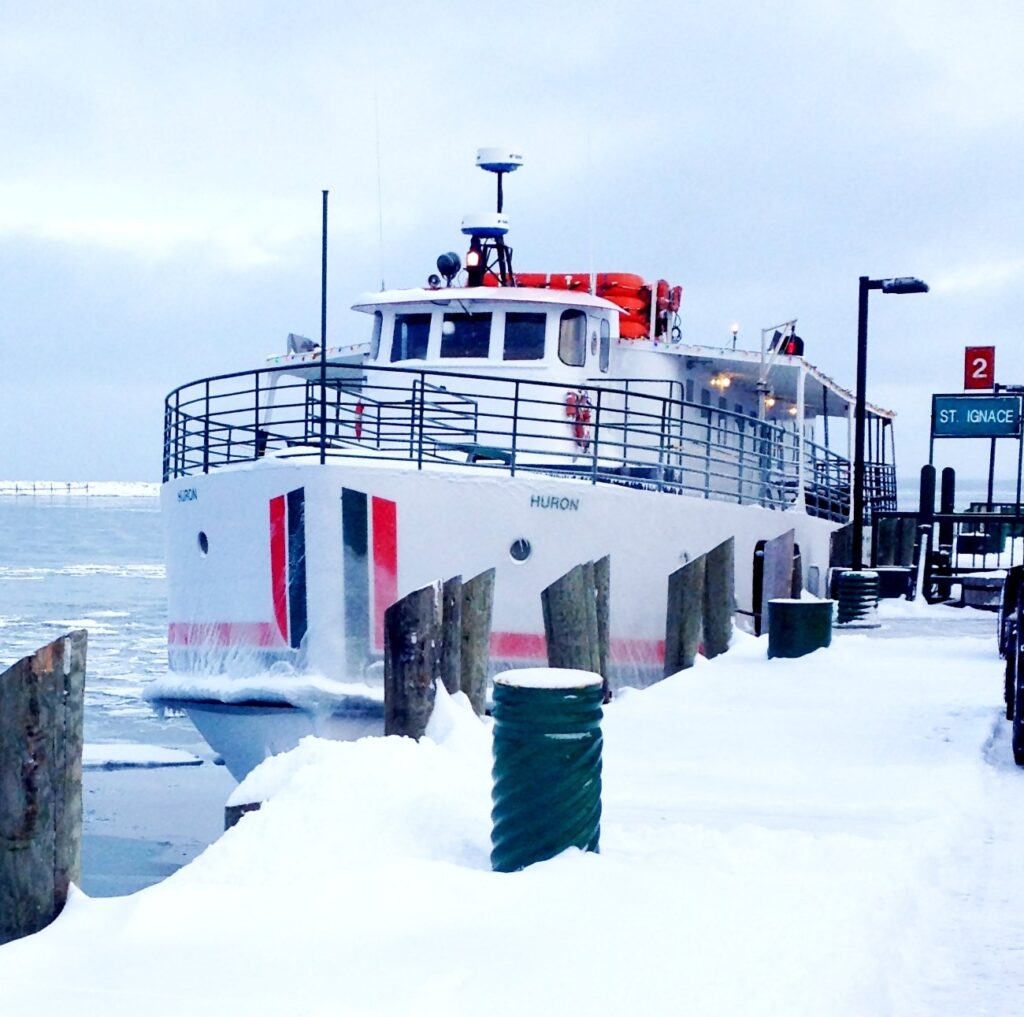
The island doesn’t close; about 500 people live there year-round. The visitor season does. In 2026 the Grand Hotel closes in the third week of October, Fort Mackinac on October 24, Colonial Michilimackinac on the mainland on October 11, and both ferry lines’ summer service on October 31. From November 1 to April 20, Arnold Transit runs a winter service from the Classic Dock in St. Ignace, weather and ice permitting. When the Straits freeze, flying is the only way across. In some winters an ice bridge forms to St. Ignace and islanders cross it by snowmobile; that isn’t a visitor route.
The mainland Straits: Mackinaw City, St. Ignace and the bridge
The island gets the attention, but the Straits of Mackinac is a two-shore destination, and the mainland is worth a half day even if you’re only passing through.
Mackinaw City
Colonial Michilimackinac is the reason to stay an extra morning. It’s a reconstructed 18th-century fort and fur-trading village, first French and later British, rebuilt on its original site from historic maps and more than 60 years of archaeological digs. It sits on the Lake Michigan shore right under the bridge at 102 W. Straits Ave., with free parking beside it. Adult admission was $17.50 in 2026 and children aged 5 to 12 paid $10.50; its 2026 season ends October 11. Next door, Old Mackinac Point Lighthouse has the same October 11 closing date in 2026, and Mackinac State Historic Parks sells combination tickets that cover several of its sites, which is cheaper if you plan to see both forts.
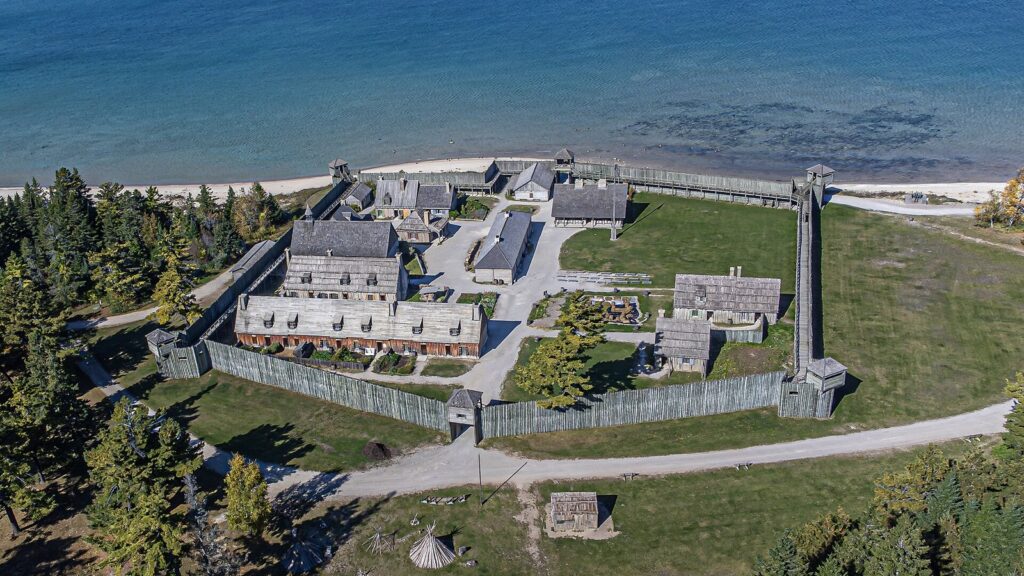
After dark, Headlands International Dark Sky Park, on the Lake Michigan shore west of town, keeps its grounds open 24 hours a day, every day of the year. On a clear night it’s the best free thing in the Straits.
St. Ignace
St. Ignace is the Upper Peninsula’s front door. Castle Rock, a limestone stack north of town that you can climb for a view back over the Straits, opens from mid-May to mid-October. The Museum of Ojibwa Culture on State Street, open seasonally with admission by donation, tells the story of the Anishinaabe people who named the island in the first place. Beyond St. Ignace, the Upper Peninsula opens up: Tahquamenon Falls, Pictured Rocks and the Lake Superior shore are all within a few hours’ drive.
The Mackinac Bridge and the Labor Day Bridge Walk
The “Mighty Mac” is five miles long (26,372 feet), with a 3,800-foot main span, and it opened to traffic in November 1957. Drivers paid a $4.00 toll per passenger vehicle in 2026, collected in both directions, and the toll booths take cards as well as cash.
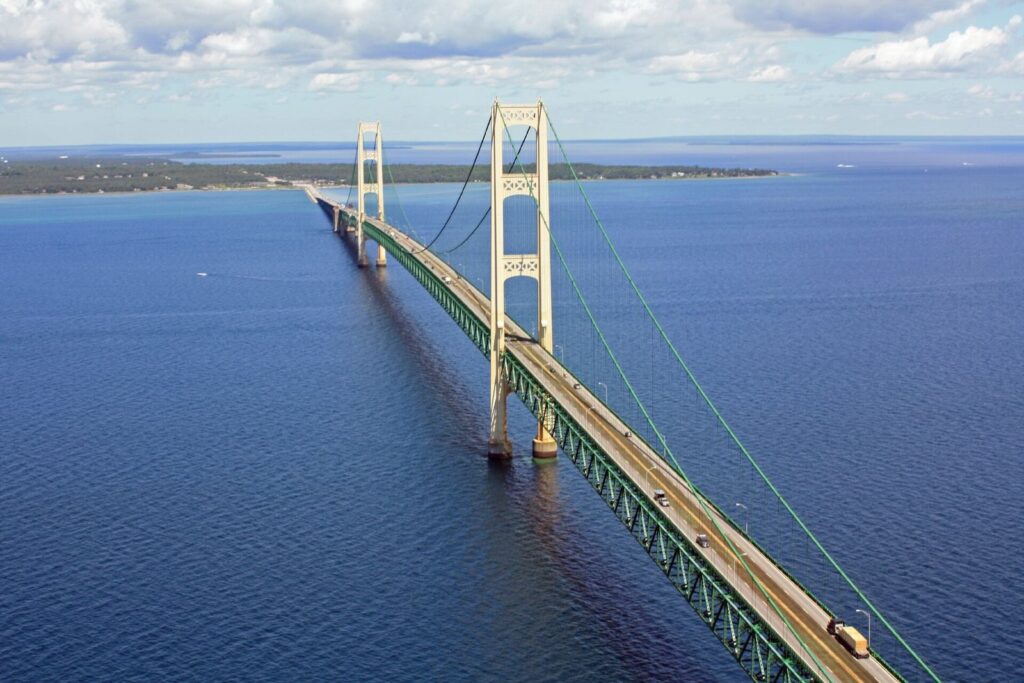
Once a year, on Labor Day morning, the bridge is handed over to walkers. The 2026 walk on September 7 drew about 34,000 people for its 68th year. Walkers started from both St. Ignace and Mackinaw City, and the bridge closed to traffic from 6:30 a.m. to noon. Labor Day 2027 falls on September 6. If you want to walk, book a room early, because Labor Day weekend fills both towns; if you only need to drive across, avoid that Monday morning.
Mackinac or Mackinaw? Spelling and pronunciation
Both are pronounced the same way: MACK-in-aw. The island, the bridge, the fort, the Straits and the county all use the French spelling, “Mackinac,” and the town at the south end of the bridge uses the English phonetic spelling, “Mackinaw City.” Say “Mack-in-ack” and everyone will know you’re from out of town.
The name comes from the Anishinaabe name for the island, often written “Mitchimakinak” and usually translated as “great turtle,” after its humped shape. French traders wrote what they heard as Michilimackinac, with the final “ac” pronounced “aw” in French, and the name was shortened to Mackinac over time. English speakers who spelled it the way it sounded gave Mackinaw City its “w.” The old long form survives on the mainland, in Colonial Michilimackinac. You’ll see “Mackinaw Island” written often, but it’s a misspelling: the island is always “ac.”
Is it worth it? The verdict, and what to skip
Verdict: yes, for most first-time visitors to northern Michigan. The island is expensive and crowded at midday in summer, and it’s still one of the most distinctive places in the Midwest. Plan to stay at least one night if you’re driving more than three or four hours each way.
Do it as a day trip if you’re staying within a couple of hours of the Straits, you’re happy with the fort, one bike loop and Main Street, and you can catch a morning boat.
Stay overnight if you want to see the island quiet, you’re driving up from Detroit, Chicago or Ohio, or you want a Grand Hotel evening.
Think twice if you’re after a beach vacation. The shoreline is mostly rock and the lake is cold; this is a place for bikes, history and porches, not swimming.
What to skip, and what to do instead:
- Enhanced or priority boarding on a quiet day. It buys a place in line, not a reserved seat or sailing time. Pay for it on a peak July or August morning if you like, and skip it otherwise.
- Main Street between 11 a.m. and 4 p.m. in July. Spend those hours in the interior, at the fort or on M-185, and come back to town for dinner.
- The Grand Hotel ticket if all you want is a photo. The porch is easy to photograph from the road below. Pay the $14 when you’ll actually sit on it.
- Bringing an e-bike without a permit. The 2026 rule is strict. Rent a regular bike on arrival.
- Driving north on a summer Friday afternoon. Go Thursday night or early Saturday instead, or come midweek.
- A day trip on Lilac Festival weekend, race weekend or Labor Day if you dislike crowds. These are the island’s busiest dates; pick a weekday in late June or September.
Frequently asked questions
How do you get to Mackinac Island?
Drive to Mackinaw City, at the tip of the Lower Peninsula, or to St. Ignace, just across the Mackinac Bridge, and take a ferry. Shepler’s and Arnold Transit both sail from both towns, and the crossing takes 16 to 40 minutes depending on the boat. An adult round trip on the fast ferries cost $37 to $59 in 2026. You can also fly: an air taxi from St. Ignace takes about seven minutes.
How much does it cost to go to Mackinac Island?
For one adult on a day trip at 2026 prices, count on $37 to $61 for the ferry, $12 to $18 an hour for a bike, $17.50 for Fort Mackinac, $46 for a carriage tour and $14 to visit the Grand Hotel, plus $10 to $15 to park the car. A lean day costs about $80 before food, and doing everything costs about $175. A night on the island adds the room.
Are cars allowed on Mackinac Island?
No. The city banned motor vehicles in 1898 and the state park commission extended the ban to the whole island in 1901, so apart from emergency vehicles you won’t share the road with cars. You leave yours in a ferry lot on the mainland and get around by bike, horse-drawn carriage or on foot. E-bikes are banned too, except for riders with a mobility disability who hold a City permit.
Is one day enough for Mackinac Island?
One full day is enough for the highlights: Fort Mackinac, a ride around the 8.2-mile M-185 loop, Arch Rock, downtown and a look at the Grand Hotel. It isn’t enough to see the island quiet. Most day-trippers come and go between late morning and early evening, so a night on the island gets you the early mornings and evenings that make it feel different.
What is Mackinac Island known for?
Its car ban, first: horses, bikes and walkers share the streets, and about 600 horses work there each summer. It’s also known for fudge, the Grand Hotel and its 660-foot porch, Fort Mackinac (1780), Arch Rock and a state park covering more than 80 percent of the island. The June lilacs and the Labor Day Bridge Walk nearby draw their own crowds.
When does Mackinac Island close for the season?
The island never closes, since about 500 people live there year-round, but the visitor season does. In 2026 the Grand Hotel closes in the third week of October, Fort Mackinac on October 24 and the ferries’ summer service on October 31. From November 1, Arnold Transit runs a winter ferry from St. Ignace until ice stops it. Most hotels, shops and attractions reopen in May.
Is it better to stay on Mackinac Island or in Mackinaw City?
Stay on the island if you want its evenings and early mornings and can pay island prices; there are no chain hotels there. Stay in Mackinaw City if you’re on a budget, want more choice or are touring by car, since both ferry lines leave from town. Many visitors split the difference: one night on the island, and the rest of the trip on the mainland.
Can you bring an e-bike to Mackinac Island?
Only if you have a mobility disability and a permit from the City of Mackinac Island. Under rules tightened in 2026, e-bikes are allowed only for riders who complete the City’s licensing, and the same rule applies in Mackinac Island State Park. Shepler’s doesn’t sell e-bike passage online, and Arnold Transit requires the permit. Everyone else should rent a regular bike on arrival.
Sources and verification
Every price, date and rule on this page was checked on September 23, 2026 against the operators and agencies listed here. This guide is compiled from those sources; it doesn’t claim first-hand visits.
- Shepler’s Mackinac Island Ferry: 2026 ticket options, plus its FAQ (crossing times, pets, luggage, parking)
- Arnold Transit Company: 2026 summer ferry rates, plus its summer parking, winter FAQ and general FAQ pages
- Mackinac State Historic Parks: 2026 seasonal hours, plus the Fort Mackinac and Colonial Michilimackinac admission pages
- Grand Hotel: visitor FAQ (non-guest admission, season, dress code), plus its rate terms
- Mackinac Bridge Authority: fare schedule, plus its bridge facts and 2026 Bridge Walk report
- Mackinac Island Tourism Bureau: e-bike rules, plus its getting-here page, island statistics, cost guide, Lilac Festival and pronunciation pages
Also checked: Mackinac Island Carriage Tours (mict.com) for tour prices and stops; the posted rate tables of two Main Street bike liveries (Ryba’s and Mackinac Cycle); Pellston Regional Airport’s daily-flights page; Bayview Yacht Club’s future race dates (bycmack.com); the St. Ignace attraction listings for Castle Rock and the Museum of Ojibwa Culture; and Wikipedia’s Mackinac Island article for the 1898 and 1901 vehicle bans and census population. Drive times were calculated with routing software on September 21, 2026.
What we couldn’t verify: 2027 ferry fares (not posted when we checked); the Lilac Festival’s exact 2027 dates beyond the June 4 opening (the bureau’s own page also names June 5); a single-site ticket price for Old Mackinac Point Lighthouse; current horse-taxi fares (the $5 to $10 figure is from a 2023 bureau guide); whether bike liveries’ posted rate tables are this year’s; and hotel room rates, which change daily and are deliberately not quoted here.
Michigan Tourism Guide is an independent publication. It is not affiliated with Pure Michigan, the Mackinac Island Tourism Bureau, Mackinac State Historic Parks, the Mackinac Bridge Authority, either ferry line or any business named here.
Photo credits
- Harbor and Marquette Park (featured image): photo by P. Hughes, Wikimedia Commons (CC BY 4.0)
- Aerial view of the island: photo by August Schwerdfeger, Wikimedia Commons (CC BY 4.0)
- Shepler's dock, Mackinaw City: photo by Peter K Burian, Wikimedia Commons (CC BY-SA 4.0)
- Arch Rock: photo by Rupashibangla, Wikimedia Commons (CC0)
- Fort Mackinac: photo by Hdeon1, Wikimedia Commons (CC BY-SA 4.0)
- Grand Hotel: photo by Hdeon1, Wikimedia Commons (CC BY-SA 4.0)
- M-185 shoreline road: photo by Jdmdetroit1, Wikimedia Commons (CC BY-SA 3.0)
- Winter ferry, December 2013: photo by Arnoldline, Wikimedia Commons (CC BY-SA 4.0)
- Colonial Michilimackinac: photo by WMrapids, Wikimedia Commons (CC BY-SA 4.0)
- Mackinac Bridge: photo by Justin Billau, Wikimedia Commons (CC BY 2.0)