Michigan’s state park system runs from a 985-acre island in the Detroit River, where a trip down the giant slide costs $1, to about 60,000 acres of old-growth forest and Lake Superior shoreline in the Porcupine Mountains, a nine-and-a-half-hour drive from Detroit. In between are dune parks an hour and a half from Chicago, a 19th-century iron-smelting town on a limestone harbor, a 49-acre stand of old-growth pine and the only state park on Lake Erie. Michigan state parks are cheap to enter and easy to reach from most of the Midwest, and in July the good ones are busy, so the park you pick matters more than you might expect.
The short answer: Michigan has 103 state parks and recreation areas, plus more than 140 state forest campgrounds. Every vehicle needs a Recreation Passport: Michigan residents add it to their plate renewal for $15, and out-of-state drivers pay $12 a day or $42 for the year (2026 prices). Walk or bike in and there’s no charge. For a first visit, choose by region: Warren Dunes or Ludington on Lake Michigan, Hartwick Pines inland, Wilderness at the Straits, Tahquamenon Falls or the Porcupine Mountains in the U.P., and Belle Isle if you have an afternoon in Detroit.
Prices, rules and park details were checked September 23, 2026 against the operators’ and agencies’ own websites.
On this page: How many parks · The Recreation Passport · National parks · Park selector · The 12 best · Lake Michigan · Upper Peninsula · Lake Huron and the Thumb · Near Detroit · Near Chicago · Dogs · Dark skies · Camping · When to go · Accessibility · Rules · Planning · What to skip · FAQ
| Michigan state parks at a glance | 2026 details |
|---|---|
| How many | 103 state parks and recreation areas, plus 140-plus state forest campgrounds and nearly 1,000 boating access sites, all run by the Michigan DNR |
| Entry | A Recreation Passport on every vehicle: residents $15 a year at plate renewal; non-residents $12 a day or $42 a year (the annual pass expires December 31) |
| On foot or by bike | No Passport needed |
| Camping | $26 to $45 a night for modern and semi-modern sites; book up to six months ahead at MiDNRReservations.com ($8 online reservation fee) |
| Largest | Porcupine Mountains Wilderness State Park, about 60,000 acres; Tahquamenon Falls, nearly 50,000 acres, is second |
| Most visited | Belle Isle Park in Detroit, around 5.5 million visitors a year |
| Oldest | Mackinac Island State Park, a state park since 1895 |
| Dogs | Welcome on a 6-foot leash, but not on designated swim beaches |
| National parks | One national park, Isle Royale, and five other National Park Service sites, with their own fees |
| Busiest time | June through August, weekends above all |
How many state parks are in Michigan?
The DNR counts 103 state parks and recreation areas. The same Recreation Passport also opens more than 140 rustic state forest campgrounds and nearly 1,000 boating access sites, so in practice one pass gets you into most of the public land you’re likely to drive to. UP Travel counts 24 state parks, recreation areas and scenic sites in the Upper Peninsula. The rest are in the Lower Peninsula, with the thickest cluster along the Lake Michigan shore and a second one around metro Detroit.
The names tell you what to expect. A state park is usually built around one feature: a beach, a dune, a waterfall, a lighthouse. Recreation areas, such as Holly, Pinckney and Waterloo in southeast Michigan, tend to be bigger inland tracts of lakes and trails, where people come to hike, ride, fish and hunt more than to see a single sight. A historic state park, such as Fayette or Fort Wilkins, preserves a townsite or a fort alongside the campground and the beach. The oldest of them all is Mackinac Island State Park, which covers more than 80 percent of the island and became a state park in 1895, after 20 years as Mackinac National Park.
Size varies enormously. The Porcupine Mountains cover about 60,000 acres and Tahquamenon Falls nearly 50,000. At the other end, Maybury, 25 miles from downtown Detroit, is about 1,000 acres of meadows and bridle trails, and Belle Isle is an island of 985 acres surrounded by a city. Big isn’t better for a first visit. The parks people come back to are usually the ones with one clear thing to do: a dune to climb, a lighthouse to walk to, a waterfall to stand beside.
Do you need a pass for Michigan state parks?
Yes, if you drive in. The Recreation Passport is Michigan’s entry pass for state parks and recreation areas, state forest campgrounds and state boating access sites. It’s priced per vehicle, not per person, so a minivan full of cousins pays the same as a solo driver, and there’s no separate admission charge on top of it: the Kitch-iti-kipi raft, the Tahquamenon boardwalks and the Lake of the Clouds overlook are all included.
| Recreation Passport | 2026 price | How it works |
|---|---|---|
| Michigan resident, annual | $15 per vehicle | Check the box when you renew your license plate; bought later, it carries a $5 convenience fee |
| Michigan resident, two-year | $29 | With a two-year plate renewal |
| Michigan resident, motorcycle | $7 | With the motorcycle’s plate renewal |
| Non-resident, annual | $42 per vehicle | Good at every park until December 31, whenever you buy it |
| Non-resident, daily | $12 per vehicle | One vehicle, one day |
For a visitor from out of state, the arithmetic is simple. Three days of daily passes cost $36 and the annual pass costs $42, so from the fourth day, or on a second trip in the same year, the annual pass wins. Because it expires at the end of the calendar year no matter when you buy it, it’s a far better deal bought in May than in September. The price is indexed to Detroit-area inflation, so expect small increases most years; the resident fee rose $1 for 2026.
Walking or biking in
The DNR’s Recreation Passport FAQ says the pass is required only for motor vehicles, motorcycles and commercial vehicles. Walk or pedal into a park and there’s no entry charge, which matters at a city park like Belle Isle and at parks on long trails, such as the 54-mile Bridge to Bay Trail through Algonac and the River Raisin Heritage connector at Sterling. Camping, cabins, pavilions and rentals still have their own fees.
What the Passport doesn’t cover
- National Park Service sites. Sleeping Bear Dunes and Pictured Rocks charge $25 per vehicle for seven days, and Isle Royale charges $7 per person per day. The Passport isn’t accepted there, and the $80 America the Beautiful federal pass doesn’t work at state parks either.
- Camping. A campsite reservation doesn’t include vehicle entry, so campers need both.
- Dune driving. At the Silver Lake ORV area, every dune vehicle also needs an ORV license and trail permit, plus an orange flag at least 10 feet off the ground.
- Everything that isn’t state land. County parks, the Huron-Clinton Metroparks around Detroit and city beaches set their own fees.
Does Michigan have any national parks?
One. Isle Royale National Park, a roadless island in Lake Superior established in 1940, is Michigan’s only national park. You reach it by ferry, seaplane or your own boat; it closes from November 1 to April 15; and visitors stay about three and a half days on average, far longer than at a typical national park, because once you’re there, there’s no quick way back. Our Isle Royale guide covers the ferries, the fees and the backcountry.
The National Park Service runs five other sites in Michigan, and each one does something the state parks don’t.
| NPS site | Where | What it is | 2026 entry |
|---|---|---|---|
| Isle Royale National Park | Lake Superior, by boat or seaplane from Houghton, Copper Harbor or Grand Portage, Minn. | Wilderness island with 165 miles of trails and 36 campgrounds | $7 per person per day; $60 season pass |
| Sleeping Bear Dunes National Lakeshore | Empire and Glen Arbor, west of Traverse City | Dunes, 450-foot bluffs above Lake Michigan, beaches | $25 per vehicle for 7 days; $45 annual |
| Pictured Rocks National Lakeshore | Munising to Grand Marais | Sandstone cliffs and waterfalls; the first national lakeshore in the country | $25 per vehicle for 7 days; $45 annual |
| Keweenaw National Historical Park | Calumet and the Keweenaw Peninsula | The story of the copper mining industry | No entrance fee |
| River Raisin National Battlefield Park | Monroe | The only national battlefield marking a War of 1812 site | No entrance fee |
| North Country National Scenic Trail | Across both peninsulas | A 4,800-mile trail through eight states, a National Park Service unit since 2023 | No trail fee |
Two affiliated areas round out the list: the MotorCities National Heritage Area, which ties together more than 100 automotive and labor history sites, and Father Marquette National Memorial in St. Ignace, a 52-acre memorial that the DNR operates from Memorial Day to Labor Day.
National lakeshore or state park?
For most trips the real choice is between a national lakeshore and the state parks around it. Sleeping Bear Dunes National Lakeshore has the bigger dunes, the Dune Climb and the Pierce Stocking Scenic Drive, but it costs $25 per vehicle and gets heavy summer crowds; Ludington State Park, farther south on the same shore, has a lighthouse walk, a river and two lakes on the Passport you may already have. Pictured Rocks’ cliffs are best seen from a boat, and its three drive-in campgrounds are small and rustic; for modern camping in the eastern U.P., Tahquamenon Falls is the state park to book. If you’ll visit both kinds of park, budget for both passes: the Recreation Passport doesn’t work at the lakeshores, and the federal pass doesn’t work at state parks.
Michigan state parks compared: a statewide selector
These 21 parks are the ones most worth planning a trip around, listed roughly south to north. Drive times are free-flow estimates from downtown Detroit and downtown Chicago. Summer Friday traffic heading north on I-75, US-131 and US-31 can add an hour or more, and Chicago drivers lose an hour crossing into Eastern time (four western U.P. counties, Gogebic, Iron, Dickinson and Menominee, stay on Central time).
| Park | Region | Water | Known for | Camping | Dogs | From Detroit / Chicago |
|---|---|---|---|---|---|---|
| Belle Isle Park | Detroit | Detroit River | Aquarium, conservatory, giant slide | No | Leashed; not on the swim beach | 15 min / 4 h 35 |
| Sterling | Monroe | Lake Erie | The only Lake Erie state park; marsh trails | Yes, plus cottages | Leashed; not on the swim beach | 45 min / 4 h 30 |
| Maybury | Northville | Fishing pond | Bridle trails, a working farm next door | Youth groups only | Leashed | 45 min / 4 h 10 |
| Algonac | St. Clair River | St. Clair River | Freighter watching, lake plain prairie | Yes | The whole riverfront | 1 h / 5 h 20 |
| Port Crescent | The Thumb | Saginaw Bay | Dark sky preserve | Yes | Leashed; not on the swim beach | 2 h 25 / 6 h 05 |
| Tawas Point | Sunrise Coast | Lake Huron | A lighthouse on a sandy point | Yes | Leashed; not on the swim beach | 3 h / 6 h 10 |
| Warren Dunes | Southwest Michigan | Lake Michigan | Dunes 260 feet above the lake | Yes, two campgrounds | 2.5 miles of beach north of the swim buoys | 3 h / 1 h 30 |
| Holland | West Michigan | Lake Michigan, Lake Macatawa | Beach facing the red Holland Harbor Light | Yes | Leashed; not on the swim beach | 3 h / 2 h 40 |
| Hoffmaster | Muskegon | Lake Michigan | Dune stairway, dune visitor center | Yes | The whole shoreline except the swim area | 3 h 05 / 3 h 15 |
| Silver Lake | Mears | Lake Michigan, Silver Lake | Open dunes you can drive | Yes | Leashed; not on the swim beach | 3 h 30 / 3 h 40 |
| Ludington | Ludington | Lake Michigan, Hamlin Lake | Big Sable Point Lighthouse | Yes, three campgrounds | Leashed; not on the swim beach | 4 h / 4 h 15 |
| Hartwick Pines | Grayling | Au Sable River, small lakes | Old-growth pines, logging museum | Yes, plus a rustic cabin | Leashed (no beach) | 3 h / 5 h 15 |
| Petoskey | Little Traverse Bay | Lake Michigan | Petoskey stones | Yes, two campgrounds | Leashed; not on the swim beach | 4 h / 5 h 45 |
| Wilderness | West of Mackinaw City | Lake Michigan | 26 miles of shore, dark sky preserve | Yes, plus rustic cabins | Two pet beaches; other shoreline closed April to August | 4 h 50 / 7 h |
| Straits | St. Ignace | Straits of Mackinac | Mackinac Bridge views | Yes | Leashed | 4 h 20 / 6 h 30 |
| Mackinac Island | Mackinac Island | Lake Huron | Fort Mackinac, Arch Rock, no cars | No | Leashed | 4 h 15 / 6 h 25 to the ferry docks |
| Tahquamenon Falls | Eastern U.P. | Tahquamenon River | Upper and Lower Falls | Yes, plus a lodge | Leashed, on all trails | 5 h 30 / 7 h 40 |
| Palms Book | Central U.P. | Kitch-iti-kipi spring | A raft over the big spring | No | Leashed | 6 h 15 / 6 h 20 |
| Fayette | Garden Peninsula | Big Bay de Noc | Ghost town, limestone cliffs | Yes | The whole shoreline except the swim area | 6 h 35 / 6 h 25 |
| Porcupine Mountains | Western U.P. | Lake Superior | Lake of the Clouds, old-growth forest | Yes, plus cabins and yurts | Leashed | 9 h 30 / 7 h |
| Fort Wilkins | Copper Harbor | Lake Superior, Lake Fanny Hooe | An 1840s fort, two lighthouses | Yes | Leashed | 9 h 50 / 8 h 10 |
The 12 best Michigan state parks
This ranking is for the trip as a whole: scenery, variety, and how much there is to do once you arrive, not size or attendance. The Upper Peninsula’s two giants lead, and six of the rest are the destination parks most visitors build a trip around.
1. Porcupine Mountains Wilderness State Park
Michigan’s largest state park covers about 60,000 acres of old-growth forest, rivers and Lake Superior shoreline at the far western end of the U.P., with 90 miles of hiking trails, including sections of the North Country Trail. Most people come for the Lake of the Clouds overlook, a short walk from the parking lot, and the ones who stay find the backcountry: rustic cabins and yurts, 65 backcountry campsites and a chain of waterfalls on the Presque Isle River. There’s also a Summit Peak observation tower, a free 18-hole disc golf course and fall chairlift rides at the East Vista ski hill. It’s remote, about nine and a half hours from Detroit and seven from Chicago, and it deserves at least two nights.
2. Tahquamenon Falls State Park
The Upper Falls, more than 200 feet wide and one of the largest waterfalls in the eastern United States, pour amber, tannin-stained water through nearly 50,000 acres of forest west of Paradise. A new accessible boardwalk now reaches the brink. Four miles downstream, the Lower Falls split around an island you can reach by footbridge or by rented rowboat, and the Lower Falls campground has 188 sites. Dogs on a 6-foot leash are allowed on every trail, including the viewing platforms. It’s about five and a half hours from Detroit, and it pairs well with Whitefish Point or Pictured Rocks.
3. Ludington State Park
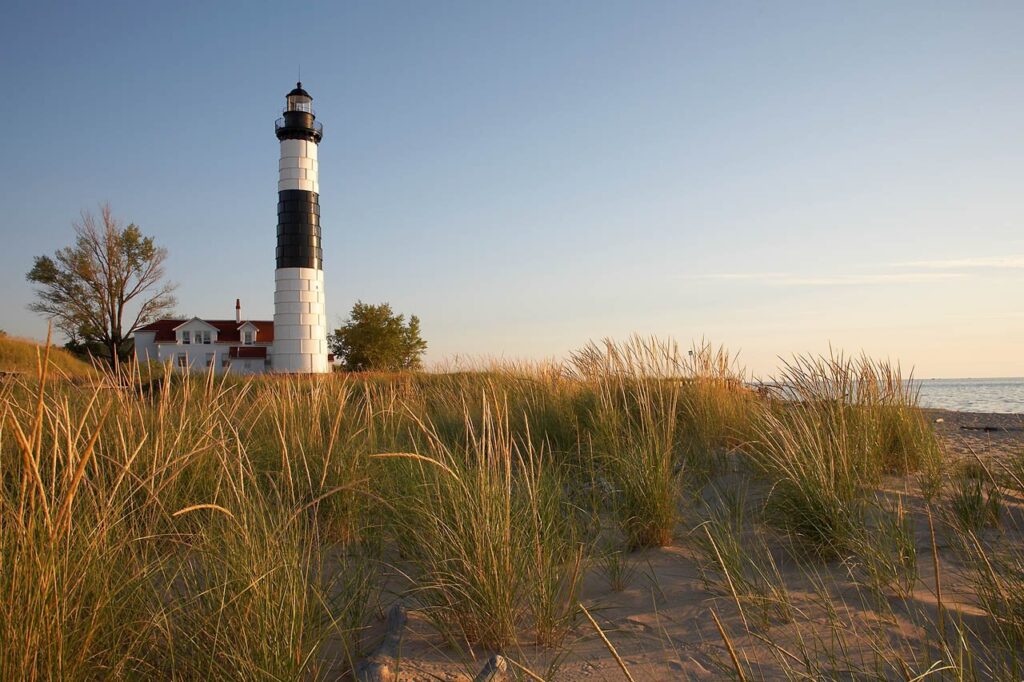
If you can visit only one state park on Lake Michigan, make it this one. Ludington State Park sits between 7 miles of Lake Michigan beach and 5,000-acre Hamlin Lake, with a mile of the Big Sable River connecting them. The signature outing is the Lighthouse Path, 1.8 miles each way on sand and gravel with little shade, to Big Sable Point Lighthouse, where volunteer keepers run tours. Add 21 miles of marked trails through dunes and forest, a 4-mile paddling trail through Hamlin Lake’s marshes, sheltered coves on Lost Lake for beginners, tubing and fishing on the river, and beach houses on both lakes, and a week here doesn’t feel long. The Skyline Trail is getting a $3.5 million renovation due to finish in 2027, so check its status before you plan around it.
- Best for: families who want a beach, a paddling lake and a lighthouse in one park.
- Camping: three campgrounds; book six months ahead for summer weekends.
- Getting there: about 4 hours from Detroit or Chicago, at the end of M-116 north of the town of Ludington. The DNR advises large vehicles to avoid Piney Ridge Road.
4. Warren Dunes State Park
The dunes at Warren Dunes rise 260 feet above Lake Michigan, high enough that hang gliders launch from them with a permit, and this is the closest big dune park to Chicago, about an hour and a half away. There are 3 miles of beach, 6 miles of trails through forested dunes, open sand and wetlands between the ridges, two campgrounds, and a beach lot lined with food trucks from May through Labor Day. Climbing the big open dune from the beach is the thing everyone does, and it’s harder than it looks on a hot July afternoon: bring water, wear shoes on sand that has been baking since noon, and go early. The park is also a stopover on a bird migration route, so spring and fall mornings are good for birders.
- Best for: Chicago weekenders, dune climbing and a big beach day.
- Dogs: 2.5 miles of pet-friendly beach north of the northernmost swim buoy.
- Rentals: paddleboards, kayaks and paddleboats from mid-May through Labor Day.
- Accessibility: three 100-foot accessible walkways toward the water, which stop just short of it, and two beach wheelchairs to borrow at the ranger station.
- Getting there: about 1½ hours from Chicago and 3 from Detroit, off I-94 near Sawyer.
5. Wilderness State Park
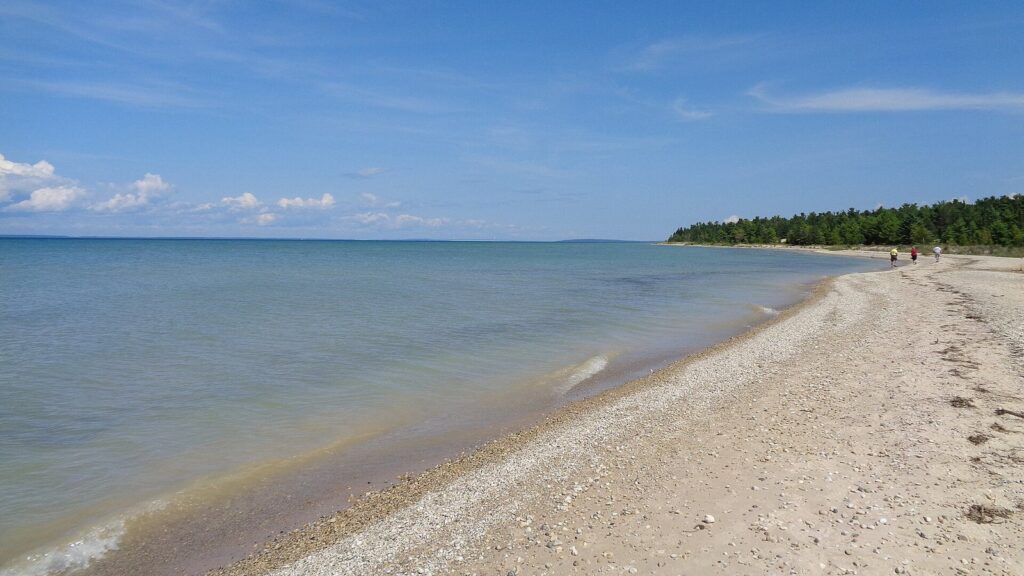
Eleven miles west of Mackinaw City, Wilderness has 26 miles of Lake Michigan shoreline, including Waugoshance Point and the small islands off its tip, and much of it lives up to the name: dense conifer forest, hardwoods, small ponds and wetlands, with wildflowers in spring. It’s a designated dark sky preserve, 9 miles from Headlands International Dark Sky Park, and from parts of the park you can see the 170-year-old Waugoshance Lighthouse to the west and the Mackinac Bridge to the east. Rustic cabins, some dating from the Civilian Conservation Corps era, are the classic way to stay, and there are lakeshore campgrounds for tents and RVs.
- Best for: quiet beaches, stargazing and a calmer base for the Straits than the motels of Mackinaw City.
- Dogs: two pet-friendly beaches all year; the rest of the shoreline is closed to pets from April through August to protect nesting piping plovers.
- Getting there: about 4 h 50 from Detroit and 7 hours from Chicago. Carry a map on the trails, as the DNR recommends.
6. Fayette Historic State Park
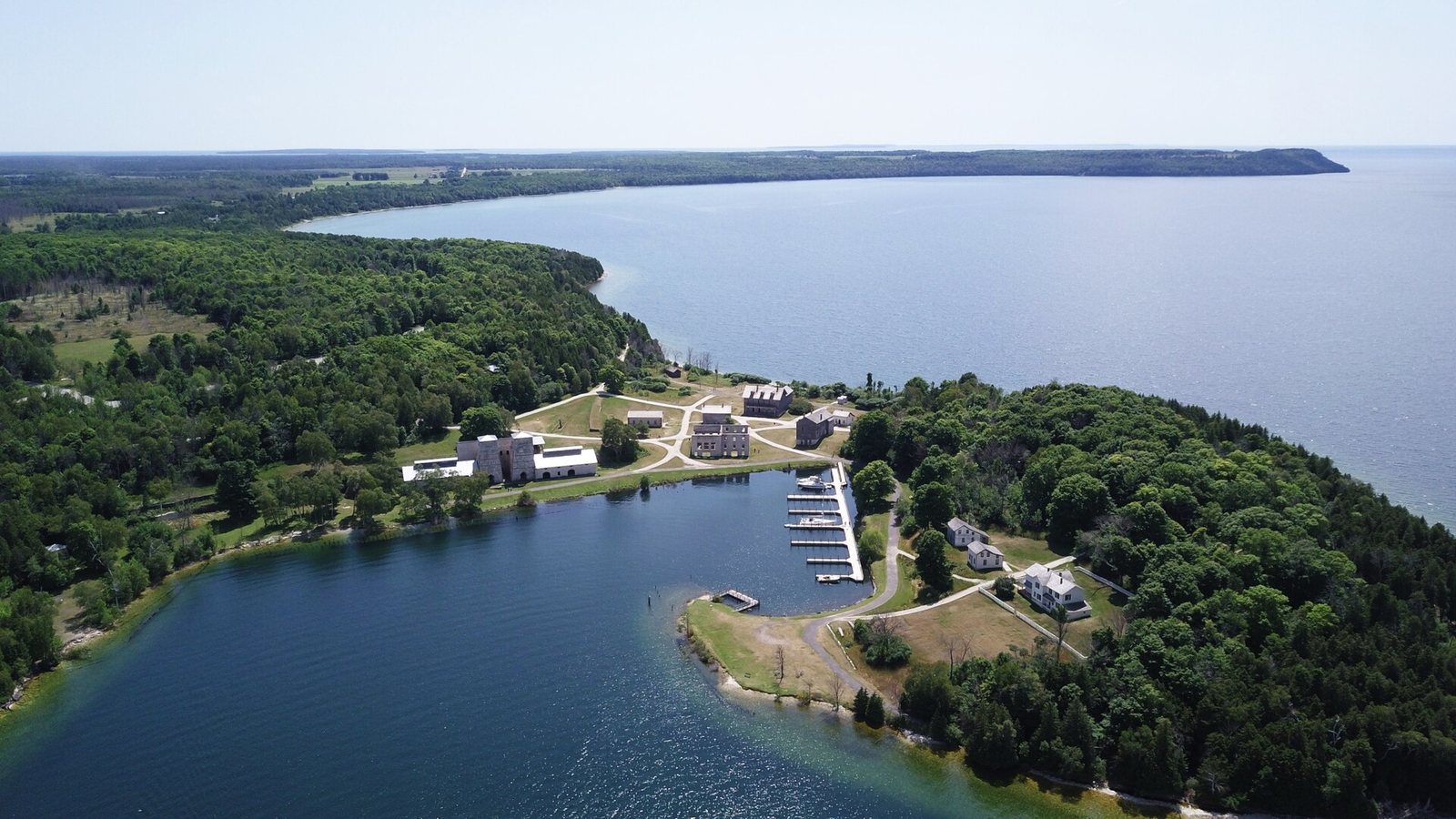
On the Garden Peninsula, where Snail Shell Harbor cuts into 90-foot limestone cliffs on Big Bay de Noc, the DNR looks after what’s left of a 19th-century company town that smelted iron from the 1860s until 1891. You can walk the townsite, study the visitor center’s scale model of the town as it looked in the 1880s, then hike 5 miles of trails along the cliffs or swim from the beach. The modern campground has three loops of moderate, shaded sites under maple and cedar, each loop with a path down to the bay, and there’s free Wi-Fi at the townsite, visitor center and campground. Big Bay de Noc is good fishing water for perch, smallmouth bass, northern pike, walleye and salmon, from shore, the harbor or a boat.
- Best for: history with a swim, and anyone who likes ghost towns.
- Dogs: allowed along the whole shoreline except the swim area.
- Getting there: about 6½ hours from either Detroit or Chicago, south of US-2 between Escanaba and Manistique.
7. Hartwick Pines State Park
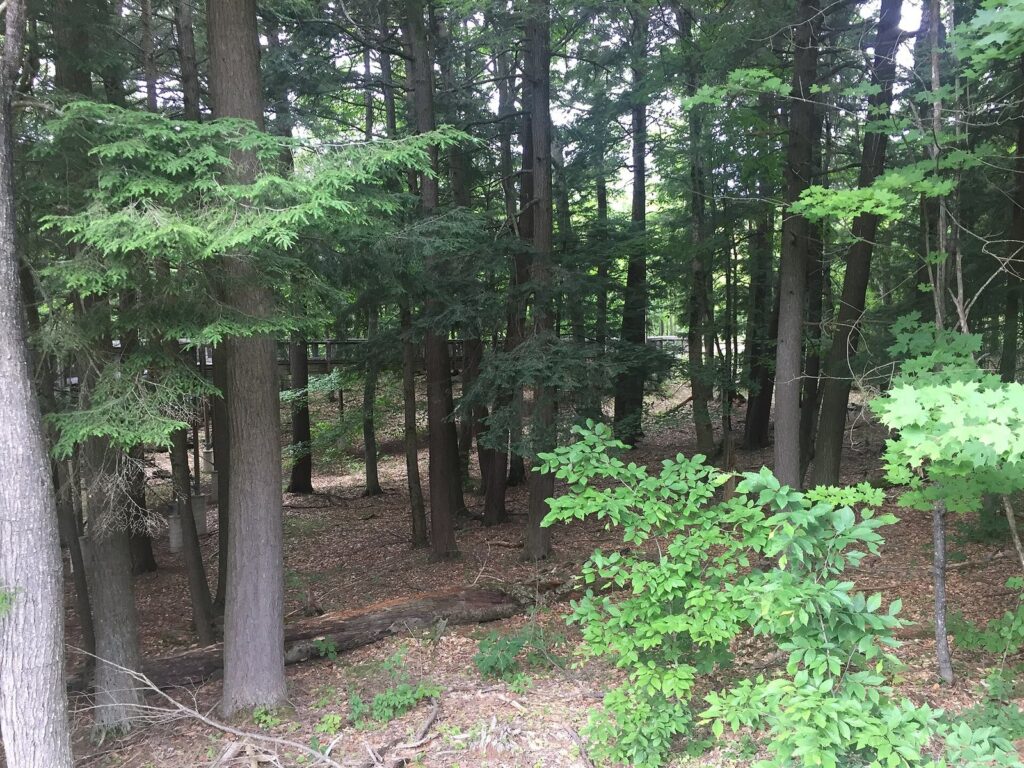
Hartwick Pines, near Grayling, is named for its 49 acres of old-growth pine, some of the last in Michigan, and it’s one of the largest state parks in the Lower Peninsula. The paved, accessible Old Growth Forest Trail loops 1.25 miles through the big trees, and the Hartwick Pines Logging Museum, about a quarter-mile walk from the visitor center, brings the 19th-century logging era to life; together they explain why so little old-growth pine is left anywhere else in the state. Beyond the old growth, 21 miles of trails cross rolling hills above the East Branch of the Au Sable River and pass a handful of spring-fed lakes, with mountain biking in summer and cross-country skiing and snowshoeing in winter.
- Best for: an easy stop off I-75, a rainy day with kids, and anyone who has never seen a forest the loggers missed.
- Camping: a modern campground and one rustic cabin.
- Getting there: about 3 hours from Detroit and 5 h 15 from Chicago.
8. P.J. Hoffmaster State Park
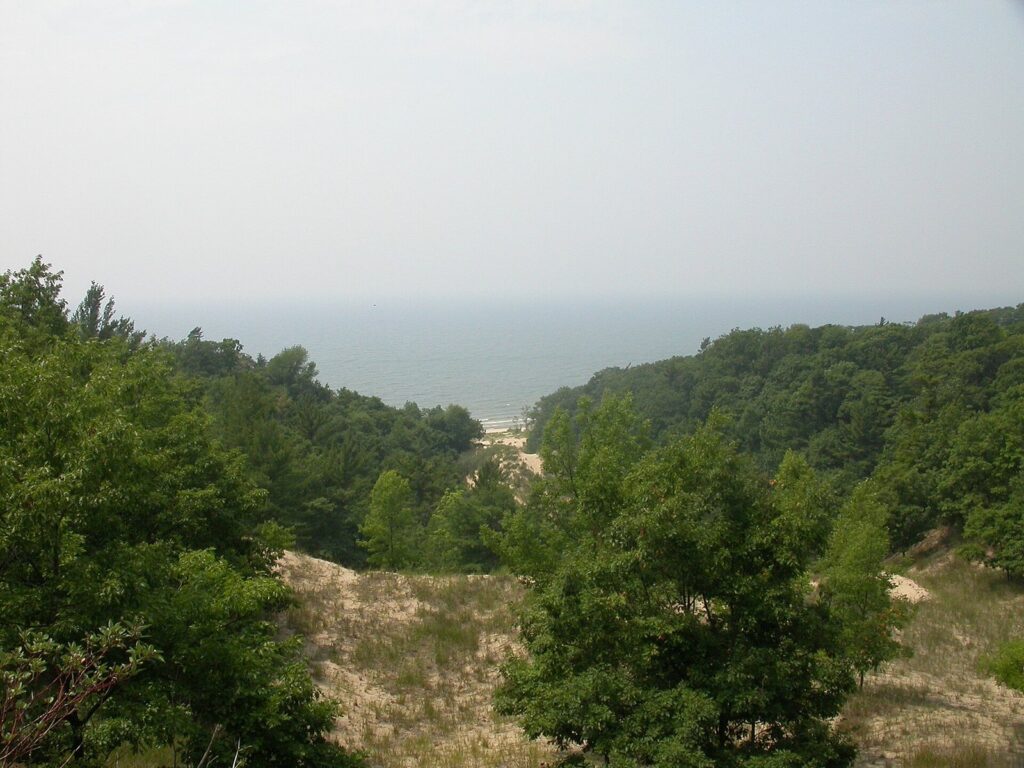
Just south of Muskegon, Hoffmaster packs 3 miles of Lake Michigan beach, towering wooded dunes and 10 miles of trails into a park you can see well in a day. The Dune Overlook Trail climbs about 220 steps over roughly half a mile round trip to a platform with a panorama of the lake and the dunes, with benches on the way up. The Gillette Sand Dune Visitor Center, perched on top of a dune, explains how the forested dunes formed. For a gentler walk, the 2-mile round-trip Homestead Trail stops at the lake. The modern campground is a five-minute walk from its own buoyed swim area.
- Best for: dunes for walkers rather than drivers, and a West Michigan beach day with fewer crowds than Holland or Grand Haven.
- Dogs: allowed along the entire Lake Michigan shoreline except the designated swim area, which is unusually generous for a beach park.
- Getting there: about 3 hours from Detroit and 3 h 15 from Chicago.
9. Fort Wilkins Historic State Park
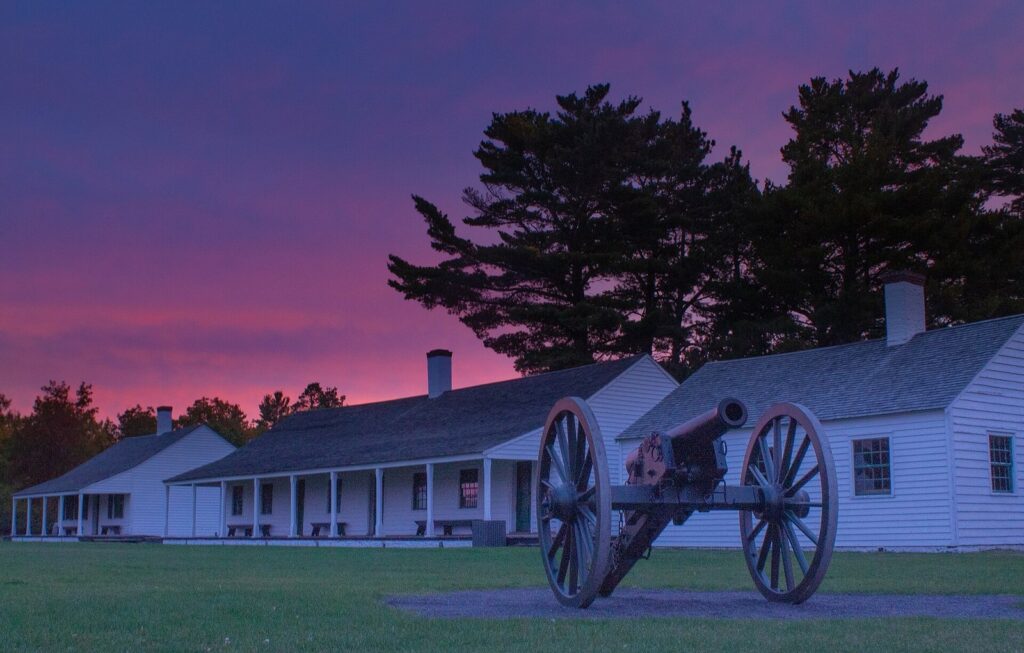
At the northern tip of the Keweenaw Peninsula, just outside Copper Harbor, Fort Wilkins preserves an 1840s army post with a living history program, plus two 1860s lighthouses on Lake Superior; the Copper Harbor Lighthouse is reached by boat tour from the Bella Vista Motel dock. The modern campground sits between the rocky Lake Superior shore and Lake Fanny Hooe, and there’s a quarter-mile of sandy beach on Lake Manganese. Brockway Mountain Drive, one of the best drives in the state, starts at the edge of town. It’s a long way from anywhere, about 9 h 50 from Detroit and 8 h 10 from Chicago, so combine it with the Isle Royale ferry from Copper Harbor or the Keweenaw’s waterfalls.
10. Belle Isle Park
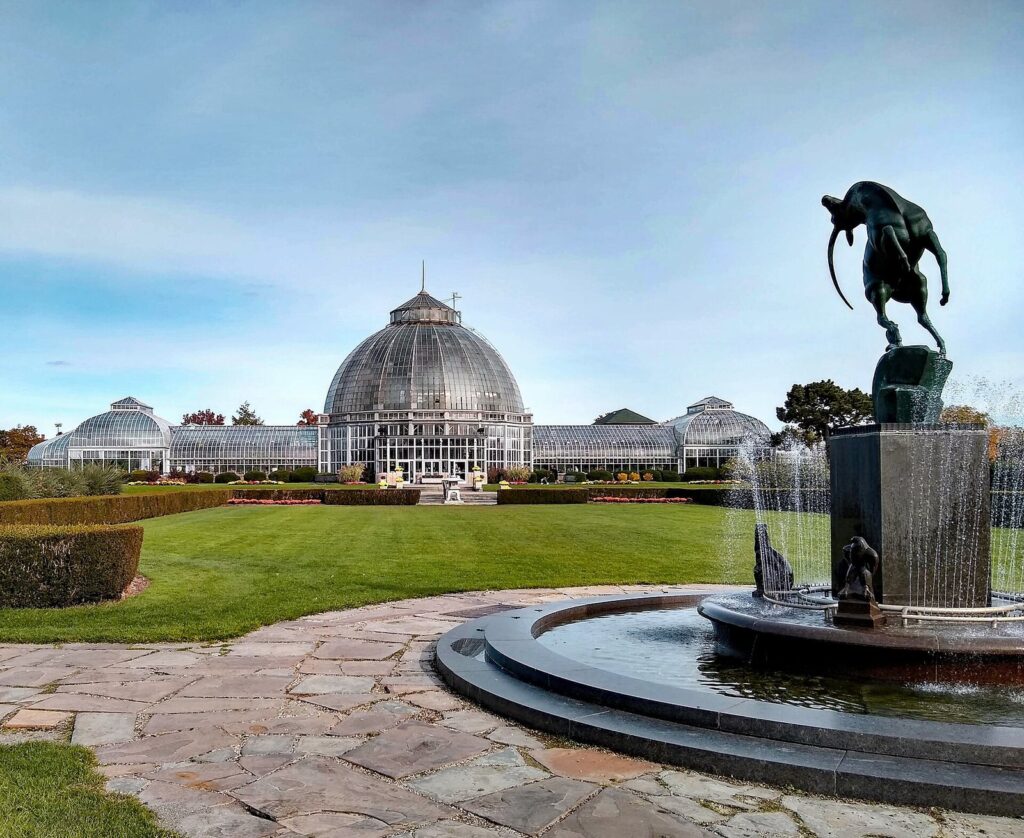
Detroit’s 985-acre island park is the most visited state park in Michigan, with around 5.5 million visitors a year by the DNR’s count, reported in July 2026. It earns them. The Belle Isle Aquarium is the oldest aquarium in North America and is free (open Thursday to Sunday, 10 a.m. to 4 p.m., with a $5 donation encouraged). There’s also the Anna Scripps Whitcomb Conservatory, the James Scott Memorial Fountain, a maritime museum on 300 years of Great Lakes shipping, a beach on the Detroit River, and the giant slide: six lanes, $1 a ride, for riders at least 48 inches tall. The Livingstone Memorial Lighthouse, built in 1929, is what the DNR calls the oldest marble lighthouse in the country. The island is 15 minutes from downtown, with views of the skyline to the north and Canada to the south.
11. Palms Book State Park
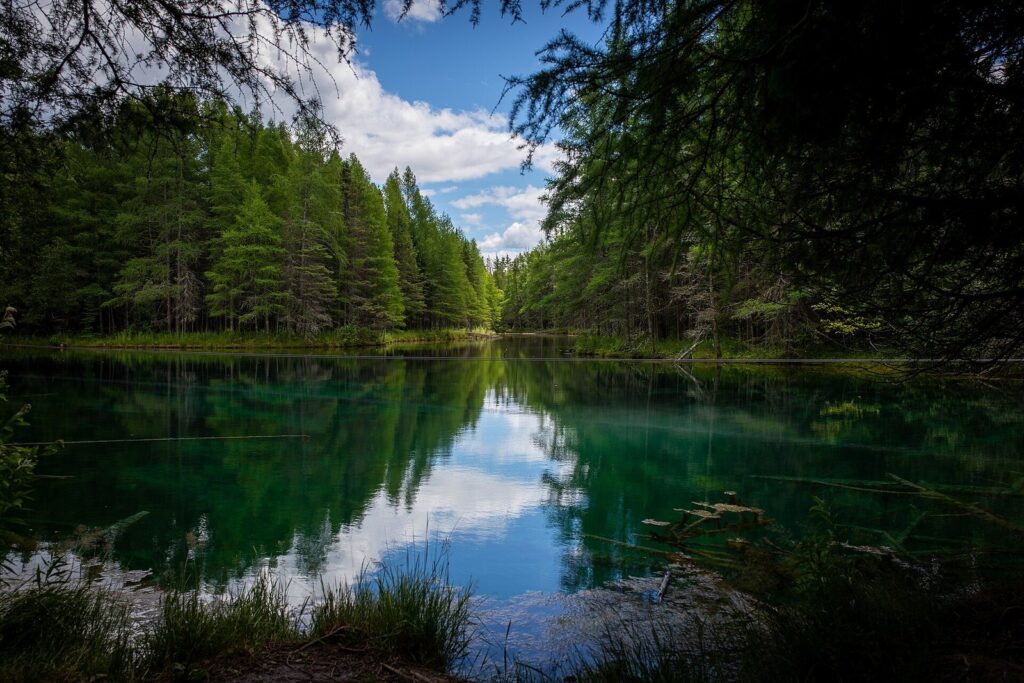
Palms Book exists for one thing, and it’s enough: Kitch-iti-kipi, Michigan’s largest freshwater spring, about 200 feet across and 40 feet deep, with more than 10,000 gallons a minute welling up through limestone at a constant 45°F. A self-propelled observation raft, which is accessible, crosses the clear water from 8 a.m. to dusk, so you can look straight down to where the springs push up through the limestone. There’s no ticket beyond the Recreation Passport. Allow an hour, and combine it with Fayette on the Garden Peninsula.
12. Sterling State Park
The only Michigan state park on Lake Erie, Sterling sits in Monroe, a few miles from the Ohio line and about 45 minutes from downtown Detroit. It has a mile of sandy beach, a modern campground and full-amenity cottages, and more than 500 acres of Great Lakes marsh and restored lake plain prairie with trails around the edge. Anglers come for walleye and perch, launching from a ramp with 300 trailer spaces, and a 1-mile connector trail links the park to downtown Monroe and River Raisin National Battlefield Park. Kayaks rent at the campground office from Memorial Day to Labor Day.
Best state parks on Lake Michigan
Lake Michigan’s eastern shore has the state’s best run of beach parks, and one Passport covers all of them. From south to north:
- Warren Dunes (Sawyer): the big dunes closest to Chicago, described above.
- Holland and Grand Haven: the classic West Michigan beach parks. Holland State Park faces the red Holland Harbor Light across the channel, and Grand Haven State Park sits beside the town’s pier and lighthouses. Both are small, sandy and packed on summer weekends, so arrive early or go on a weekday.
- Hoffmaster (Muskegon): the dune stairway and visitor center.
- Silver Lake (Mears): open dunes you can drive, with an ORV area open from April through October in 2026 (9 a.m. to 10 p.m. from May 1 to September 15).
- Ludington: the lighthouse, the river and Hamlin Lake.
- Petoskey: about a mile of sandy beach on Little Traverse Bay between Petoskey and Harbor Springs, two campgrounds, and a good beach for hunting Petoskey stones.
- Young (Boyne City): on Lake Charlevoix rather than Lake Michigan, with pet-friendly shoreline east of the boat launch.
- Wilderness: 26 miles of wild shoreline at the top of the Lower Peninsula.
Sleeping Bear Dunes, between Ludington and Petoskey, is a national lakeshore rather than a state park and needs its own pass. For the beaches themselves, including swim conditions, water temperatures and the best stretches of sand on all four Great Lakes, see our guide to Michigan beaches.
Best Upper Peninsula state parks
UP Travel counts 24 state parks, recreation areas and scenic sites in the Upper Peninsula, and they’re spread thin: the drive from Straits State Park at the Mackinac Bridge to Fort Wilkins at the tip of the Keweenaw, about 5 hours 40 minutes, takes longer than the drive from Detroit to the bridge. Pick one end of the peninsula per trip.
Eastern U.P.
- Tahquamenon Falls (Paradise): the Upper and Lower Falls, described above.
- Straits State Park (St. Ignace): a campground with Mackinac Bridge views and an ADA-accessible overlook of the bridge, just south of US-2.
- Mackinac Island State Park: the oldest state park, covering more than 80 percent of the island, with Fort Mackinac, Arch Rock and more than 70 miles of trails. There are no cars and no camping; you arrive by ferry.
Central U.P.
- Palms Book (near Manistique): Kitch-iti-kipi, the big spring.
- Fayette (Garden Peninsula): the ghost town on Snail Shell Harbor.
Pictured Rocks, between Munising and Grand Marais, is federal land; see the national parks section above.
Western U.P. and the Keweenaw
- Porcupine Mountains: the largest state park in Michigan, and the best.
- Lake Gogebic State Park: on Lake Gogebic, a big inland lake that straddles the line between the Central and Eastern time zones, so check which clock your campground runs on.
- Fort Wilkins (Copper Harbor): the fort, the lighthouses and the end of US-41.
Three practical points for the U.P. Fill up when you can, since gas stations thin out between towns. Cell service is patchy in the Porkies and on the back roads, so download maps before you leave. And in June, black flies and mosquitoes can make a lakeside campsite miserable; July, August and September are easier.
Lake Huron and the Thumb
The Lake Huron side of the Lower Peninsula is the quieter coast, with long sandy beaches, lighthouses and some of the darkest skies in the state.
- Port Crescent: on Saginaw Bay at the tip of the Thumb, about 2 hours 25 minutes from Detroit, and one of six DNR dark sky preserves.
- Tawas Point: a lighthouse on a sandy point in Lake Huron, about 3 hours from Detroit, with a campground.
- Negwegon, Rockport and Thompson’s Harbor: three more dark sky preserves on the northern Sunrise Coast, between Harrisville and Rogers City.
- Algonac: on the St. Clair River, where freighters pass close to the shore (see near Detroit, below).
State parks near Detroit
You don’t need to drive Up North for a state park. Five good ones are within about an hour of downtown Detroit:
| Park | From downtown Detroit | Why go |
|---|---|---|
| William G. Milliken State Park and Harbor | Downtown, on the Detroit RiverWalk | A riverfront park and harbor you can walk to from the city center |
| Belle Isle Park | 15 minutes | Aquarium, conservatory, fountain, beach, giant slide |
| Maybury State Park | 45 minutes | Hiking, mountain biking and horseback riding; a working farm next door |
| Sterling State Park | 45 minutes | A Lake Erie beach, marsh trails and walleye fishing |
| Algonac State Park | About 1 hour | Freighters on the St. Clair River and a rare prairie |
Maybury is the pick for kids who like animals. The Northville Community Foundation runs an 80-acre working farm half a mile west of the entrance, and the park has 8 miles of equestrian trails with a riding stable, an 8-acre spring-fed fishing pond with a pier, and an inclusive playground. Algonac’s 1,550 acres include a 1,200-acre natural area of lake plain prairie and oak savanna that shelters 22 threatened, endangered or special-concern species, and its half-mile of riverfront is one of the best places near Detroit to watch freighters; there’s a sensory play area by the Bishop Lake campground. For bigger inland trail systems and lake campgrounds, Holly, Pinckney and Waterloo recreation areas are an hour or so from the city.
State parks near Chicago
For Chicagoans, Michigan’s state parks start about 90 minutes away, and the whole Lake Michigan shore is within reach of a long weekend. Remember the time change: you lose an hour when you cross into Eastern time, so a 90-minute drive that leaves at noon arrives at 2:30.
| Park | From Chicago | Why go |
|---|---|---|
| Warren Dunes | 1 h 30 | 260-foot dunes and a big beach |
| Holland | 2 h 40 | Beach and channel, with downtown Holland nearby |
| Hoffmaster | 3 h 15 | Dune stairway and visitor center |
| Silver Lake | 3 h 40 | Dune driving and dune rides |
| Ludington | 4 h 15 | Lighthouse walk, river and Hamlin Lake |
| Fayette | 6 h 25 | Ghost town on a limestone harbor |
| Porcupine Mountains | 7 h | The biggest and wildest state park |
One surprise for Chicago drivers: the central and western U.P. are closer to you than to Detroit. The Porcupine Mountains are about 7 hours from Chicago through Wisconsin and 9½ from Detroit, and Fayette and Palms Book are a toss-up.
Can you bring dogs to Michigan state parks?
Yes. Pets are welcome in state parks, campgrounds, state forest campgrounds, harbors, trails and boating access sites, on a leash no longer than 6 feet and under your immediate control. They aren’t allowed on designated swim beaches, in endangered-species habitat or in other posted areas, and you’re expected to bag and bin the waste.
Some parks set aside shoreline for dogs:
- Warren Dunes: 2.5 miles of beach north of the northernmost swim buoy.
- Hoffmaster and Fayette: the whole shoreline apart from the swim area.
- Algonac: the entire St. Clair River frontage.
- Young State Park: the shoreline east of the boat launch on Lake Charlevoix.
- Wilderness: two pet-friendly beaches all year; the rest of the shoreline is open to leashed dogs only from September through March, because piping plovers nest there from April through August.
- Tahquamenon Falls: leashed dogs on every trail, including the falls platforms.
Plover closures are the rule to watch on the northern Lake Michigan shore; at Sleeping Bear Dunes, too, some beaches are closed to pets from April 15 to August 15. Many state park cabins and yurts accept pets, some for a nightly fee, so check the listing before you book.
Dark sky preserves and parks
Michigan has designated six dark sky preserves inside state parks, open to stargazers around the clock: Lake Hudson Recreation Area in the far south, Port Crescent in the Thumb, Negwegon, Rockport and Thompson’s Harbor on the Sunrise Coast, and Wilderness at the Straits. Wilderness sits 9 miles from Headlands International Dark Sky Park in Mackinaw City, whose grounds, trails and viewing areas are open 24 hours a day, every day of the year. In the Keweenaw, the Keweenaw Dark Sky Park at the Keweenaw Mountain Lodge near Copper Harbor is also open year-round, day and night, and pairs well with a stay at Fort Wilkins. Beaver Island holds an International Dark Sky Sanctuary designation, and Dr. T.K. Lawless County Park in Cass County is another International Dark Sky Park.
For the best sky, go in the days around a new moon, check the cloud forecast rather than the calendar, bring a red flashlight and give your eyes 20 minutes to adjust. In the U.P., watch the northern horizon on nights when the aurora forecast is active.
Camping in Michigan state parks
Most of the big parks have campgrounds, and they’re the cheapest way to sleep near the water. Modern and semi-modern sites cost $26 to $45 a night in 2026, depending on the park and the hookups, on top of the Recreation Passport. Campsites, cabins, yurts and lodges can be booked up to six months ahead at MiDNRReservations.com or by phone, with new dates opening at 8 a.m. on weekdays and 9 a.m. on weekends, and there’s a non-refundable $8 fee online. The best sites at popular beach parks can be gone within minutes of the window opening for July weekends. Quiet hours run from 10 p.m. to 8 a.m., and the peak-season stay limit is 15 nights.
Our Michigan camping guide covers booking strategy, cabins and yurts, state forest and national forest campgrounds, and free dispersed camping.
When to visit Michigan state parks
Summer (June to August) is peak season, when beach parks fill, campgrounds are booked months ahead and lots at the busiest beaches can close by late morning on weekends. The DNR flies beach flags at all 30 state parks and recreation areas with Great Lakes beaches: green for low hazard; yellow for moderate surf and currents; single red for high waves and strong currents, when swimming is allowed but not advised; and double red, when the water is closed and going in is against the law. If a rip current catches you, flip onto your back, float, and follow the shore out of the pull before swimming in. Lake Superior stays cold enough to cause cold shock even in August.
September is the best month for many parks: the crowds leave after Labor Day, the lakes have had all summer to warm, and campgrounds have open sites midweek.
Fall color comes first to the U.P., where it usually starts in mid to late September and peaks during the first three weeks of October, beginning in the west and the interior and moving east and toward the shorelines, according to UP Travel’s weekly reports. The Lake of the Clouds overlook in the Porkies and the Tahquamenon Falls boardwalks are classic color stops; the northern Lower Peninsula follows into October.
Winter is quiet and cheap. Tahquamenon Falls grooms about 4 miles of cross-country ski trails at the Upper Falls and marks 9 miles of snowshoe trails, and its Hemlock campground loop, shower building and lodge stay open all year. Hartwick Pines is a winter destination for cross-country skiing and snowshoeing, and the DNR lists cross-country ski trails at parks including Warren Dunes, Ludington, Hoffmaster and Wilderness.
Spring is waterfall season in the U.P., when snowmelt can push Tahquamenon’s flow as high as 50,000 gallons a second, against an average of about 7,000. Trails are muddy, some facilities open only in May, and the bugs arrive in June.
Accessible state parks
Several of Michigan’s best parks have invested in access, and the DNR lists features park by park. Highlights:
- Beach wheelchairs: two to borrow at Warren Dunes (at the ranger station) and at Hoffmaster, and one at Wilderness (from the campground host). Warren Dunes also has three 100-foot accessible walkways toward the water.
- Paved trails: the 1.25-mile Old Growth Forest Trail at Hartwick Pines.
- Waterfalls and springs: Tahquamenon’s new 1,100-foot accessible boardwalk to the brink of the Upper Falls, and Kitch-iti-kipi’s accessible trail and raft.
- Views: the ADA-accessible Mackinac Bridge overlook at Straits State Park.
- Paddling and play: an accessible canoe and kayak launch and an accessible playground at Ludington, an inclusive playground at Maybury, and a sensory play area at Algonac.
- Fishing: an accessible pier on Lake Fanny Hooe at Fort Wilkins.
Surfaces, slopes and loaner equipment change, so call the park before a trip that depends on them.
Rules worth knowing
- Beach flags: double red means the water is closed and entering it is against the law, with penalties.
- Quiet hours: 10 p.m. to 8 a.m. in campgrounds.
- Pets: a 6-foot leash, and no dogs on designated swim beaches.
- Firewood: buy it near the park rather than bringing it from home, which spreads tree-killing insects and diseases.
- Metal detecting: where it’s allowed, only registered campers may detect in campgrounds.
- Hang gliding: allowed at Warren Dunes with a permit.
- Hunting: some parks open part of their land to hunting in season, such as 400 acres at Fayette, so watch for posted areas in the fall.
- Dune vehicles: Silver Lake’s ORV area requires an ORV license, a trail permit and a tall orange flag, on top of the Passport.
Planning a state park trip
- Get the Passport sorted first. Residents check the box at plate renewal; visitors can buy a daily or annual pass when they arrive.
- Book early for July. Campsites open six months ahead, and rooms in the gateway towns of Ludington, Mackinaw City, Munising and Copper Harbor go early for summer weekends.
- Arrive early at beach parks. On hot weekends the lots at Holland, Grand Haven and Warren Dunes can fill, and you may be turned away until space opens.
- Pack for the lake. Water shoes, sun protection and a warm layer for the evening; nights on Lake Superior can be cold even in July.
- Download maps. Signal is patchy in the U.P. and the northern forests, and park trail maps are worth having offline.
- Plan one region per trip. Michigan is bigger than it looks: Detroit to Copper Harbor is close to ten hours.
What to skip, and what to do instead
Skip Holland and Grand Haven on a July Saturday afternoon. Go early, go on a weekday, or head north to Hoffmaster or Ludington, where there’s more beach per car.
Skip the daily pass if you’ll be here four days or more. Out-of-state visitors save with the $42 annual Passport from the fourth day.
Skip trying to see the U.P.’s parks in one weekend. Straits to Fort Wilkins is a longer drive than Detroit to the bridge. Pick the east (Tahquamenon, the Straits) or the west (the Porkies, the Keweenaw).
Skip bringing the dog to the swim beach. Use the pet beaches at Warren Dunes, Hoffmaster, Fayette or Wilderness instead.
Skip the Porkies as a day trip. Lake of the Clouds alone isn’t worth nine and a half hours each way from Detroit; stay two nights or go somewhere closer.
Don’t skip the small parks. Palms Book takes an hour and Belle Isle an afternoon, and both beat plenty of full-day attractions.
Frequently asked questions
How many state parks are in Michigan?
Michigan has 103 state parks and recreation areas, run by the Department of Natural Resources. The same Recreation Passport also covers more than 140 rustic state forest campgrounds and nearly 1,000 boating access sites. UP Travel counts 24 state parks, recreation areas and scenic sites in the Upper Peninsula, from Straits State Park at the Mackinac Bridge to Fort Wilkins at the tip of the Keweenaw.
Do you need a pass for Michigan state parks?
Yes, for any vehicle. Every car, motorcycle or commercial vehicle entering a state park or recreation area needs a Recreation Passport. Michigan residents buy it with their license plate renewal for $15 a year in 2026, and non-residents pay $12 a day or $42 a year. If you walk or ride a bicycle in, you don’t need one.
How much is a Michigan state park pass for out-of-state visitors?
In 2026 a non-resident Recreation Passport costs $12 for one day or $42 for the year. The annual pass expires on December 31 no matter when you buy it, so it’s the better deal for a trip of four days or more, or for more than one trip in the same year. It covers state parks, recreation areas, state forest campgrounds and boating access sites.
What is the most visited state park in Michigan?
Belle Isle Park in Detroit, with around 5.5 million visitors a year by the DNR’s count, as reported in July 2026. It took the top spot from Holland State Park in 2016. Belle Isle is a 985-acre island in the Detroit River with an aquarium, a conservatory, a beach and a $1 giant slide, about 15 minutes from downtown.
What is the largest state park in Michigan?
Porcupine Mountains Wilderness State Park, at about 60,000 acres on Lake Superior in the western Upper Peninsula. It has 90 miles of hiking trails, the Lake of the Clouds overlook, rustic cabins and yurts, and 65 backcountry campsites. Tahquamenon Falls State Park, at nearly 50,000 acres, is second, and Hartwick Pines is one of the largest in the Lower Peninsula.
Are Michigan state parks free to walk into?
Yes. The DNR requires the Recreation Passport only for motor vehicles, so visitors who walk or ride a bicycle in don’t need one. That makes city parks such as Belle Isle, and parks on long trails such as Algonac and Sterling, free for walkers and cyclists. Camping, cabins, pavilions and rentals still carry their own fees.
Does Michigan have any national parks?
One: Isle Royale National Park, a roadless wilderness island in Lake Superior reached by ferry or seaplane and closed from November 1 to April 15. The National Park Service also runs Sleeping Bear Dunes and Pictured Rocks national lakeshores, Keweenaw National Historical Park, River Raisin National Battlefield Park and the North Country National Scenic Trail. The lakeshores charge $25 per vehicle for seven days.
Can you bring dogs to Michigan state parks?
Yes, on a leash no longer than 6 feet and under your control. Dogs are allowed in campgrounds, on trails and along most shorelines, but not on designated swim beaches or in posted areas such as piping plover nesting sites. Warren Dunes, Hoffmaster, Fayette, Young and Wilderness have pet-friendly beaches or shoreline, and Tahquamenon allows leashed dogs on every trail.
Sources and verification
Everything above was checked on September 23, 2026 against the organizations listed below. This guide is compiled from their published information and claims no first-hand visits.
- Michigan DNR: state parks
- Michigan DNR: Recreation Passport
- National Park Service: Michigan’s national parks
- UP Travel: Upper Peninsula state parks
- MiDNRReservations.com
Also checked: the DNR’s Recreation Passport FAQ, camping rules, pet rules and beach flag rules; the Belle Isle Conservancy; The Detroit News on Belle Isle attendance (July 2026); UP Travel’s fall color reports; and drive times computed with OpenStreetMap routing.
Michigan Tourism Guide is an independent publication. It is not affiliated with Pure Michigan or any agency or business named here.
Photo credits
- Fayette Historic State Park and Snail Shell Harbor from the air (featured image): photo by Rklawton, Wikimedia Commons (CC BY-SA 4.0)
- Big Sable Point Lighthouse, Ludington State Park: photo by James Phelps from USA, Wikimedia Commons (CC BY 2.0)
- Lake Michigan shore at Wilderness State Park: photo by Notorious4life (talk) (Uploads), Wikimedia Commons (CC0)
- Forest at Hartwick Pines State Park: photo by Guettarda, Wikimedia Commons (CC BY-SA 4.0)
- Dunes at P.J. Hoffmaster State Park: photo by NOAA Great Lakes Environmental Research Laboratory, Wikimedia Commons (CC BY-SA 2.0)
- Fort Wilkins Historic State Park at dawn: photo by CorynHamill, Wikimedia Commons (CC BY-SA 4.0)
- Anna Scripps Whitcomb Conservatory, Belle Isle: photo by P. Hughes, Wikimedia Commons (CC BY-SA 4.0)
- Kitch-iti-kipi, Palms Book State Park: photo by Phillip L Hofmeister, Wikimedia Commons (CC BY-SA 4.0)