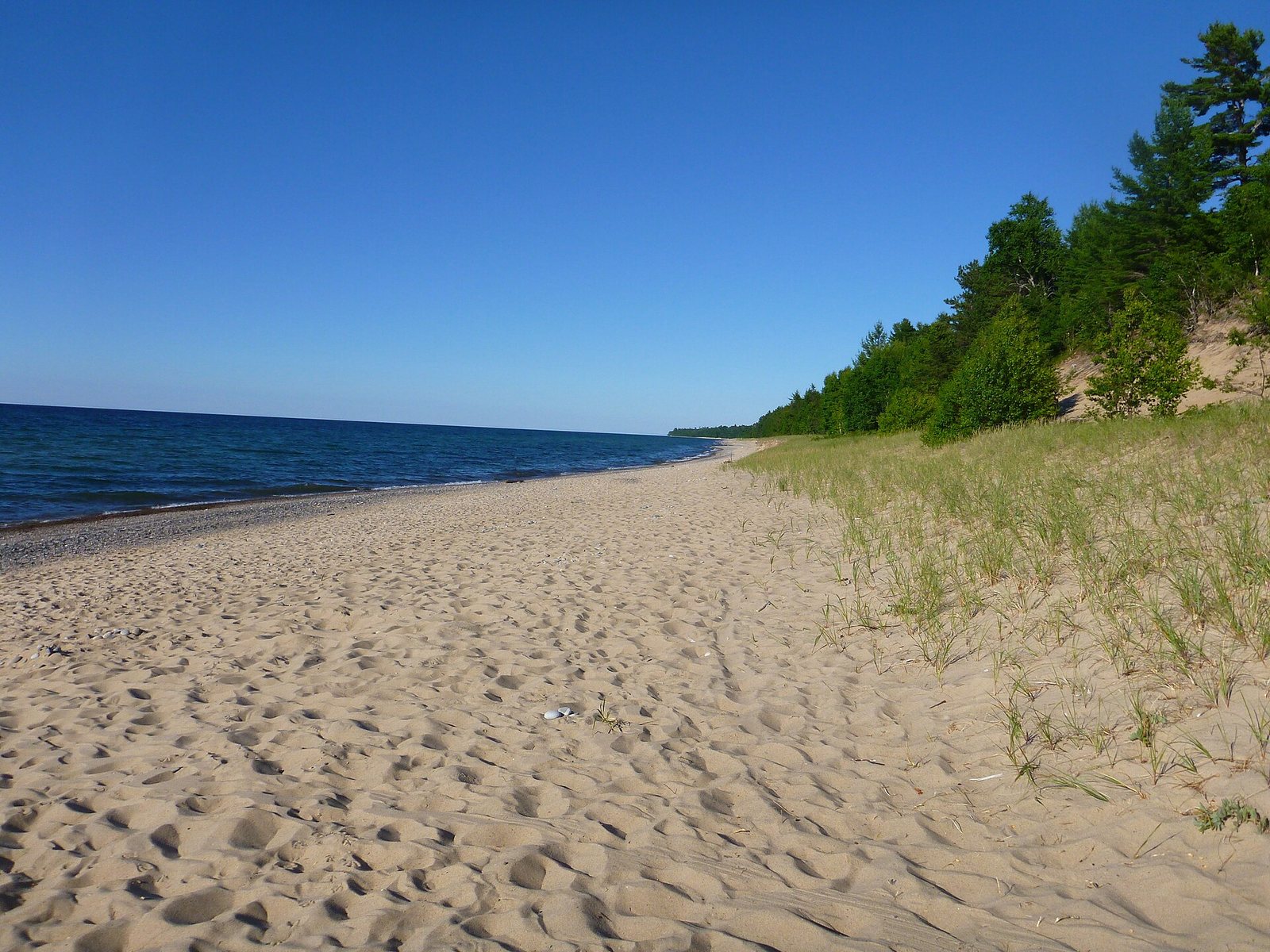
Michigan is the only state that touches four of the five Great Lakes, and each of the four gives you a different beach. Lake Michigan’s east shore is the classic one: soft sand, big dunes and sunsets over the water. Lake Superior is colder, emptier and clearer, with agates and pebbles in the surf. Lake Huron’s beaches face the sunrise and warm up fastest in their shallow bays, and Lake Erie’s short Michigan shore is the closest to Detroit. The best Michigan beaches are spread across more than 3,200 miles of Great Lakes shoreline, so the right one depends on where you’re starting and what you want from a day on the sand.
The short answer: for scenery, go to Sleeping Bear Dunes; for a classic town beach, Grand Haven State Park; for dunes within reach of Chicago, Warren Dunes; for solitude, Twelvemile Beach on Lake Superior. State park beaches need a Recreation Passport (non-residents $12 a day or $42 a year in 2026), the national lakeshores charge $25 per vehicle for seven days, and town beaches set their own parking rules. Go in August for the warmest water.
Fees, rules and dates below were checked on September 23, 2026 against the operators’ and agencies’ own websites, including the DNR, the National Park Service and EGLE’s beach monitoring program. Water quality changes day to day, so check the live sources in the safety section before you swim.
On this page: At a glance · The 12 best · By region · What it costs · Lake Michigan · Lake Superior · Lake Huron · Near Detroit · Dogs and kids · Sand dunes · Rocks and glass · Water temperature · Safety and water quality · Are beaches public? · When to go · What to skip · FAQ
The best Michigan beaches at a glance
Every beach below is on a Great Lake or connecting water. “State park” means a Recreation Passport on your vehicle; “NPS” means a national lakeshore pass. Don’t expect lifeguards: state park and national lakeshore beaches are generally unguarded, which is why the flag system in the safety section matters.
| Beach | Lake, and which way it faces | Entry (2026) | Dogs | Bottom | Drive |
|---|---|---|---|---|---|
| Sleeping Bear Dunes (Glen Haven, North Bar Lake, Esch Road) | Michigan, sunset | NPS $25 per vehicle, 7 days | On designated stretches only | Sand, some pebbles | About 4 h 25 from Detroit, 2 h 35 from Grand Rapids |
| Grand Haven State Park | Michigan, sunset | Recreation Passport | Not on the swim beach | Sand | About 35 min from Grand Rapids |
| Warren Dunes State Park | Michigan, sunset | Recreation Passport | North of the swim buoys (about 2.5 miles) | Sand | About 1 h 25 from Chicago |
| Oval Beach, Saugatuck | Michigan, sunset | City parking fee | Check city rules | Sand | About 40 min from Grand Rapids |
| Ludington State Park | Michigan, sunset | Recreation Passport | Not on the swim beach | Sand | About 1 h 30 from Grand Rapids |
| Holland State Park | Michigan, sunset | Recreation Passport | Not on the swim beach | Sand | About 45 min from Grand Rapids |
| Silver Lake State Park | Michigan, sunset | Recreation Passport (plus ORV permits to drive the dunes) | Not on the swim beach | Sand | About 1 h 10 from Grand Rapids |
| Petoskey State Park | Michigan (Little Traverse Bay), sunset | Recreation Passport | Not on the swim beach | Sand and stones | About 4 h 05 from Detroit |
| Twelvemile and Miners beaches, Pictured Rocks | Superior, north | NPS $25 per vehicle, 7 days | Check NPS pet rules | Sand | About 6 h 25 from Detroit (Munising) |
| Tawas Point State Park | Huron, sunrise | Recreation Passport | Not on the swim beach | Sand | About 3 h from Detroit |
| Port Crescent State Park | Huron (Saginaw Bay), sunset over the bay | Recreation Passport | Not on the swim beach | Sand | About 2 h 25 from Detroit |
| Pere Marquette Park, Muskegon | Michigan, sunset | City parking rules | Check city rules | Sand | About 50 min from Grand Rapids |
| Sterling State Park, Monroe | Erie, east | Recreation Passport | Not on the swim beach | Sand | About 45 min from Detroit |
| Belle Isle | Detroit River | Recreation Passport | Not on the swim beach | Sand | About 15 min from downtown Detroit |
Drive times are free-flow estimates without traffic. Most state park beaches have restrooms and a large parking lot; national lakeshore beaches have restrooms at the main lots; town beaches vary. On summer weekends the popular lots fill by late morning.
The 12 best beaches in Michigan
This ranking weighs the setting, the sand, the water and how pleasant the beach is to visit, not just how famous it is. Eight of the twelve are on Lake Michigan, because that shore really is the state’s best stretch of sand; the rest cover Superior and Huron.
1. Sleeping Bear Dunes: Glen Haven and North Bar Lake
Sleeping Bear has the most dramatic beach setting in the Midwest: sand bluffs hundreds of feet high, clear water over pale sand and 35 miles of mainland shoreline. Glen Haven Beach, by the old cannery and the Maritime Museum, is the easy-access favorite, and North Bar Lake, a small, warmer inland lake separated from Lake Michigan by a strip of sand, is the one families love. Esch Road Beach, south of Empire, is quieter. Entry is the park’s $25 vehicle pass for seven days. Leashed dogs are allowed only on designated stretches, including Esch Road Beach north to the park boundary in Empire and the stretch from Empire Beach north to the south end of North Bar Lake, and some beaches close to pets in plover season. Our guide to Sleeping Bear Dunes National Lakeshore covers every beach, trail and rule; note that the Manitou Islands are closed for all of 2026.
2. Grand Haven State Park
Grand Haven State Park is the classic Lake Michigan town beach: a wide sweep of soft sand beside the Grand River channel, with the red pier lights and their catwalk at one end, a campground right on the sand and downtown Grand Haven’s boardwalk a short walk away. It’s about 35 minutes from Grand Rapids and less than three hours from Chicago, and on a hot July weekend the lot fills before noon. The pier is the town’s sunset walk, but stay off it when waves break over it; structural currents along the pier are dangerous. A Recreation Passport covers parking, and the park posts the DNR’s beach flags.
3. Warren Dunes State Park
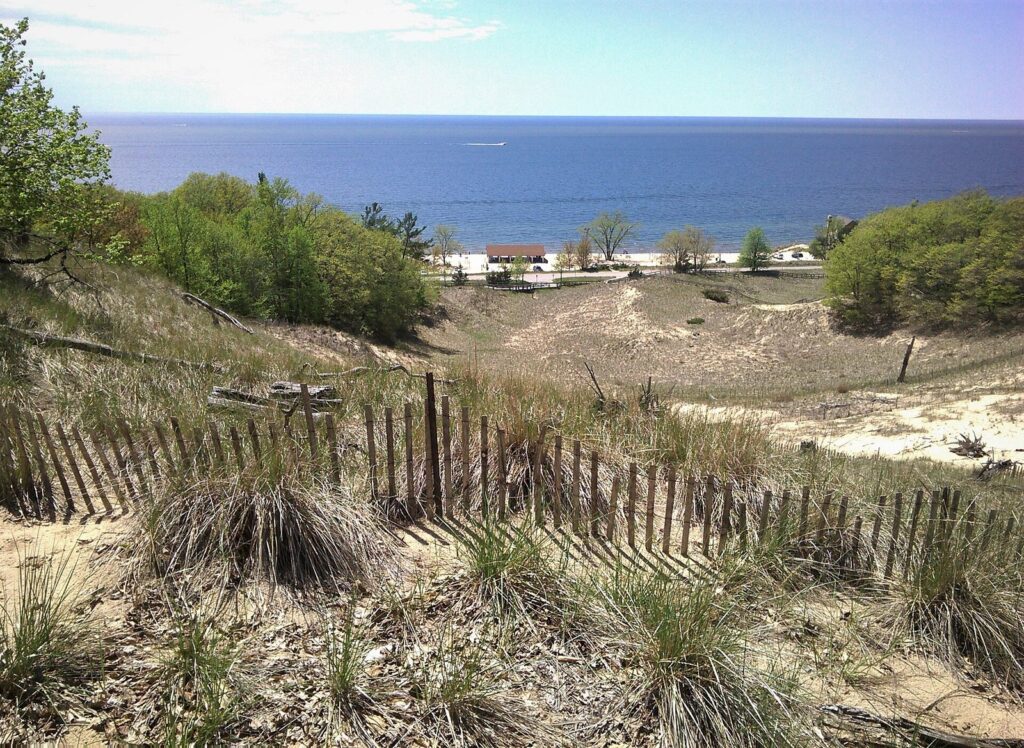
Warren Dunes, near Sawyer in the far southwest corner of the state, is about 1 hour 25 minutes from Chicago and the nearest big-dune beach to the city. The park has about three miles of Lake Michigan shore below dunes you can climb (and run down), plus a large campground in the woods behind. It’s also one of the best state park beaches for dogs: leashed dogs are allowed north of the northernmost swim buoy, about two and a half miles of beach. Come early on summer weekends, because this is where half of Chicago goes when it gets hot, and bring water for the dune climb.
4. Oval Beach, Saugatuck
Oval Beach sits on Lake Michigan just south of the Kalamazoo River mouth, below the wooded dunes of Mount Baldhead, and it’s the best-looking town beach in West Michigan: no buildings in sight, just sand, dune grass and water. It’s run by the city of Saugatuck, which charges for parking in season, and it’s about 40 minutes from Grand Rapids and 2 hours 20 minutes from Chicago. Combine it with the galleries and restaurants in Saugatuck and Douglas, and climb Mount Baldhead’s stairs for the view back over the lake.
5. Ludington State Park
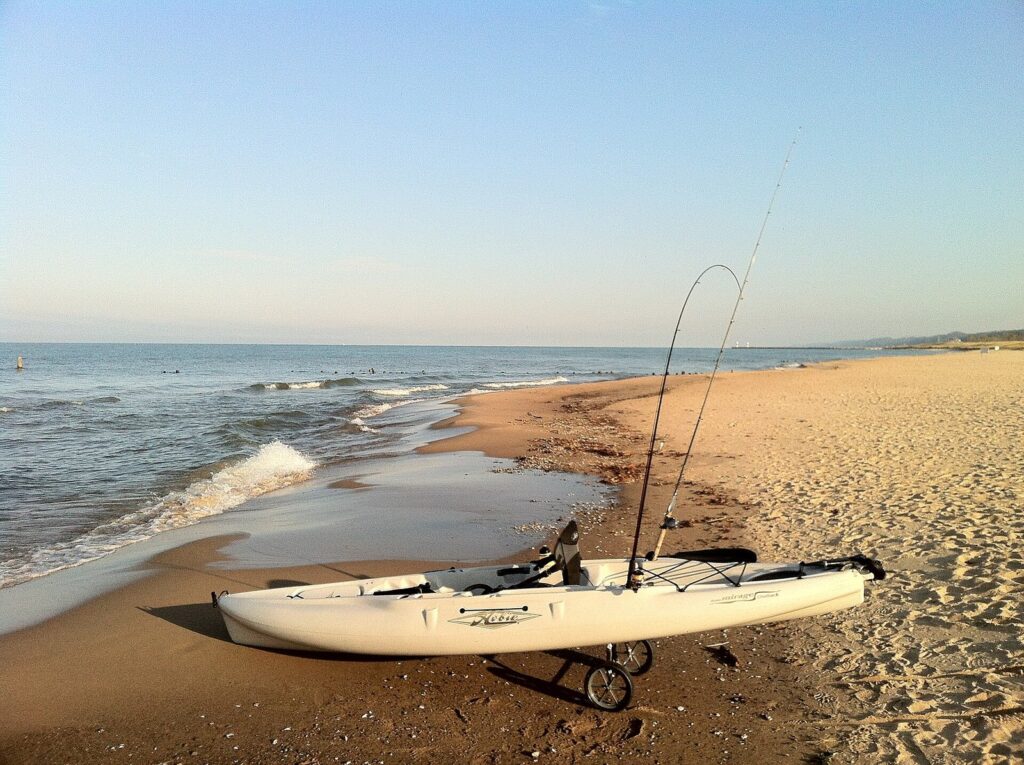
Ludington State Park sits between Lake Michigan and Hamlin Lake north of the town of Ludington, and it gives you two kinds of swimming in one park: the big lake’s surf and the calmer, warmer water of Hamlin Lake. The main beach centers on the park’s historic beach house, and a walk of a couple of miles each way leads north along the shore to Big Sable Point Lighthouse. The park is about 1 hour 30 minutes from Grand Rapids and about 4 hours from Chicago and Detroit, so most visitors stay in its campgrounds or in town. In summer, the SS Badger car ferry sails from Ludington to Wisconsin.
6. Holland State Park
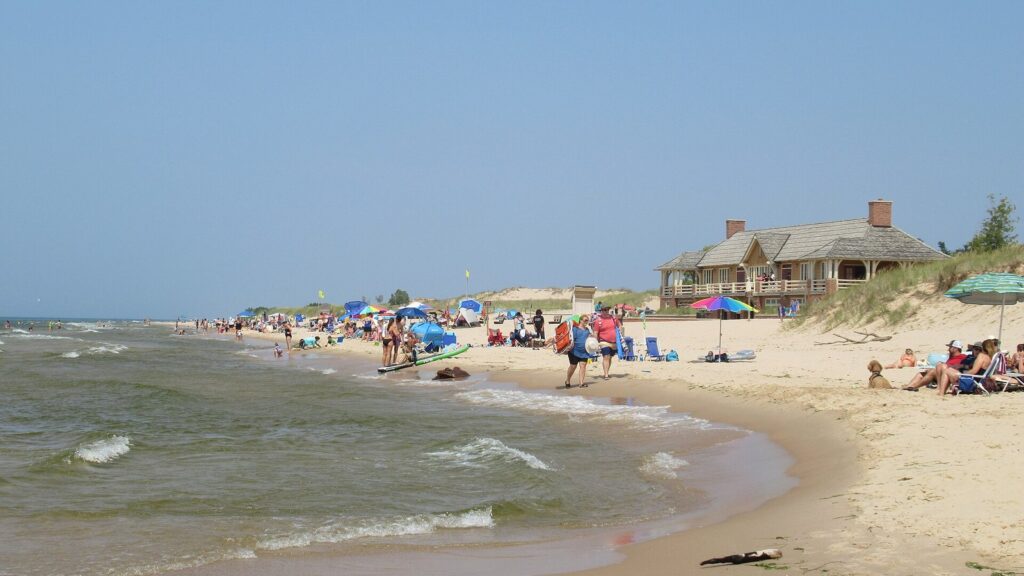
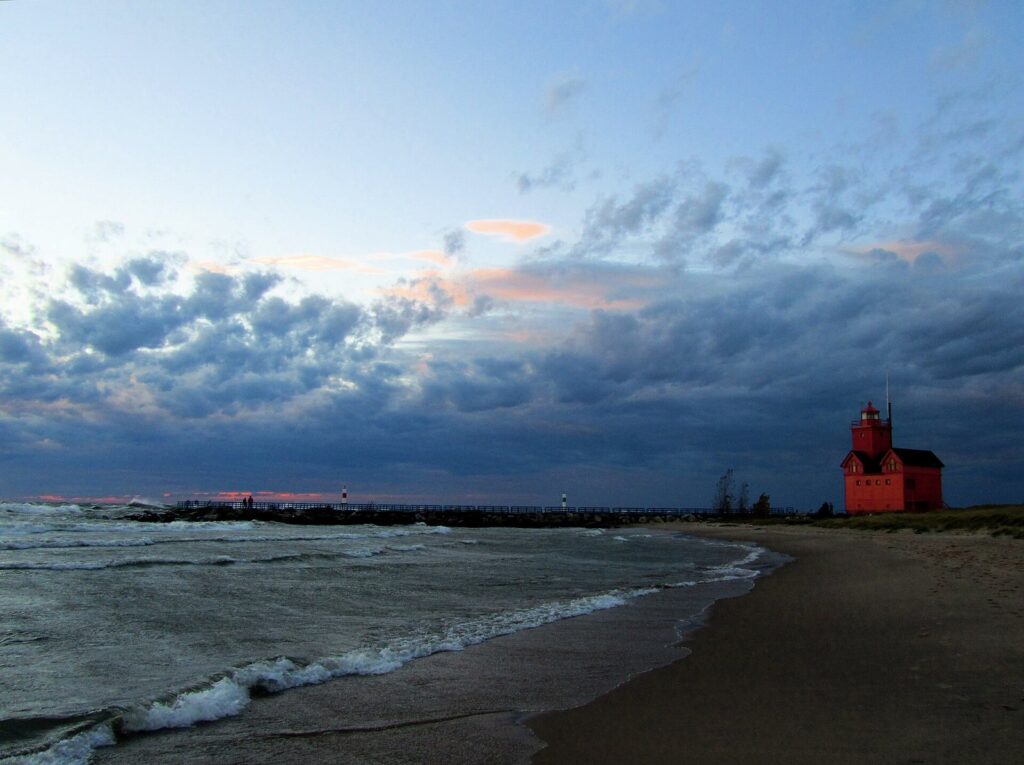
Holland State Park’s Lake Michigan beach looks straight across the channel at Big Red, the Holland Harbor Light, which makes it one of the most photographed beaches in the state. It’s also one of the busiest state parks in Michigan, with a second unit and campground on Lake Macatawa, and it’s about 45 minutes from Grand Rapids and 2 hours 40 minutes from Chicago. Arrive early on summer weekends, when the lot can close, or come for sunset after the day crowd leaves.
7. Silver Lake State Park
Silver Lake State Park, near Mears between Muskegon and Ludington, is where Michigan’s dunes get loud. The park has three parts: a Lake Michigan beach and Little Sable Point Lighthouse at its south end, a pedestrian-only dune area, and the Silver Lake ORV Area, where dune buggies, jeeps and off-road vehicles run on open sand. You can also ride the dunes as a passenger with Mac Wood’s Dune Rides, which runs 40-minute tours from mid-May through October. It’s about 1 hour 10 minutes from Grand Rapids. Details on driving the dunes are in the dunes section below.
8. Petoskey State Park
Petoskey State Park, on Little Traverse Bay between Petoskey and Harbor Springs, has about a mile of sandy beach with stones at the waterline, and it’s the best-known place in Michigan to hunt Petoskey stones, the fossil coral that is the state stone. The bay is more sheltered than the open lake, the park has two campgrounds in the dunes behind the beach, and the town of Petoskey is 10 minutes away. For how to get to Petoskey, Michigan, and where to stay around the bay, see our Petoskey and Little Traverse Bay guide.
9. Twelvemile and Miners beaches, Pictured Rocks
Lake Superior’s best sand beaches are at Pictured Rocks National Lakeshore. Miners Beach, near Miners Castle, is the most accessible, a wide crescent of sand with the cliffs rising at one end. Twelvemile Beach, farther east toward Grand Marais and west of the Au Sable Light, lives up to its name: miles of empty sand below a pine-covered bluff, with a rustic campground on top ($25 a night in 2026, mid-May to mid-October). The water is cold even in August, so this is a walking and sunset beach more than a swimming one. The lakeshore’s $25 vehicle pass covers entry, and collecting rocks is not allowed inside the park.
10. Tawas Point State Park
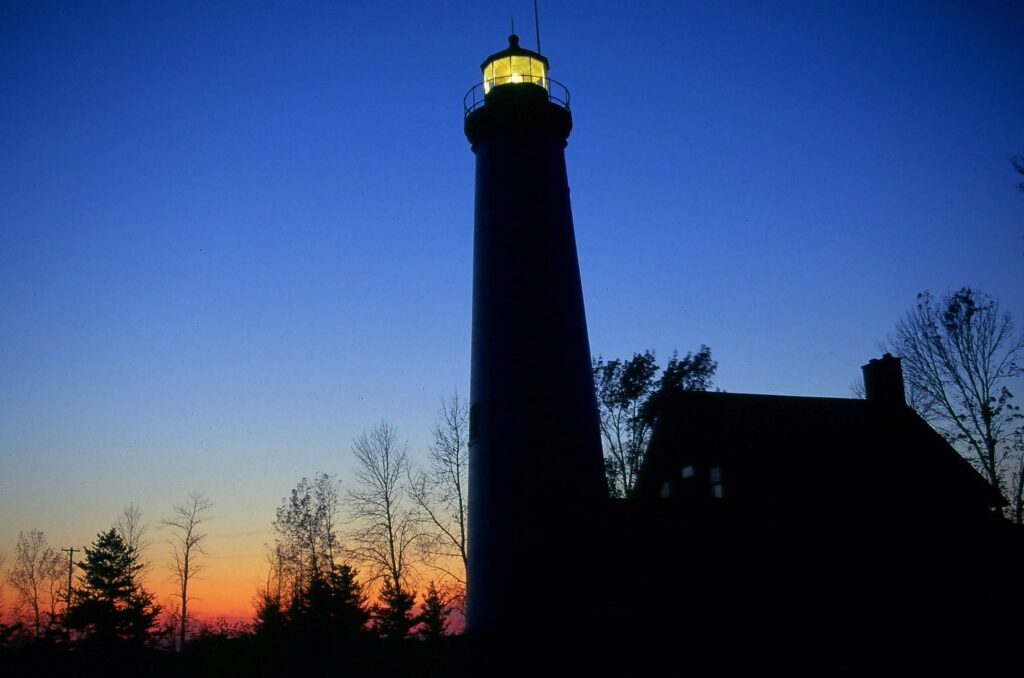
Tawas Point, on a sandy spit between Tawas Bay and Lake Huron about 3 hours from Detroit, is the best beach on the Sunrise Coast. The bay side is shallow and warms up faster than the open lake, which makes it good for small children, and the point has a 19th-century lighthouse and some of the best spring and fall bird-watching in the state, when migrating shorebirds and songbirds stop on the spit. Watch the sunrise over Lake Huron, then move to the bay side for the afternoon.
11. Port Crescent State Park
Port Crescent State Park, just west of Port Austin at the tip of the Thumb, has a long sandy beach on Saginaw Bay, low dunes and the Pinnebog River winding behind them. It’s about 2 hours 25 minutes from Detroit, much quieter than the Lake Michigan parks, and it’s one of Michigan’s six state dark sky preserves, so stay for the stars. Port Austin, 10 minutes east, is the jumping-off point for the paddle to Turnip Rock.
12. Pere Marquette Park, Muskegon
Muskegon’s big city beach runs along Lake Michigan beside the harbor channel, with a long stretch of sand, volleyball courts and the red South Pierhead Light at the channel mouth. It’s about 50 minutes from Grand Rapids and 3 hours 20 minutes from Chicago, and it’s the easiest big beach for a day out from Grand Rapids when Holland and Grand Haven are packed. Nearby, P.J. Hoffmaster State Park’s dunes and the Muskegon State Park beach are quieter alternatives.
Where the beaches are: a region-by-region list
Use this as a map in words: find your region, then your base town.
| Region | Beaches covered here | Base yourself in |
|---|---|---|
| Southwest Michigan (Harbor Country) | Warren Dunes, Grand Mere, Weko Beach, Silver Beach, New Buffalo | New Buffalo, St. Joseph |
| West Michigan | Oval Beach, Holland State Park, Tunnel Park, Grand Haven State Park, North Beach Park, Pere Marquette Park | Saugatuck, Holland, Grand Haven, Muskegon |
| North Lake Michigan | Silver Lake, Ludington State Park, Sleeping Bear (Glen Haven, North Bar Lake, Esch Road) | Ludington, Glen Arbor, Traverse City |
| Little Traverse Bay | Petoskey State Park, Depot Beach (Charlevoix) | Petoskey, Charlevoix |
| Lake Superior | Miners Beach, Twelvemile Beach, Grand Marais, McCarty’s Cove (Marquette), Union Bay (Porcupine Mountains) | Munising, Grand Marais, Marquette |
| Sunrise Coast | Tawas Point, Oscoda, Harrisville | Tawas City, Oscoda |
| The Thumb | Port Crescent, Port Austin, Caseville, Lexington | Port Austin |
| Metro Detroit | Belle Isle, Lake St. Clair Metropark, Sterling State Park, Kensington, Stony Creek, Lakeside Park (Port Huron) | Detroit |
What Michigan beaches cost: passes, lots and national lakeshore fees
Michigan has three kinds of beach access, and each charges in its own way. Knowing which is which saves a surprise at the gate.
| Who runs the beach | What you pay (2026) | Examples |
|---|---|---|
| State parks and recreation areas | Recreation Passport on the vehicle: Michigan residents $15 a year with plate renewal; non-residents $12 a day or $42 a year (through December 31) | Grand Haven, Holland, Warren Dunes, Ludington, Petoskey, Tawas Point, Sterling, Belle Isle |
| National lakeshores | $25 per private vehicle for 7 days, or $45 for an annual park pass; the $80 America the Beautiful pass covers US residents at both | Sleeping Bear Dunes, Pictured Rocks |
| Cities, townships and counties | Their own parking fees or permits, often higher for non-residents in summer | Oval Beach, Pere Marquette Park, many town beaches |
| Huron-Clinton Metroparks (metro Detroit) | A Metroparks vehicle pass, daily or annual | Lake St. Clair Metropark, Kensington, Stony Creek |
Which pass makes sense? If you’re a non-resident visiting state park beaches on four or more days in a year, the $42 annual Recreation Passport beats the daily pass. If you’ll spend a week at Sleeping Bear, the $25 seven-day pass is all you need; if you’ll visit both lakeshores and other national parks in a year and you’re a US resident, the $80 America the Beautiful pass pays for itself quickly. Non-US residents pay $250 for that pass in 2026, so for them the individual lakeshore passes are usually cheaper.
Lake Michigan beaches: the sunset coast
The east shore of Lake Michigan, from the Indiana line to the Straits of Mackinac, is Michigan’s main beach coast. Prevailing west winds have piled up sand here for thousands of years, so the beaches are wide and sandy and backed by dunes, and every one of them faces the sunset. The water is clear and cold in June, and by August it’s comfortable on most days along the southern and central shore.
Southwest Michigan and Harbor Country
The closest Michigan beaches to Chicago are in Berrien County: New Buffalo’s city beach, Warren Dunes and Grand Mere state parks near Sawyer and Stevensville, Weko Beach in Bridgman, and St. Joseph’s Silver Beach by the pier. It’s a 90-minute drive from the Loop, so summer weekends are busy; midweek, the dunes can feel almost empty.
West Michigan: South Haven to Muskegon
This stretch is beach-town country. South Haven has city beaches on both sides of the Black River channel, Saugatuck has Oval Beach, Holland has Holland State Park and Tunnel Park, Grand Haven has its state park and a string of county parks to the north, and Muskegon has Pere Marquette Park and Muskegon State Park. The towns are close together, 35 to 60 minutes from Grand Rapids, so you can pick your beach by the crowds on the day.
Northern Lake Michigan: Ludington to the Straits
North of Muskegon the coast gets wilder: Silver Lake’s dunes, Ludington’s state park, the Nordhouse Dunes and Manistee National Forest shoreline, then Sleeping Bear, Frankfort and the Leelanau Peninsula. Farther north, the beaches around Charlevoix, Petoskey and Harbor Springs mix sand with the stones that make the area famous. Water here stays cooler than in the south, and the crowds thin with every hour of driving.
Lake Superior beaches: cold, clear and empty
Lake Superior is the biggest, deepest and coldest of the Great Lakes, and its Michigan shore runs the length of the Upper Peninsula. Its beaches are the emptiest in the state, from the long sand of Twelvemile Beach and Miners Beach at Pictured Rocks to the pebble and agate beaches around Grand Marais, Whitefish Point and the Keweenaw. Swimming is possible in August in shallow, sandy coves and at city beaches like Marquette’s McCarty’s Cove, but the water can cause cold shock, especially in June and early July. Most people come to walk, hunt rocks and watch the sunset. In Marquette, Presque Isle Park, a wooded peninsula ringed by rock ledges and small coves, is the city’s favorite place to watch the lake, and the ore dock and harbor beaches are a short drive away.
Plan around distance: Munising is about 6 hours 25 minutes from Detroit and Grand Marais about 6 hours 15 minutes, and there are few services between towns. Whitefish Point is a national wildlife refuge, so rock collecting there is prohibited, and the national lakeshore forbids it too.
Lake Huron beaches: the Sunrise Coast and the Thumb
Lake Huron’s Michigan shore faces east, so its beaches are for sunrises, and many of them are in shallow bays that warm up faster than the open lake. The Sunrise Coast along US-23 has Tawas Point, the beaches at Oscoda and Harrisville, and Alpena’s parks, about 3 hours from Detroit. The Thumb has Port Crescent and Port Austin at the tip, Caseville’s beaches on Saginaw Bay and small-town beaches at Lexington and Port Sanilac, 1 to 2½ hours from Detroit. Port Huron’s Lakeside Park, about an hour and 10 minutes from downtown Detroit, is the closest Lake Huron beach to the city.
Beaches near Detroit
You don’t have to drive three hours from Detroit to get your feet wet. These are the closest options, with free-flow drive times from downtown:
- Belle Isle (about 15 minutes). The island park in the Detroit River has a swimming beach; Belle Isle is a state park, so bring a Recreation Passport.
- Lake St. Clair Metropark (about 35 to 40 minutes). The former Metro Beach in Harrison Township has a big beach and boardwalk on Lake St. Clair; a Metroparks vehicle pass is required.
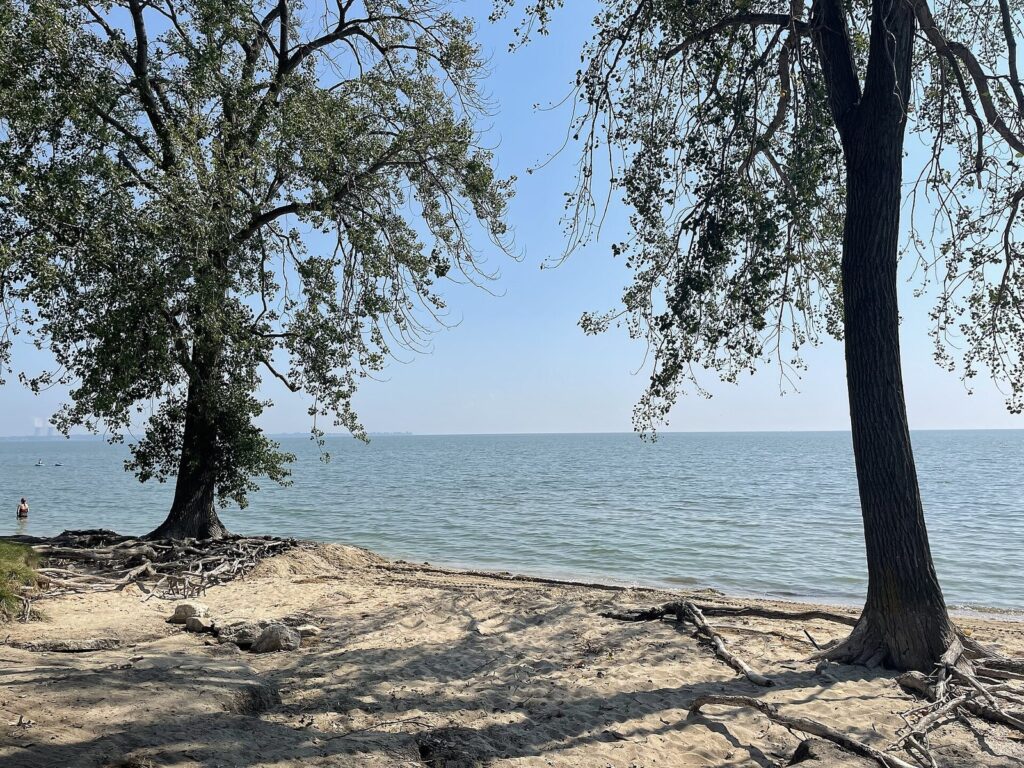
- Sterling State Park (about 45 minutes). Michigan’s only state park on Lake Erie, near Monroe, with a beach, trails through the marsh and a campground. In late summer, watch for algal bloom advisories on western Lake Erie.
- Kensington and Stony Creek Metroparks (45 to 50 minutes). Inland lake beaches with calm water, good for young children.
- Lakeside Park, Port Huron (about 1 hour 10 minutes). The nearest Lake Huron beach, a city park north of the Blue Water Bridge.
Dog-friendly and kid-friendly beaches
Where you can take a dog
In Michigan state parks, leashed pets (6-foot leash, under your control) are welcome in the campgrounds, on trails and at boat launches, but not on designated swim beaches, in endangered-species habitat or in other posted areas. A few parks set aside pet-friendly stretches of shoreline. The DNR’s list includes Warren Dunes (north of the northernmost swim buoy, about 2.5 miles of beach), Young State Park on Lake Charlevoix (the shoreline east of the boat launch) and Wilderness State Park near Mackinaw City (a pet beach down a path from the picnic area). Sleeping Bear allows leashed dogs on designated beaches, but some close from April 15 to August 15 to protect nesting piping plovers. Town beaches set their own rules, so check before you go, and bring water: hot sand and dehydration are hard on dogs.
Best beaches for young children
For small children, look for shallow, warm, sheltered water. The bay side of Tawas Point, North Bar Lake at Sleeping Bear, Hamlin Lake at Ludington State Park, Depot Beach on Lake Charlevoix, and the inland Metropark beaches near Detroit all fit. On the open Lake Michigan shore, a calm day with a green flag is fine for paddling at the edge, but waves and currents change quickly, and there are no lifeguards at state park beaches, so stay within arm’s reach.
Michigan sand dunes, including Silver Lake
Michigan has the largest collection of freshwater sand dunes in the world by most accounts, almost all of them along Lake Michigan’s east shore, plus the Grand Sable Dunes near Grand Marais on Lake Superior. The best-known are at Sleeping Bear, a national lakeshore that counts more than 1.6 million visits a year; Warren Dunes; Saugatuck’s dunes; P.J. Hoffmaster State Park near Muskegon, home to the state’s dune visitor center; Ludington and the Nordhouse Dunes; and Silver Lake.
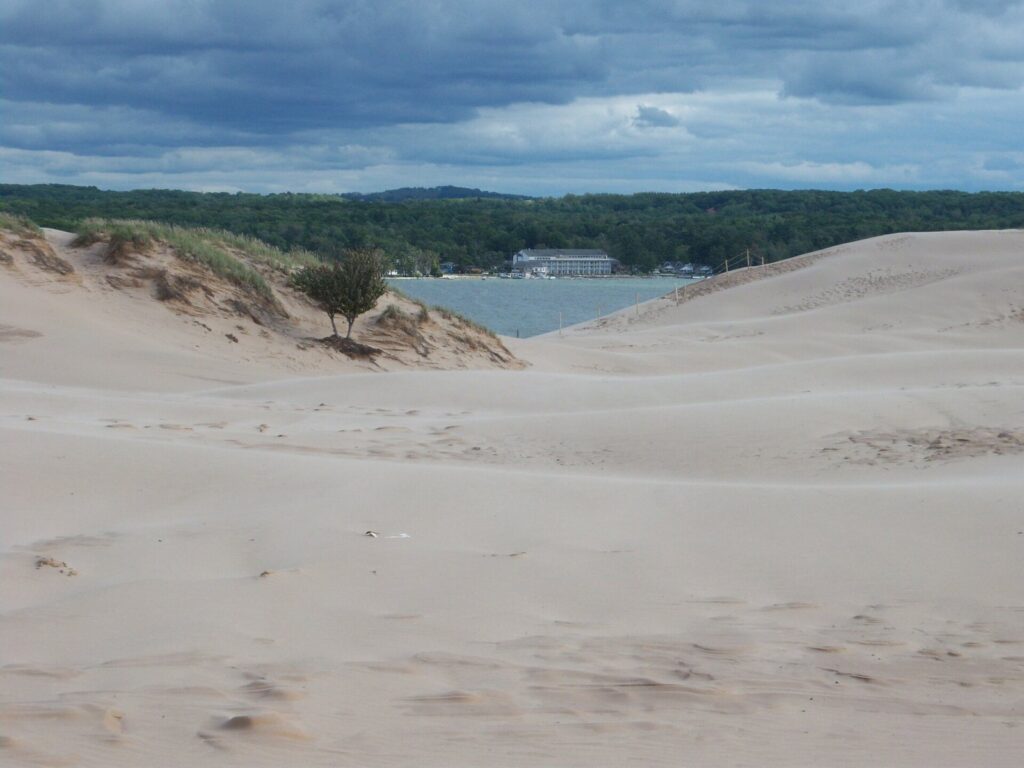
Silver Lake is the Michigan dune field known for driving. In 2026 the ORV Area opens April 1, with hours of 9 a.m. to 8 p.m. in April, 9 a.m. to 10 p.m. from May 1 to September 15, and 9 a.m. to 8 p.m. from September 16 through October 31; entry stops half an hour before closing. Every dune vehicle, plated or not, needs a valid Michigan ORV license and trail permit plus a Recreation Passport, and an orange flag mounted at least 10 feet off the ground. If you’d rather ride than drive, Mac Wood’s Dune Rides runs 40-minute tours in its own section of the dunes from mid-May through October, 9:30 a.m. to 4 p.m., walk-in only. Everywhere else, stay on marked trails through dune grass, which holds the dunes together, and never slide down a bluff above the lake that you can’t climb back up.
Rock hunting, beach glass and Petoskey stones
Michigan’s beaches are some of the best rock hunting in the country. Petoskey stones, fossil coral with a six-sided honeycomb pattern, turn up along the northern Lake Michigan shore around Petoskey, Charlevoix and the Leelanau Peninsula. Lake Superior agates, banded red, orange and white, wash up on the U.P. beaches around Grand Marais and the Keweenaw. Beach glass is easiest to find near old port towns and after storms. The best time for all of it is spring, after the ice has churned the beaches, or the morning after a big blow.
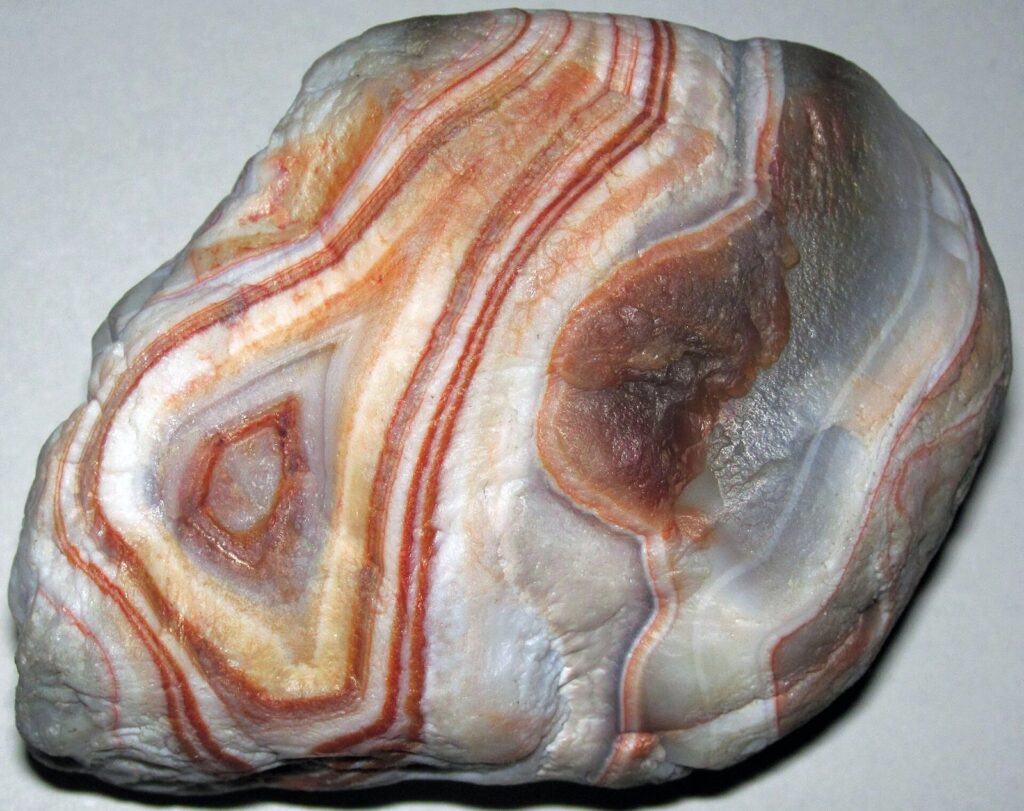
Know the rules before you fill a bag. Michigan lets each person collect up to 25 pounds of rocks, minerals and fossils a year from state-owned land and the public-trust Great Lakes shoreline for personal use, and violations can bring civil fines of up to $500. Collecting is prohibited inside Sleeping Bear Dunes and Pictured Rocks national lakeshores and at Whitefish Point, a national wildlife refuge. National forest land has its own, smaller allowance. Never take anything from a shipwreck or an archaeological site.
Great Lakes water temperatures by month
The Great Lakes warm slowly. Here’s the typical pattern; check NOAA’s Great Lakes CoastWatch maps and your local National Weather Service office for the actual temperature on the day, because a change in wind can drop nearshore water sharply overnight when cold water wells up from below.
| Month | Lake Michigan (southern and eastern shore) | Lake Huron bays and Lake Erie | Lake Superior |
|---|---|---|---|
| June | Cold; brief dips only | Cool; shallow bays warm first | Very cold |
| July | Swimmable on warm, calm days | Comfortable in the shallows | Cold; sheltered sandy coves are best |
| August | The warmest month, with the best swimming | The warmest; Lake Erie is the warmest of the lakes | As warm as it gets; still bracing |
| September | Still swimmable early in the month | Cooling but often pleasant | Cooling fast |
Lake Erie, the shallowest Great Lake, warms first and most. Lake Superior, the deepest, stays cold enough all summer that a sudden plunge can trigger cold shock, the involuntary gasp that causes drownings. Wear a wetsuit if you plan to paddle or swim any distance there.
Beach safety, rip currents and water quality
Beach flags
The DNR flies warning flags at all 30 state parks and recreation areas with Great Lakes beaches:
- Green: low hazard, calm conditions.
- Yellow: medium hazard, moderate surf and currents.
- Single red: high hazard. Swimming is allowed but not advised; high waves and strong currents are likely.
- Double red: water access is closed. Entering the water is against the law, and you can be penalized.
Rip currents and piers
The Great Lakes have rip currents, and they drown swimmers every summer, usually on windy days when waves are running. Rips form along sandbars and, most dangerously, beside piers and breakwalls, where water rushing along the structure can pull a swimmer out and waves can sweep people off the concrete. If you’re caught in a current, flip onto your back, float to keep your head above water, and follow the shore by swimming parallel to it until you’re out of the pull, then swim in. Stay off piers when waves break over them, don’t swim near them, and watch for the National Weather Service’s beach hazard statements.
Bacteria closures and EGLE BeachGuard
Local health departments test many public beaches for E. coli in summer and report the results to BeachGuard, the state’s beach monitoring website run by EGLE, Michigan’s environment department. The state standard allows a daily average of 300 E. coli per 100 milliliters of water (from at least three samples) and a 30-day average of 130; a beach that exceeds 300 in a single sampling can be closed or placed under an advisory until clean samples come back. Heavy rain washes bacteria into the lakes, so the day or two after a big storm is when advisories are most common. Before you go, check BeachGuard for your beach, and in late summer check for algal bloom advisories on western Lake Erie.
Are Michigan beaches public?
Partly. In Glass v. Goeckel (2005), the Michigan Supreme Court held that the public may walk along the Great Lakes shoreline below the ordinary high-water mark, even in front of private property, because that strip is held in public trust. In practice, that means you can walk the wet and recently wet sand along the lake. It doesn’t give you a right to cross private land to reach the water, to set up camp or a beach blanket above the high-water mark in front of someone’s cottage, or to use private docks and stairs. Get to the shore from public land, a state park, a public beach or a public road end, then walk. Inland lakes follow different rules, and their shorelines are usually private.
When to go
The Michigan beach season peaks around the Fourth of July, with the week of June 28 to July 4 at the top of the curve, and lots at the popular state parks fill early. August has the warmest water and the most dependable swimming weather. September is the insider’s month: the water is still near its warmest early in the month, the crowds are gone after Labor Day, and the light is softer. Spring is for rock hunting and empty beaches, and winter is for looking at ice from a safe distance, never walking on shelf ice or iced-over piers.
For a weekend, arrive at the beach by 10 a.m. on summer Saturdays, pack shade and plenty of water (many beaches have little of either), and plan a sunset on the Lake Michigan side or a sunrise on Lake Huron. For a longer trip, pair the beaches with a base town: Grand Haven, Holland or Saugatuck in West Michigan; Traverse City or Glen Arbor for Sleeping Bear; Petoskey for Little Traverse Bay; Munising or Grand Marais for Lake Superior.
Camping on the beach
Some of the best beach days start at a campsite a few steps from the water. State park campgrounds close to the sand include Grand Haven (right on the beach), Ludington, Warren Dunes, Holland (on Lake Macatawa), Petoskey, Tawas Point, Port Crescent and Sterling; book them through the DNR’s reservation system, which opens months ahead, and expect July weekends to go first. On Lake Superior, the National Park Service’s rustic Twelvemile Beach campground at Pictured Rocks ($25 a night in 2026, mid-May to mid-October) sits on the bluff above the beach, and Union Bay campground in the Porcupine Mountains has sites on the shore.
What to bring to a Great Lakes beach
- Shade and water. Most Great Lakes beaches have little natural shade, and many have no drinking fountains near the sand. Bring an umbrella or a small shelter, and more water than you think.
- Layers. A lake breeze can make the beach far cooler than it is a mile inland, and evenings get cool fast. A sweatshirt belongs in the bag even in July.
- Water shoes for the stony beaches around Petoskey and on Lake Superior, and for the pebbles at the waterline on many northern beaches.
- A way to check conditions: the beach flag at the entrance, the National Weather Service forecast and EGLE’s BeachGuard.
- A payment card for city parking machines and a Recreation Passport on the car for state parks.
- A trash bag. Pack out everything, including food scraps, which draw gulls and raccoons.
What to skip, and what to do instead
Skip Grand Haven and Holland at noon on a July Saturday. Go before 10 a.m., after 5 p.m., or on a weekday, or drive 20 minutes to a county park beach.
Skip swimming on a double-red-flag day. It’s illegal at state parks, and it’s how people drown. Walk the beach and come back tomorrow.
Skip the pier in high waves. The view isn’t worth being swept off the concrete.
Skip collecting at the national lakeshores. It’s prohibited at Sleeping Bear and Pictured Rocks; hunt Petoskey stones at Petoskey State Park and agates on state land instead, within the 25-pound limit.
Skip Lake Superior for a swimming vacation with small children. Go for the scenery, but swim on Lake Michigan or in a Lake Huron bay.
Skip the Manitou Islands in 2026. They’re closed all season; Sleeping Bear’s mainland beaches are open.
Frequently asked questions
What is the best beach in Michigan?
For scenery, the beaches of Sleeping Bear Dunes National Lakeshore, especially Glen Haven and North Bar Lake, are hard to beat: pale sand, clear water and huge bluffs. Grand Haven State Park is the best classic town beach, Warren Dunes is the best dune beach near Chicago, and Twelvemile Beach at Pictured Rocks is the best for solitude, though Lake Superior is cold for swimming.
Are Michigan beaches public?
The Great Lakes shoreline below the ordinary high-water mark is held in public trust, and the Michigan Supreme Court ruled in 2005 (Glass v. Goeckel) that the public may walk along it, even in front of private homes. You still need a legal way to reach the shore, such as a public beach, park or road end, and you can’t camp or settle in above the high-water mark on private land.
What Michigan beaches allow dogs?
State parks allow leashed dogs in campgrounds and on trails but not on designated swim beaches. Dog-friendly beach areas include Warren Dunes north of the northernmost swim buoy (about 2.5 miles), Young State Park east of the boat launch and a pet beach at Wilderness State Park. Sleeping Bear allows dogs on designated beaches, with some closed April 15 to August 15 for piping plovers.
Are any Michigan beaches closed due to bacteria?
Closures and advisories happen every summer, usually after heavy rain. Local health departments test for E. coli and post results on EGLE’s BeachGuard website; a beach that exceeds 300 E. coli per 100 milliliters in a sampling can be closed or placed under advisory until clean samples come back. Check BeachGuard for your beach before you go, and wait a day or two after big storms.
What is the biggest beach in Michigan?
It depends how you measure. For a single stretch of sand, Twelvemile Beach at Pictured Rocks lives up to its name on Lake Superior. For protected shoreline, Sleeping Bear Dunes has 35 miles along the mainland. Among state parks, Warren Dunes has about three miles of Lake Michigan beach, and Ludington State Park’s shore runs miles north to Big Sable Point.
Can you swim in Lake Superior?
Yes, but it’s cold. Lake Superior is the coldest of the Great Lakes, and even in August the water can cause cold shock, especially on the open lake. The most comfortable swimming is in shallow, sandy coves and city beaches in August, such as Marquette’s McCarty’s Cove or Miners Beach at Pictured Rocks on a calm day. Swim near shore, never alone, and watch for rip currents.
Do you need a Recreation Passport for Michigan beaches?
Only at state parks and state recreation areas, including popular beaches such as Grand Haven, Holland, Warren Dunes, Ludington and Belle Isle. Residents buy it with their plate renewal for $15; non-residents pay $12 a day or $42 a year in 2026. National lakeshores charge their own $25 weekly vehicle fee, and city and county beaches set their own parking fees.
What Michigan beaches have sea glass?
Beach glass turns up most often near old port and industrial towns and after storms, on Lake Huron and Lake Erie shores and along parts of the Keweenaw. It’s less common on the big sandy Lake Michigan beaches. Look along the waterline in spring and after a strong onshore wind, and remember that collecting of any kind is prohibited in the national lakeshores.
Sources and verification
Everything on this page was checked on September 23, 2026 against the organizations listed here. This guide is compiled from those sources; it doesn’t claim first-hand visits.
- Michigan DNR: beach safety at state parks, plus the DNR’s pet-friendly recreation, Recreation Passport and Silver Lake ORV Area pages
- EGLE: standards in Michigan beach monitoring, plus the BeachGuard site
- National Park Service: Sleeping Bear Dunes fees, plus the park’s pet rules
- National Park Service: Pictured Rocks fees, plus its camping page
- NOAA Great Lakes CoastWatch for live water temperatures, and the National Weather Service rip current page
Also checked: Mac Wood’s Dune Rides for its 2026 season; the Michigan Supreme Court’s 2005 Glass v. Goeckel decision; reporting on the DNR’s rock-collecting limits; the Huron-Clinton Metroparks; and drive times from a routing service.
Michigan Tourism Guide is an independent publication. It is not affiliated with Pure Michigan or any agency or business named here.
Photo credits
- Twelvemile Beach, Pictured Rocks (featured image): photo by NPS photo, Wikimedia Commons (public domain)
- North Beach Park near Grand Haven: photo by Gpwitteveen, Wikimedia Commons (CC BY-SA 4.0)
- Oval Beach, Saugatuck: photo by tb2bfit, Wikimedia Commons (CC BY-SA 3.0)
- Ludington State Park beach: photo by Notorious4life (talk) (Uploads), Wikimedia Commons (CC0)
- Big Red from Holland State Park: photo by Kramer from Grandville, MI, United States, Wikimedia Commons (CC BY 2.0)
- Tawas Point Lighthouse: photo by Chris "Mr. Pants" Landis, Wikimedia Commons (CC BY 2.0)
- Sterling State Park, Lake Erie: photo by GregMcCollum, Wikimedia Commons (CC0)
- Silver Lake Sand Dunes: photo by NOAA Great Lakes Environmental Research Laboratory, Wikimedia Commons (CC BY-SA 2.0)
- Lake Superior agate: photo by James St. John, Wikimedia Commons (CC BY 2.0)