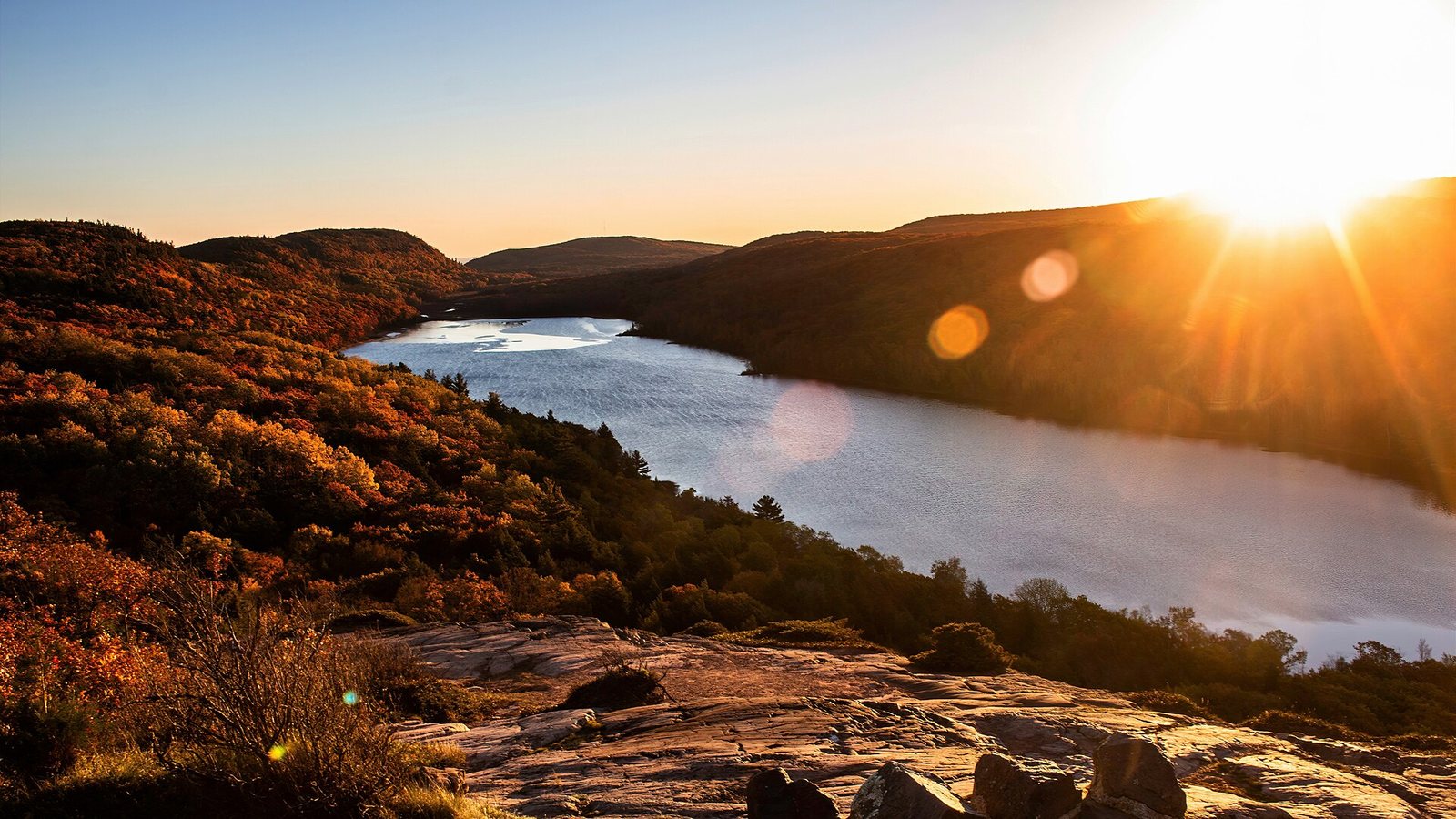
The Upper Peninsula holds 29% of Michigan’s land and about 3% of its people, which tells you most of what you need to know before you cross the Mackinac Bridge: there’s a lot of it, and not many towns in between. The Upper Peninsula runs more than 300 miles from the bridge at St. Ignace to the Wisconsin line, with three Great Lakes on its shores, and a trip that looks short on a map can mean five hours of two-lane highway through forest. Plan by region, and it’s one of the best road trips in the Midwest.
The short answer: pick one or two regions rather than the whole U.P.: the eastern U.P. for Tahquamenon Falls, the Soo Locks and Mackinac Island; the central U.P. for Pictured Rocks, Marquette and Kitch-iti-kipi; the Keweenaw for copper country, Copper Harbor and the Isle Royale boats; the western U.P. for the Porcupine Mountains and waterfalls. Give it at least three days, a week for a full loop. Crossing the Mackinac Bridge costs $4 per car, and four western counties run on Central time.
The details below were checked September 23, 2026 against the operators’ and agencies’ own websites, including the Mackinac Bridge fare schedule, park fees and 2027 winter event dates.
On this page: At a glance · Is it worth it? · The four regions · Getting there · Time zones · Top 15 things to do · Where to base yourself · When to go · Winter · Northern lights · Yooper culture · With kids · Checklist · From Chicago and Minneapolis · U.P. vs. Lower Peninsula · Itineraries · Passes and fees · Safety · What to skip · FAQ
The U.P. at a glance
| What you need to know | Details (checked September 23, 2026) |
|---|---|
| Size | 29% of Michigan’s land area and about 3% of its population, with shoreline on Lakes Superior, Michigan and Huron |
| Regions | Eastern (the Soo, Tahquamenon, St. Ignace), central (Marquette, Munising, Manistique), the Keweenaw (Houghton to Copper Harbor), western (the Porcupine Mountains, Ironwood) |
| Getting in | The Mackinac Bridge from the Lower Peninsula ($4 per passenger vehicle, 2026), US-2 and US-41 from Wisconsin, or the International Bridge from Ontario |
| Airports | Marquette (SAW), Hancock (CMX) and Chippewa County (CIU) near the Soo; 2024 boardings 44,574, 25,833 and 26,482 |
| Time zones | Eastern, except Gogebic, Iron, Dickinson and Menominee counties, which use Central |
| From the bridge | Sault Ste. Marie under an hour; Tahquamenon a little over an hour; Munising about 2 h; Marquette about 3 h; Houghton about 4 h 40 min; Copper Harbor about 5 h 30 min |
| Park passes (2026) | Recreation Passport for state parks: non-residents $12 a day or $42 a year; Pictured Rocks $25 per car for 7 days; Isle Royale $7 per person per day |
| Best time | Late June to early September for summer; late September to mid-October for fall color; December to March for snow |
| Time needed | 3 days for one region; 5 days for two; a week or more for a full loop |
Is the Upper Peninsula worth visiting?
Yes, and for many Michiganders it’s the best part of the state. The U.P. is where you go for big water, waterfalls, forests, dark skies and small towns that still feel like themselves. What it doesn’t offer is density: attractions are spread out, towns are small, and some services close for the season. Travelers who plan around the distances love it; those who try to see it all in a long weekend spend most of their time in the car.
For nature lovers: absolutely. Pictured Rocks, Tahquamenon Falls, the Porcupine Mountains, Isle Royale and hundreds of waterfalls.
For road trippers: yes. Lake Superior shorelines, empty highways and ridge-top drives like Brockway Mountain.
For families: yes, with a plan. Base in one region to cut down on driving; the Soo Locks, Kitch-iti-kipi and the Pictured Rocks cruises are big hits with kids.
For winter sports: yes. Deep lake-effect snow, the Midwest’s steepest skiing and thousands of miles of snowmobile trails.
Less worth it: a two-day “see it all” trip from Detroit or Chicago; shopping, nightlife and fine dining are not the point.
The four regions of the Upper Peninsula
The Upper Peninsula Travel & Recreation Association divides the U.P. into three regions, eastern, central and western. For trip planning, it helps to split the Keweenaw Peninsula out of the west, because it’s a destination of its own and a long drive from everything else.
| Region | Main towns | Highlights | From the bridge |
|---|---|---|---|
| Eastern U.P. | St. Ignace, Sault Ste. Marie, Paradise, Newberry | Mackinac Island, the Soo Locks, Tahquamenon Falls, Whitefish Point, Drummond Island | Under 1 h to about 1.5 h |
| Central U.P. | Marquette, Munising, Manistique, Escanaba, Grand Marais | Pictured Rocks, Kitch-iti-kipi, Fayette, Seney National Wildlife Refuge, Marquette’s lakeshore | About 2 to 3 h |
| The Keweenaw | Houghton, Hancock, Calumet, Copper Harbor | Copper mines, Keweenaw National Historical Park, Brockway Mountain Drive, the Jampot, the Isle Royale boats | About 4.5 to 5.5 h |
| Western U.P. | Ironwood, Bessemer, Wakefield, Iron Mountain, Iron River | The Porcupine Mountains, Lake of the Clouds, the Black River waterfalls, Bond Falls, Copper Peak | About 5 h or more |
The eastern U.P.
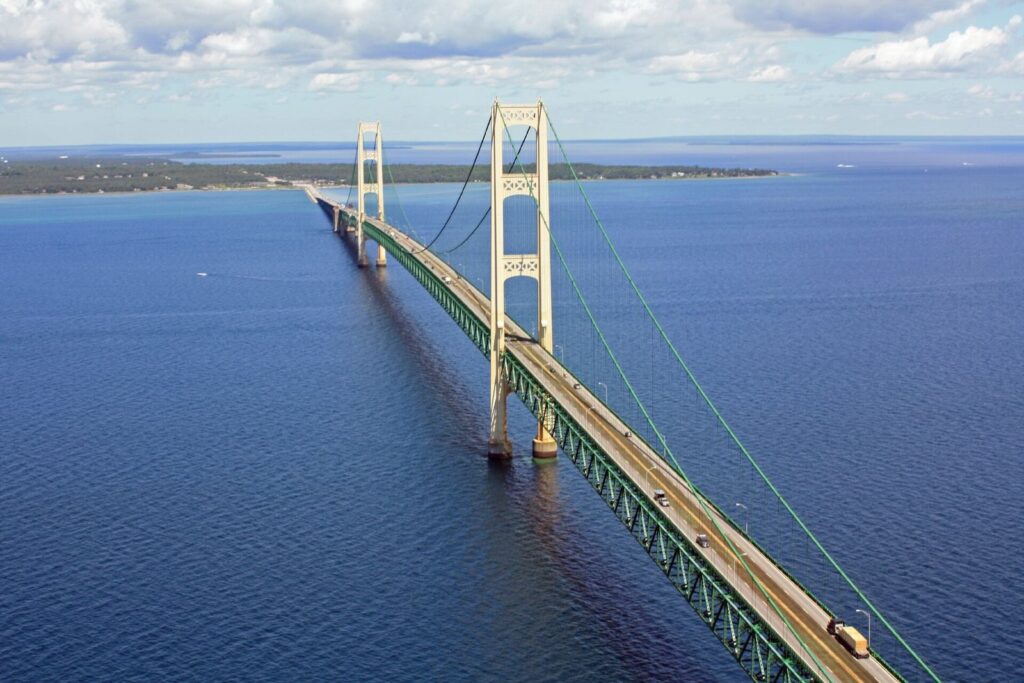
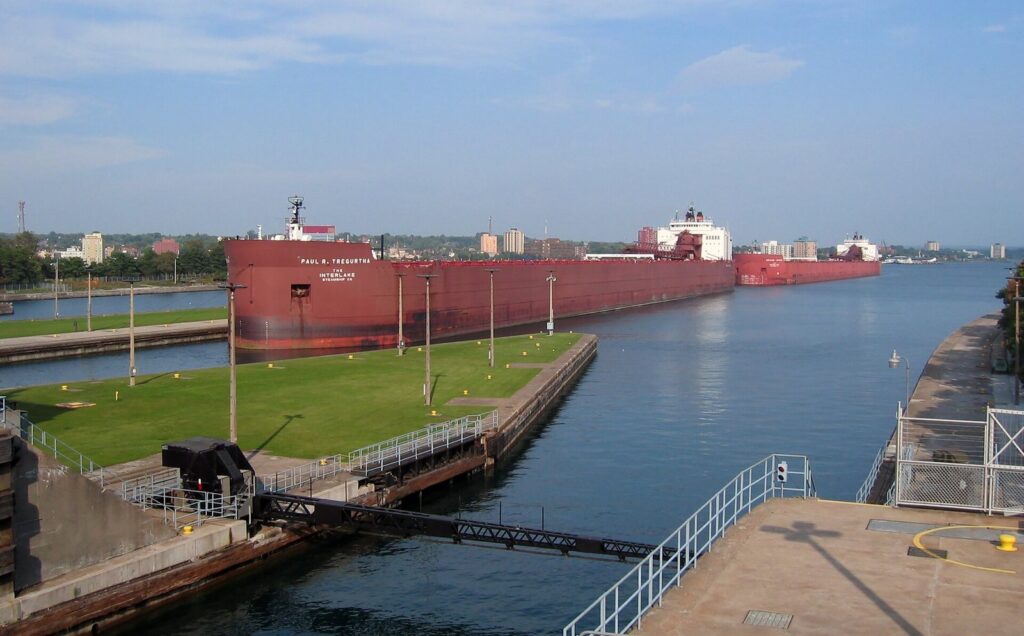
The eastern U.P. starts at the bridge. St. Ignace is the northern landing and a departure point for the ferries to Mackinac Island, the car-free island in the Straits. North on I-75, Sault Ste. Marie, Michigan’s oldest city, sits on the St. Marys River, where the Soo Locks lift freighters up to 1,000 feet long between Lake Huron and Lake Superior; a new lock sized for the biggest ships is under construction, with completion targeted for 2030. West of the Soo, Tahquamenon Falls State Park has the Upper Falls, about 48 feet high and more than 200 feet wide, with water stained the color of tea by tannins, and a set of smaller Lower Falls. At Whitefish Point, the Great Lakes Shipwreck Museum tells the story of the ships lost on Lake Superior, including the Edmund Fitzgerald, whose bell is displayed there. Drummond Island, off the eastern tip, is a quiet escape for boaters and off-road riders. Sault Ste. Marie is about 5 hours from Detroit, and Paradise about 5.5.
How to spend your time in the east: give the Soo Locks an hour or two, watching from the observation platforms as the freighters rise and fall, and add a boat tour through the locks if you have the time. At Tahquamenon, the Upper and Lower Falls are about four miles apart by road or by a river trail, so plan half a day for both, and remember the Recreation Passport. Whitefish Point is also one of the best bird-watching spots in the Great Lakes during spring migration, when hawks and waterbirds funnel along the point. Newberry, the nearest town to the falls, calls itself Michigan’s moose capital, and the roads north toward Paradise are a good place to look for them at dusk.
The central U.P.
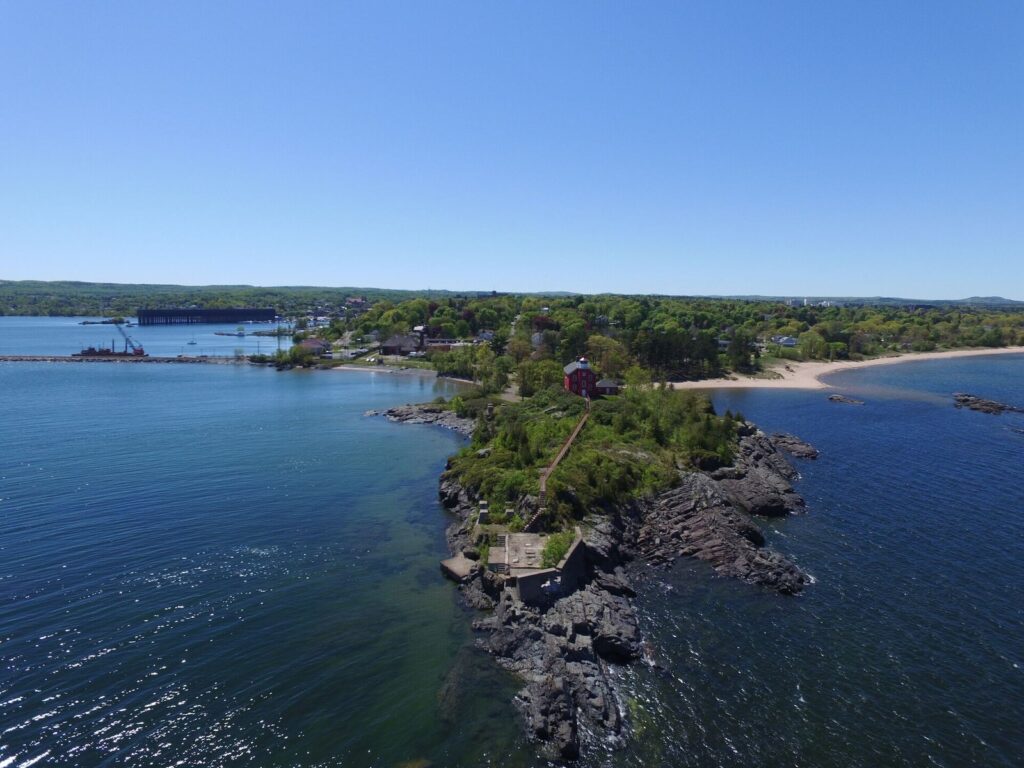
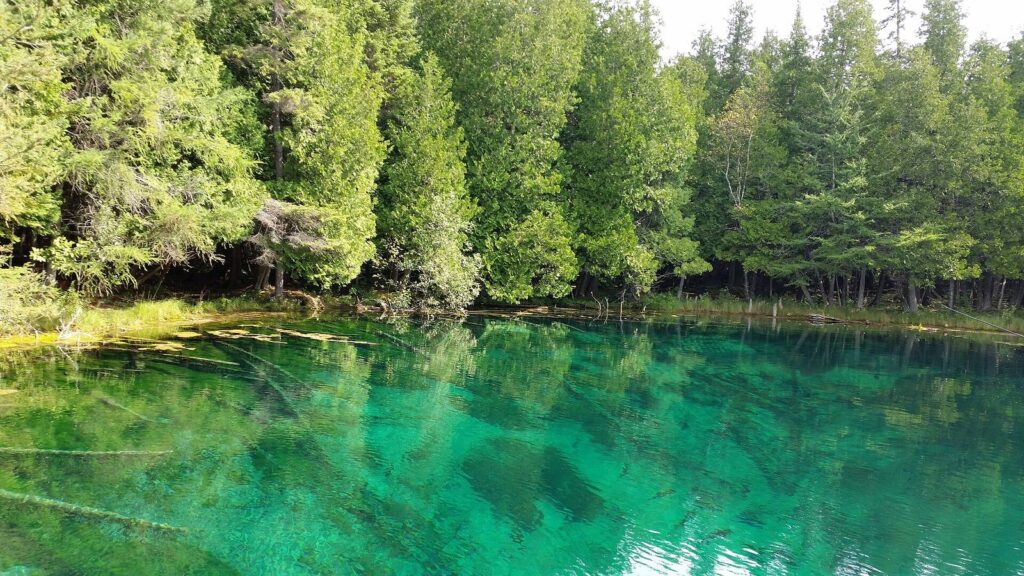
The central U.P. has the peninsula’s most famous scenery. Pictured Rocks National Lakeshore, between Munising and Grand Marais, puts mineral-streaked sandstone cliffs up to about 200 feet high along Lake Superior, best seen from a boat cruise out of Munising. Marquette, the U.P.’s largest city, has a giant ore dock on its harbor, a lighthouse, hikes up Sugarloaf Mountain and the rocky headland of Presque Isle Park. On the Lake Michigan side, Manistique is the gateway to Kitch-iti-kipi, Michigan’s largest freshwater spring, and Fayette Historic State Park preserves a 19th-century iron-smelting town on the Garden Peninsula. Between them, Seney National Wildlife Refuge is a vast wetland for birders. Munising is about 6 hours 25 minutes from Detroit and Chicago; Marquette is about 7 hours 10 minutes from Detroit and 6 hours 30 minutes from Chicago.
Marquette makes the best central base if you want restaurants, breweries and a bit of city life between days outdoors. Northern Michigan University gives it a college-town energy, and a network of trails for mountain biking in summer and skiing in winter starts right at the edge of town. Munising, an hour east, is the base for Pictured Rocks and a ring of easy waterfalls, and Grand Marais at the far end of the lakeshore is the quietest option. On the Lake Michigan side, Manistique’s lakefront boardwalk and Escanaba’s lighthouse and harbor are the south shore’s anchors, and Indian Lake, near Manistique, is one of the U.P.’s larger inland lakes. At Seney National Wildlife Refuge, a one-way wildlife drive through the marshes is good for spotting loons, trumpeter swans and sandhill cranes in summer.
The Keweenaw
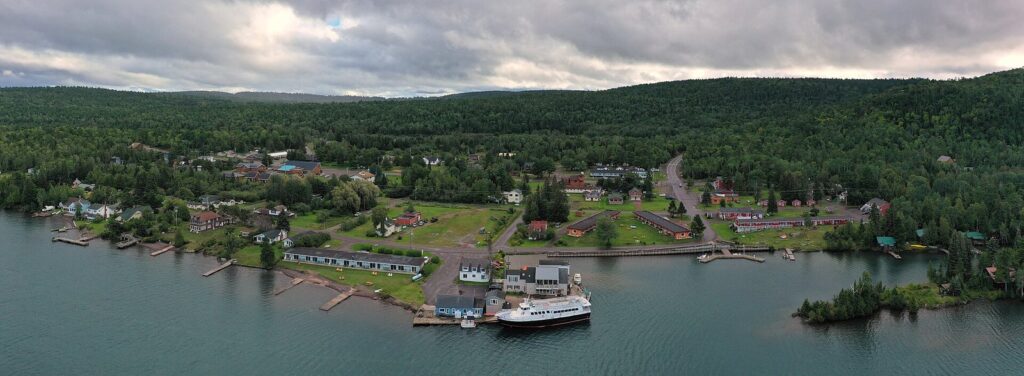
The Keweenaw Peninsula curls up into Lake Superior from Houghton and Hancock, the twin towns on either side of the Portage Canal and home to Michigan Tech. This was copper country: the Quincy Mine in Hancock operated from 1846 to 1945 and produced nearly a billion pounds of copper, and its tours go more than 360 feet underground, where it’s about 40 degrees year-round. Calumet, farther north, is the heart of Keweenaw National Historical Park. Near Eagle Harbor, the monks of the Jampot sell baked goods and thimbleberry jam, and at the tip, Copper Harbor has Fort Wilkins Historic State Park, the ridge-top Brockway Mountain Drive and the Isle Royale Queen IV to Isle Royale National Park. The Keweenaw is also the snowiest place in Michigan, with a 48-year average of 240.9 inches recorded on Keweenaw County’s roadside gauge. Houghton is about 9 hours from Detroit and 7 hours 20 minutes from Chicago.
The Keweenaw rewards slow travel. Keweenaw National Historical Park recorded 35,489 recreation visits in 2025, a fraction of Pictured Rocks’ crowds, and its sites and partner museums tell the story of copper mining and the immigrant communities it drew. The drive north on M-26 along the Lake Superior shore passes waterfalls at Eagle River, the lighthouse at Eagle Harbor and the sand beaches of Great Sand Bay. Near Copper Harbor, the Estivant Pines sanctuary protects a stand of old-growth white pines, and the town’s mountain-biking trails draw riders from across the Midwest. Fort Wilkins Historic State Park, on Lake Fanny Hooe, preserves a restored 1840s army post. And in winter, Mount Bohemia brings skiers to the snowiest corner of the state.
The western U.P.
The western U.P. is the most remote and, for many, the most beautiful. The Porcupine Mountains Wilderness State Park covers 59,020 acres of old forest and rugged hills above Lake Superior, and its Lake of the Clouds overlook is one of the most photographed views in Michigan. Around Ironwood, Bessemer and Wakefield, “Big Snow Country” is known for its winter snow, its ski hills and its summer waterfalls, many of them along the Black River Scenic Byway. Bond Falls, near Paulding, is one of the most popular waterfalls in the U.P., and Copper Peak, near Ironwood, is a giant ski-flying hill. Much of the region is on Central time. The Porcupine Mountains are about 7 hours from Chicago and 9.5 from Detroit, and Ironwood is about 4 hours from Minneapolis.
In the Porcupine Mountains, the drive-up Lake of the Clouds overlook takes minutes, but the park rewards a full day: the waterfalls of the Presque Isle River at the park’s west end, the backcountry trails and cabins, and the long Lake Superior shoreline. Farther south, Lake Gogebic is the region’s big inland lake for fishing and boating, and near Norway, Piers Gorge on the Menominee River is known for its whitewater, with rafting trips in summer. Iron Mountain and Iron River, in the south-central U.P., are old mining towns with their own ski hills and a slower pace. For a western base, Ironwood, Bessemer and Wakefield have the most lodging, while Silver City sits at the doorstep of the Porkies.
Getting to the U.P. and getting around
How much does it cost to cross the Mackinac Bridge?
The Mackinac Bridge toll is $4.00 for a passenger vehicle in 2026, charged at $2 per axle; other vehicles pay $5 per axle. You pay on the St. Ignace side, heading north or south, with cash, cards, Apple Pay or Google Pay, or with a prepaid MacPass account. The bridge is five miles long, with a main span of 3,800 feet, and opened in November 1957. High winds can slow traffic or restrict high-profile vehicles, so check conditions in stormy weather.
Drive times
| Destination | From Detroit | From Grand Rapids | From Chicago | From Minneapolis |
|---|---|---|---|---|
| St. Ignace (the bridge) | about 4 h 20 min | about 3 h 40 min | about 6 h 30 min | |
| Sault Ste. Marie | about 5 h | about 4 h 25 min | about 7 h 15 min | |
| Paradise (Tahquamenon Falls) | about 5 h 30 min | about 4 h 50 min | about 7 h 40 min | |
| Munising (Pictured Rocks) | about 6 h 25 min | about 5 h 45 min | about 6 h 25 min | |
| Marquette | about 7 h 10 min | about 6 h 35 min | about 6 h 30 min | about 6 h 35 min |
| Houghton | about 9 h | about 8 h 20 min | about 7 h 20 min | about 6 h |
| Copper Harbor | about 9 h 50 min | about 9 h 10 min | about 8 h 10 min | |
| Silver City (Porcupine Mountains) | about 9 h 30 min | about 8 h 55 min | about 7 h | |
| Ironwood | about 4 h 10 min |
These are free-flowing times; summer weekend traffic at the bridge, road work on two-lane highways and deer at dusk all add time. Chicago and Minneapolis drivers reach the central and western U.P. through Wisconsin without crossing the bridge. Remember that Central-time counties change the clock.
Flying in
The U.P.’s airports are small. Sawyer International (SAW), south of Marquette, had 44,574 boardings in 2024; Houghton County Memorial (CMX) in Hancock, for the Keweenaw, had 25,833; and Chippewa County International (CIU), near Sault Ste. Marie, had 26,482. Pellston (PLN), just south of the bridge in the Lower Peninsula, is another option for the eastern U.P. Most U.P. flights connect through a major hub, and you’ll need a rental car on arrival.
Getting around
A car is essential. Public transit is limited to local systems, and distances between attractions are long. Fill the tank when you can, because stations are far apart in places like the Seney stretch of M-28 and along the Lake Superior shore; carry water and snacks; and download offline maps, since cell coverage drops out across large parts of the U.P. Watch for deer, especially at dawn and dusk, and for moose in the central and western U.P.
Scenic routes worth building in
Some of the best U.P. driving is on the way to somewhere else. US-2 west of St. Ignace runs right along Lake Michigan’s northern shore past dunes and beaches toward Naubinway. M-28 between Munising and Marquette follows Lake Superior for long stretches, with pullouts for the view. H-58 winds through the forest behind Pictured Rocks to Grand Marais. M-26 up the Keweenaw passes waterfalls, harbors and sand beaches on the way to Copper Harbor, and Brockway Mountain Drive climbs above it. In the far west, the Black River Scenic Byway leads north from Bessemer past a string of waterfalls to Lake Superior. Leave extra time for all of them; you’ll stop more than you expect, and on a clear evening the Lake Superior stretches are worth timing for sunset, when the light turns the water gold.
Is the Upper Peninsula in a different time zone?
Mostly not, but it matters. Most of the U.P. is on Eastern time, like the rest of Michigan, but Gogebic, Iron, Dickinson and Menominee counties, along the Wisconsin border in the western and south-central U.P., use Central time. That puts Ironwood, Bessemer, Iron Mountain, Iron River, Norway and Menominee an hour behind Marquette, Houghton and the Soo. Lake Gogebic even spans both zones. The practical effects: a tour or ferry time in Houghton is on Eastern time even if you’re staying in Ironwood; Chicago drivers keep their home time in the Central counties and lose an hour elsewhere; and anyone driving east across the line should reset their watch before a timed reservation.
Top 15 things to do in the Upper Peninsula
- Cruise or paddle Pictured Rocks from Munising, then hike to Miners Castle and Chapel Rock.
- See Tahquamenon Falls, the Upper Falls and the Lower Falls, west of Paradise.
- Float over Kitch-iti-kipi, the 200-foot-wide, 40-foot-deep spring near Manistique, on the free hand-powered raft (a Recreation Passport is needed for the car).
- Watch the freighters at the Soo Locks in Sault Ste. Marie.
- Visit Mackinac Island by ferry from St. Ignace.
- Stand on the shore at Whitefish Point and visit the Great Lakes Shipwreck Museum.
- Walk Marquette’s lakeshore, from the ore dock to Presque Isle Park, and climb Sugarloaf Mountain.
- Go underground at the Quincy Mine in Hancock, and explore Calumet’s copper-era downtown.
- Drive Brockway Mountain above Copper Harbor, and stop at the Jampot on the way.
- Cross to Isle Royale from Houghton or Copper Harbor for the Midwest’s wildest national park.
- Look out over Lake of the Clouds in the Porcupine Mountains.
- Chase waterfalls along the Black River Scenic Byway and at Bond Falls.
- Explore Fayette, the ghost town of an iron-smelting company on the Garden Peninsula.
- Take a fall color drive in late September and early October, when the U.P. leads Michigan’s fall color season.
- Come back in winter for skiing, snowmobiling, ice caves and Michigan Tech’s Winter Carnival.
For more on the U.P.’s place in the state’s autumn, see our guide to Michigan fall colors, which covers peak timing region by region.
Where to base yourself in the U.P.
| Trip style | Base | Why |
|---|---|---|
| A first U.P. trip | Munising or Marquette | Pictured Rocks, waterfalls and Marquette’s restaurants and services within an hour |
| Waterfalls and Tahquamenon | Paradise or Newberry | The falls, Whitefish Point and the Lake Superior shore |
| The Soo and Mackinac | Sault Ste. Marie or St. Ignace | The locks, the ferries to Mackinac Island and an easy drive from the bridge |
| Copper country and Isle Royale | Houghton-Hancock or Copper Harbor | Mines, historic towns, Brockway Mountain and the Isle Royale boats and seaplanes |
| The Porkies and western waterfalls | Ironwood, Wakefield or Silver City | The Porcupine Mountains, the Black River falls and Big Snow Country |
| Lake Michigan shore | Manistique or Escanaba | Kitch-iti-kipi, Fayette and the quieter south shore |
Cabins, motels or hotels?
The U.P.’s lodging leans toward independent motels, lakeside cabins and small resorts, with chain hotels in the bigger towns like Marquette, the Soo, Houghton, Escanaba and St. Ignace. Cabins suit longer stays and families, with kitchens and lake views, but often require minimum stays in summer. Motels suit road trips. Book early for July, August and fall color weekends, especially in small gateway towns like Munising, Copper Harbor and Grand Marais, where there isn’t much to choose from. Many seasonal places close from late October to spring. Campers can choose from state parks, state forest campgrounds and national forest sites across the peninsula.
When to go: the U.P. month by month
| Month | What it’s like | Watch for |
|---|---|---|
| January to March | Deep snow, skiing, snowmobiling, ice caves, winter festivals | Winter driving; short days; Central-time counties |
| April | Snowmelt and the fullest waterfalls | Mud, lingering snow and many seasonal closures |
| May | Waterfalls and quiet trails; Isle Royale boats start mid-month | Black flies arrive late in the month; cold nights |
| June | Long days and green forests | Black flies and mosquitoes at their worst |
| July to August | Peak summer: warmest days, everything open | Crowds at Pictured Rocks and Tahquamenon; book lodging early; Lake Superior stays cold |
| September | Fewer bugs and crowds, cool nights; color starts in the west late in the month | Isle Royale boats end in September |
| October | Fall color, usually best in the first three weeks | Businesses closing after color season; early snow possible |
| November | Quiet, gray and between seasons | Firearm deer season opens November 15; wear orange in the woods |
| December | Snow returns and ski season begins | Winter storms and lake-effect squalls |
What is the best month to visit the Upper Peninsula?
For most visitors, it’s late August or early September, when the bugs have eased, the lake-shore towns are still open, the crowds have thinned and the weather is often at its most settled. July and August are the warmest months and the best for boat tours and beaches. Late September through mid-October is fall color season, with the western U.P. usually peaking first. December to March is for skiers and snowmobilers. Avoid June if black flies and mosquitoes bother you, and April if you dislike mud.
Fall color in the U.P.
The U.P. starts Michigan’s fall color season. UP Travel’s weekly color report, updated every Wednesday, expected the western counties to peak in the last week of September and the first week of October in 2026, the central U.P. in the first and second weeks of October, and the eastern U.P. in the second week. The best color drives follow the same pattern from west to east: the Black River Scenic Byway and the roads around the Porcupine Mountains first, then US-41 and M-26 up the Keweenaw and Brockway Mountain Drive, then H-58 behind Pictured Rocks and M-123 to Tahquamenon Falls. Book color weekends early, because rooms in the small towns go fast.
Summer on Lake Superior
Summer is short and bright on the big lake. Lake Superior stays cold all year, so most swimmers stick to sheltered bays, shallow sandy beaches warmed by the sun and the U.P.’s many inland lakes. The real beach pastime is rock hunting: Lake Superior’s shores, especially around Grand Marais and the Keweenaw, are known for agates and colorful stones, and collecting a few is part of a U.P. summer where rules allow it (national park units restrict collecting). Sunsets come late, after 9:30 p.m. around the solstice in the Eastern-time areas, and are worth staying up for.
Accessible highlights
Several of the U.P.’s best sights work for visitors with limited mobility. Kitch-iti-kipi’s observation raft and the path to it are accessible, the Soo Locks’ viewing platforms are close to parking, the Pictured Rocks cruises show the cliffs from the water, the Miners Castle overlook has paved paths, and the Upper Falls at Tahquamenon has viewing areas near the parking lot. Call ahead about specific needs, since older buildings and remote trails can be challenging.
Money-saving tips
Buy an annual Recreation Passport if you’ll visit several state parks. Travel in the shoulder seasons of early June and September, when rooms are cheaper and easier to find. Rent a cabin with a kitchen for longer stays, pack picnics for long days on the road, and look for free sights like the Soo Locks, Kitch-iti-kipi (with the passport), waterfalls and lighthouses.
Winter in the U.P.
The U.P. is one of the snowiest places east of the Rockies. Lake Superior’s lake-effect snow buries the Keweenaw, the Marquette area and the western hills, and Keweenaw County’s snow gauge records a record 390.4 inches in the winter of 1978-79. That snow makes the U.P. a winter destination in its own right.
- Skiing: Mount Bohemia in the Keweenaw has the most vertical in Michigan and deep natural snow, and Snowriver near Wakefield joins the Ikon Pass for 2026-27. Big Powderhorn, Marquette Mountain, Pine Mountain and Mont Ripley round out the list; our guide to Michigan ski resorts compares them all.
- Snowmobiling: thousands of miles of groomed trails link towns across the peninsula, and many motels and restaurants cater to riders.
- Festivals: Michigan Tech’s Winter Carnival in Houghton, with its giant snow statues, runs February 3-6, 2027, and the UP200 sled dog race starts in Marquette on February 11-15, 2027.
- Ice: frozen waterfalls, the Eben Ice Caves near Munising and ice climbing on the Pictured Rocks cliffs.
- Cross-country skiing and snowshoeing: groomed trails in the national lakeshore and around the bigger towns.
Winter travel needs preparation: winter tires, an emergency kit, a full tank and a flexible schedule. Storms can close roads, and never walk onto lake ice unless local authorities have confirmed it’s safe.
Can you see the northern lights in the U.P.?
Yes. The U.P.’s northern latitude, dark skies and long Lake Superior shoreline make it one of the best places in the Midwest to see the aurora, though sightings depend on solar activity and clear skies and are never guaranteed. The best chances come on clear, moonless nights from late summer through spring, when nights are long. Face north over Lake Superior from a dark spot away from town lights: the Keweenaw around Copper Harbor, Marquette’s Presque Isle Park, Whitefish Point and the Lake Superior shore near Grand Marais are all favorites. Check an aurora forecast, such as NOAA’s Space Weather Prediction Center, and dress warmly, since the best displays often come late at night.
Yooper culture: pasties, saunas and the Jampot
People from the U.P. call themselves Yoopers, from “U.P.-ers,” and they call people from the Lower Peninsula “trolls,” because they live under the bridge. The U.P.’s culture grew out of mining, logging and fishing towns settled by Cornish, Finnish, Italian, French-Canadian and many other immigrants, alongside the Anishinaabe peoples who have lived here for thousands of years.
- Pasties: the U.P.’s signature food, a hand-held pastry filled with beef, potato, onion and often rutabaga, brought by Cornish miners who carried them underground. You’ll find pasty shops in almost every town.
- Saunas: the Keweenaw has one of the largest concentrations of Finnish Americans in the country, and the sauna tradition runs deep. Locals pronounce it “SOW-na.”
- The Jampot: near Eagle Harbor, the monks of the Society of St. John run a bakery selling fruitcakes, muffins and jams made from local thimbleberries, blueberries and other fruit. In 2026 its door sales run Wednesday to Saturday until October 17, reopening in spring.
- Thimbleberry jam: made from a wild raspberry-like berry that grows along Lake Superior, sold in small jars across the Keweenaw.
- The accent: a distinctive Yooper way of talking, with Finnish and Canadian influences, and plenty of “eh.”
Beyond the pasty: what to eat in the U.P.
Pasties are only the start. Lake Superior whitefish and trout, fried, broiled or smoked, show up on menus all along the shore and at roadside fish shops. In the Keweenaw, Finnish pancakes, called pannukakku, are a breakfast tradition, baked in the oven and thicker than their Swedish cousins. Around Ishpeming and Negaunee, cudighi, a spiced Italian sausage sandwich, is the local specialty. Thimbleberry jam, wild blueberries in August and craft beer from the breweries in Marquette, Houghton, Munising and other towns round it out. Many restaurants in small towns keep seasonal hours, so check before driving far for dinner, especially after mid-October.
The U.P. with kids
The U.P. is a great family road trip if you keep the driving in check. Base in one or two places for several nights rather than moving every day, and build each day around one big outing and one easy one. Kids tend to love the Soo Locks, where the freighters seem close enough to touch; the Pictured Rocks cruises; the hand-powered raft at Kitch-iti-kipi; the waterfalls at Tahquamenon and around Munising; the underground tour at the Quincy Mine; and hunting for agates and interesting stones on Lake Superior’s beaches. Pack layers even in summer, bug spray for June and July, and plenty of snacks, since restaurants can be far apart. Most state parks and national park units run junior ranger or nature programs in summer.
A U.P. road-trip checklist
- Before you go: book lodging early for summer and fall color weekends, buy a Recreation Passport if you’ll visit state parks, and check whether the places on your list are open for the season.
- In the car: offline maps, a paper map as backup, water, snacks, a first-aid kit, bug spray and a warm layer.
- On the road: fill up at half a tank, plan long drives for daylight, and watch for deer and moose.
- Money: carry a card and some cash; a few small businesses in remote areas prefer cash, while others, like Mount Bohemia, are card-only.
- Time: note which reservations are on Eastern and which on Central time.
Tips for Chicago and Twin Cities drivers
For travelers from Chicago and Minneapolis-St. Paul, the U.P. is closer than it looks, and you don’t need to cross the Mackinac Bridge at all. From Chicago, the central and western U.P. are reached through Wisconsin: Munising and Marquette are each about six and a half hours away, and the Porcupine Mountains about seven. From the Twin Cities, Ironwood is only about four hours, Houghton about six and Marquette about six and a half. Both routes cross into the Central-time counties first, then into Eastern time farther east, so an evening arrival in Marquette or Houghton comes an hour later on the clock than you might expect. A good plan for a week is to enter through Wisconsin, loop east to the bridge and Mackinac Island, and return home through the Lower Peninsula or back the way you came.
The U.P. vs. the Lower Peninsula
Choose the U.P. for: wilderness, waterfalls, Lake Superior, dark skies, fewer people and a slower pace.
Choose the Lower Peninsula for: shorter drives from Detroit and Chicago, beach towns, wineries, bigger resorts and more restaurants and shopping.
Our verdict: for a first northern trip with limited time, the northern Lower Peninsula is easier; for a trip you’ll remember for the landscape, cross the bridge.
Sample U.P. itineraries
Three days: the central U.P.
- Day 1: cross the bridge and drive to Munising, about two hours on M-28, or take US-2 along Lake Michigan and add a stop at Kitch-iti-kipi near Manistique, which makes a longer day.
- Day 2: a Pictured Rocks cruise in the morning, Miners Castle and Munising Falls in the afternoon.
- Day 3: Marquette: the lakeshore, Presque Isle Park, the ore dock and a hike up Sugarloaf Mountain before heading home.
Five days: the Keweenaw
- Day 1: drive to Houghton-Hancock.
- Day 2: the Quincy Mine tour and Calumet’s historic downtown.
- Day 3: the drive up the Keweenaw along M-26 through Eagle River and Eagle Harbor, with a stop at the Jampot, to Copper Harbor and Fort Wilkins.
- Day 4: Brockway Mountain Drive at sunrise, then a day trip to Isle Royale on the Queen IV, or a day hiking and paddling around Copper Harbor.
- Day 5: back south along Lake Superior, with a night in Marquette if you have time.
Seven days: the full U.P. loop
- Day 1: cross the bridge, visit the Soo Locks and spend the night in Sault Ste. Marie.
- Day 2: Whitefish Point and Tahquamenon Falls; overnight in Paradise or Newberry.
- Day 3: west on M-28 to Munising and Pictured Rocks.
- Day 4: Marquette.
- Day 5: the Keweenaw: Houghton, the Quincy Mine and Copper Harbor.
- Day 6: the Porcupine Mountains and Lake of the Clouds.
- Day 7: back east along US-2 via Escanaba, Fayette and Kitch-iti-kipi to the bridge, a long day that’s better split over two.
U.P. passes and fees
| Pass or fee (2026) | Price | What it covers |
|---|---|---|
| Mackinac Bridge toll | $4 per passenger vehicle | Each crossing |
| Recreation Passport | $15 residents at plate renewal; non-residents $42 a year or $12 a day | State parks, including Tahquamenon Falls, the Porcupine Mountains, Palms Book (Kitch-iti-kipi), Fort Wilkins and Fayette |
| Pictured Rocks National Lakeshore | $25 per private vehicle for 7 days; $45 annual | The national lakeshore |
| Isle Royale National Park | $7 per person per day; $60 season pass | Entry to the island (transport extra) |
| America the Beautiful | $80 U.S. residents; $250 non-residents | All federal fee areas, including Pictured Rocks and Isle Royale |
Most of the U.P.’s best sights are in state or national parks, so for a week-long trip a non-resident’s $42 annual Recreation Passport usually beats paying $12 a day. If you’ll visit both Pictured Rocks and Isle Royale, compare the America the Beautiful pass with the individual fees.
Staying safe in the U.P.
- Distances: keep the tank at least half full, carry water and snacks, and download offline maps.
- Wildlife on the road: deer are common everywhere, especially at dawn and dusk, and moose live in the central and western U.P.
- Lake Superior: it’s cold enough to cause cold shock even in August. Check beach flags where posted, stay out when waves are high and remember rip currents can form on any Great Lakes beach.
- Bugs: bring repellent and a head net for June and July, and check for ticks after hiking.
- Hunting season: wear bright orange if you’re in the woods in the fall, especially after the firearm deer season opens on November 15.
- Winter: travel with winter tires and an emergency kit, and stay off lake ice unless it’s confirmed safe.
What to skip
Skip trying to see the whole U.P. in a weekend. Pick one or two regions and slow down.
Skip June if you hate bugs. Black flies and mosquitoes peak; late August and September are far more comfortable.
Skip driving after dark in deer country if you can. Plan long drives for daylight.
Skip forgetting the time zone. The western counties run on Central time; ferry and tour times in the Keweenaw don’t.
Skip late October in the small lakeshore towns. Many seasonal businesses close after color season.
Skip the fast-food stop. Have a pasty instead.
Frequently asked questions
What is the Upper Peninsula of Michigan known for?
The U.P. is known for wild Lake Superior shorelines, Pictured Rocks National Lakeshore, Tahquamenon Falls, the Soo Locks, Mackinac Island, the Porcupine Mountains and Isle Royale, hundreds of waterfalls, deep winter snow and snowmobiling, and its copper-mining history. It’s also known for pasties, Finnish sauna culture and its proud residents, the Yoopers.
How many days do you need in the Upper Peninsula?
Plan at least three days for one region, such as Munising, Pictured Rocks and Marquette, and five days for two regions or the Keweenaw. A full loop of the U.P., from the Soo and Tahquamenon to the Keweenaw and the Porcupine Mountains, needs a week or more, because the distances between regions are long.
What is the prettiest part of the Upper Peninsula?
It’s a close call, but most people would pick the Lake Superior shore: Pictured Rocks between Munising and Grand Marais, the Keweenaw from Eagle Harbor to Copper Harbor and Brockway Mountain, and the Porcupine Mountains’ Lake of the Clouds. Tahquamenon Falls and Kitch-iti-kipi are the most striking inland sights.
Is the Upper Peninsula in a different time zone?
Mostly no. Most of the U.P. is on Eastern time, like the rest of Michigan, but Gogebic, Iron, Dickinson and Menominee counties along the Wisconsin border use Central time. That includes Ironwood, Iron Mountain, Iron River and Menominee. Ferry and tour times in Houghton and Copper Harbor are on Eastern time.
How much does it cost to cross the Mackinac Bridge?
In 2026, the toll is $4.00 for a passenger vehicle, charged at $2 per axle, and $5 per axle for other vehicles. You pay at the toll plaza on the St. Ignace side in either direction, with cash, cards, Apple Pay or Google Pay, or with a prepaid MacPass account.
What is the best month to visit the Upper Peninsula?
Late August and early September are the best all-round choice, with fewer bugs and crowds and pleasant weather. July and August are warmest and best for boat tours and beaches. Late September to mid-October brings fall color, and December to March suits skiers and snowmobilers. June is buggy, and April is muddy.
Can you see the northern lights in the U.P.?
Yes, on clear, dark nights when solar activity is high, though sightings are never guaranteed. The best chances come from late summer through spring. Face north over Lake Superior from a dark spot such as Copper Harbor, Marquette’s Presque Isle Park, Whitefish Point or the shore near Grand Marais, and check an aurora forecast before you go.
Is the Upper Peninsula worth visiting?
Yes. The U.P. has some of the Midwest’s best scenery: Pictured Rocks, Lake Superior’s shoreline, Tahquamenon Falls, the Porcupine Mountains and Isle Royale, plus dark skies and small towns with character. It’s worth it if you plan around the long distances, base yourself in one or two regions and give it at least three days.
Sources and verification
Everything on this page was checked on September 23, 2026 against the organizations listed below. The guide is compiled from their published information and claims no first-hand visits.
- Upper Peninsula Travel & Recreation Association: regions (regional attractions)
- Mackinac Bridge Authority: fare schedule (2026 tolls and payment options)
- National Park Service: Keweenaw National Historical Park
- Quincy Mine (history, hours and underground conditions)
- The Jampot, Society of St. John (2026 hours and season)
We also used the Michigan DNR for Recreation Passport prices and Palms Book State Park, the National Park Service for Pictured Rocks and Isle Royale fees, FAA boarding figures for the U.P.’s airports, Michigan Tech and the UP200 for 2027 event dates, the Keweenaw County Road Commission’s snow gauge and a routing service for drive times.
Michigan Tourism Guide is an independent publication. It is not affiliated with Pure Michigan or any agency or business named here.
Photo credits
- Lake of the Clouds (featured image): photo by Stevenliuyi, Wikimedia Commons (CC BY-SA 4.0)
- Mackinac Bridge: photo by Justin Billau, Wikimedia Commons (CC BY 2.0)
- Soo Locks: photo by Acroterion, Wikimedia Commons (CC BY-SA 4.0)
- Marquette Harbor Lighthouse: photo by Ben Harris, Wikimedia Commons (CC BY-SA 4.0)
- Copper Harbor: photo by August Schwerdfeger, Wikimedia Commons (CC BY 4.0)
- Kitch-iti-kipi: photo by Notorious4life (talk) (Uploads), Wikimedia Commons (CC0)