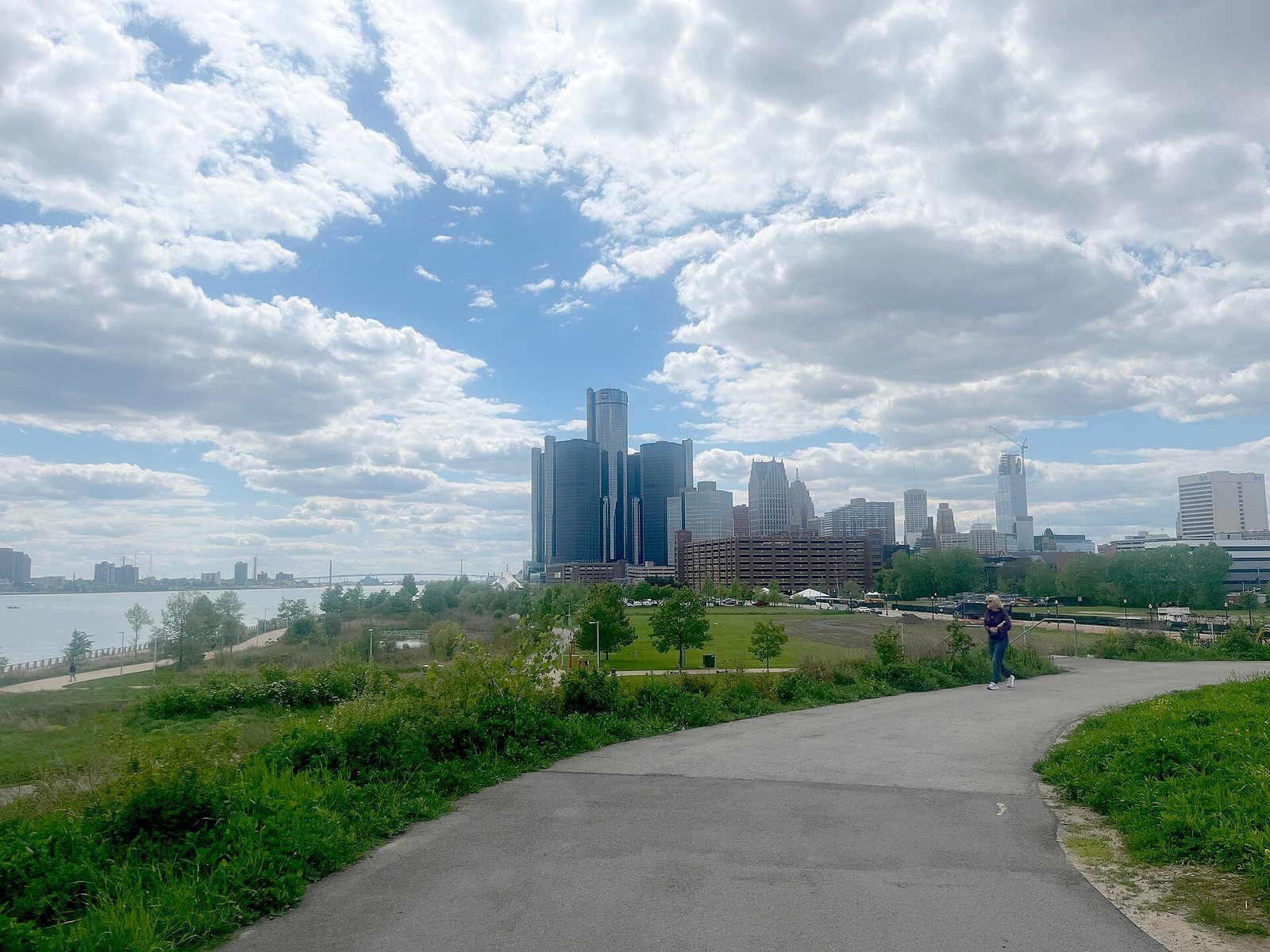
You can ride the People Mover’s downtown loop for free, walk into Michigan Central Station’s restored lobby for free, and, if you live in Wayne, Oakland or Macomb County, see Diego Rivera’s Detroit Industry murals for free. That’s a good way to start thinking about things to do in Detroit: the city’s biggest sights are close together, often cheaper than you’d expect, and spread across a handful of neighborhoods you can string together in a day or two, from the riverfront and downtown to Midtown’s museums, Corktown, Eastern Market and Dearborn.
The short answer: in two or three days, see the Detroit Institute of Arts, The Henry Ford in Dearborn, Michigan Central Station, the RiverWalk and Belle Isle, and spend a Saturday morning at Eastern Market. Get around downtown and up Woodward on the fare-free People Mover and QLine. Know the 2026-27 changes: Motown Museum tours are paused until spring 2027, the Gordie Howe International Bridge to Windsor opened July 27, 2026, and the new Ralph C. Wilson Jr. Centennial Park opened on the west riverfront in October 2025.
The details below were checked September 23, 2026 against the operators’ and agencies’ own websites, including 2026 ticket prices and hours for The Henry Ford, the DIA, Michigan Central and Eastern Market.
On this page: Top 12 · Detroit in brief · Downtown and the riverfront · Midtown museums · Corktown and Michigan Central · Eastern Market · Belle Isle · Motown and New Center · Dearborn and The Henry Ford · Ann Arbor · Black history · Architecture · More neighborhoods · With kids · Getting around · Safety · Events 2026-27 · At night · Sports · On a budget · Free things · Where to stay · Food · Windsor · How many days · When to go · What to skip · FAQ
Detroit in one screen: the top 12 things to do in Detroit
| Pick | Neighborhood | Price (2026) | Hours | Time needed |
|---|---|---|---|---|
| Detroit Institute of Arts | Midtown | Free for Wayne, Oakland and Macomb residents; $20 adults, $10 seniors and college students, $8 ages 6-17 for others | Tue-Thu 9-4, Fri 9-9, Sat-Sun 10-5; closed Mon | 2-4 h |
| Henry Ford Museum of American Innovation | Dearborn | $34-36 adults, bought online by date | Check the day’s hours online | 3-5 h |
| Greenfield Village | Dearborn | $37-39 adults | Seasonal; check dates | Half to full day |
| Ford Rouge Factory Tour | Dearborn | $24 adults | Check the day’s schedule | About 2 h |
| Michigan Central Station | Corktown | Free to walk the lobby; 90-minute guided tours are extra | Lobby daily 8 a.m.-5 p.m. | 30 min to 1.5 h |
| Detroit RiverWalk and Centennial Park | Riverfront | Free | Daily | 1-3 h |
| Belle Isle | Detroit River | Free on foot or bike; cars need a Recreation Passport ($12 a day for non-residents) | Aquarium Thu-Sun 10-4 (free, $5 donation encouraged) | Half a day |
| Eastern Market | Eastern Market | Free to browse | Saturday 6 a.m.-4 p.m. year-round; Sunday and Tuesday markets June-September | 2 h |
| Charles H. Wright Museum of African American History | Midtown | Check current admission | Check current hours | 2 h |
| Motown Museum | West Grand Boulevard | Tours paused until spring 2027 | Museum store open | 30 min |
| People Mover and QLine | Downtown and Woodward | Free | Check service hours | 15-45 min |
| Campus Martius and Hart Plaza | Downtown | Free | Daily | 1 h |
Prices for The Henry Ford are for tickets bought online, which vary by date; seniors 62 and over get 10% off, youth 5 to 11 get 25% off, children 4 and under are free, and $10 parking is added to each online order, plus a $4 service fee (2026).
Detroit in brief: what the city is known for
Detroit was founded in 1701 as a French fur-trading post, Fort Pontchartrain du Detroit, on the strait between Lake St. Clair and Lake Erie that gave the city its name. After a fire destroyed the town in 1805, it adopted a motto that still fits: Speramus meliora; resurget cineribus, “We hope for better things; it shall rise from the ashes.”
The 20th century made Detroit the Motor City. Henry Ford’s moving assembly line began turning out Model Ts in 1913 in nearby Highland Park, Ford, General Motors and Chrysler built the modern auto industry here, and during World War II the city’s factories became the “Arsenal of Democracy.” The jobs drew hundreds of thousands of Southern Black families in the Great Migration and immigrants from around the world, and by 1950 Detroit had about 1.85 million people. Out of that city came Motown, founded by Berry Gordy in 1959, and later techno.
The decades that followed were hard: the 1967 uprising, the flight of people and jobs to the suburbs and beyond, and in 2013 the largest municipal bankruptcy in U.S. history. The population fell to about 640,000 by 2020. The city that visitors find now is in the middle of a long recovery, most visible downtown, in Midtown and Corktown and along the riverfront, and the restored Michigan Central Station has become its symbol.
Downtown Detroit and the riverfront
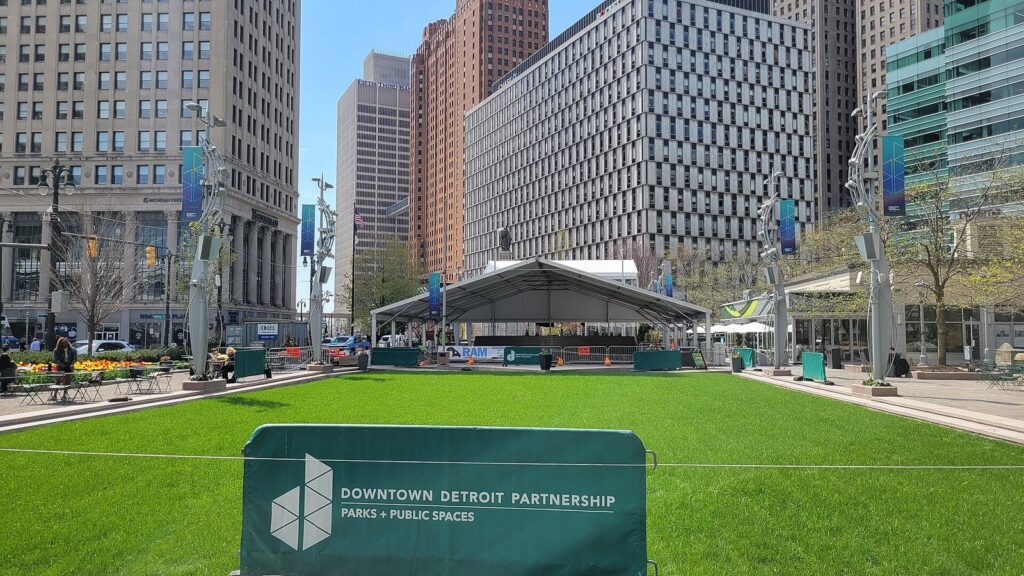
Downtown Detroit is compact, busy and easy to walk, built around Woodward Avenue running north from the Detroit River. Its center is Campus Martius Park, a public square ringed by office towers that turns into an urban beach in summer and an ice rink under a giant Christmas tree in winter. A few blocks south, Hart Plaza sits on the river and hosts the city’s biggest festivals, including Movement, the electronic music festival, each Memorial Day weekend.
The RiverWalk and Centennial Park
The Detroit RiverWalk is the city’s best free attraction: a wide path along the Detroit River with views across to Windsor, parks and plazas along the way, and connections to the Dequindre Cut, a sunken greenway on a former rail line that runs north toward Eastern Market. On the east side it runs toward the bridge to Belle Isle, past a carousel, a riverside beach area and Milliken State Park. On the west side, the Ralph C. Wilson Jr. Centennial Park opened in October 2025: 22 acres of riverfront park at 1801 W. Jefferson, with a water-play feature planned for spring 2026. Walk or bike it at sunset, when the Renaissance Center’s towers and the Windsor skyline catch the light.
What else is downtown
- Architecture: the Guardian Building’s Art Deco banking hall is one of the most striking interiors in the city, and downtown is full of early-20th-century towers.
- Hudson’s Detroit: the development on the site of the old Hudson’s department store is rising in stages. Its 12-story building was completed in October 2025, Nick Gilbert Way opened through the site in November 2025, and a 45-story tower with The Detroit EDITION hotel is due in 2027.
- Sports: Ford Field (Lions), Comerica Park (Tigers) and Little Caesars Arena (Red Wings and Pistons) are all within walking distance of each other on the north side of downtown.
- Theaters: the Fox, the Fillmore and the Detroit Opera House anchor the theater district around Grand Circus Park.
- Greektown: a block of restaurants and a casino along Monroe Street.
Midtown: the DIA, the Wright Museum and the museum district
Midtown, a mile or two north of downtown along Woodward and reachable on the QLine, is Detroit’s cultural district, home to Wayne State University and a cluster of museums within a few blocks of each other.
The Detroit Institute of Arts
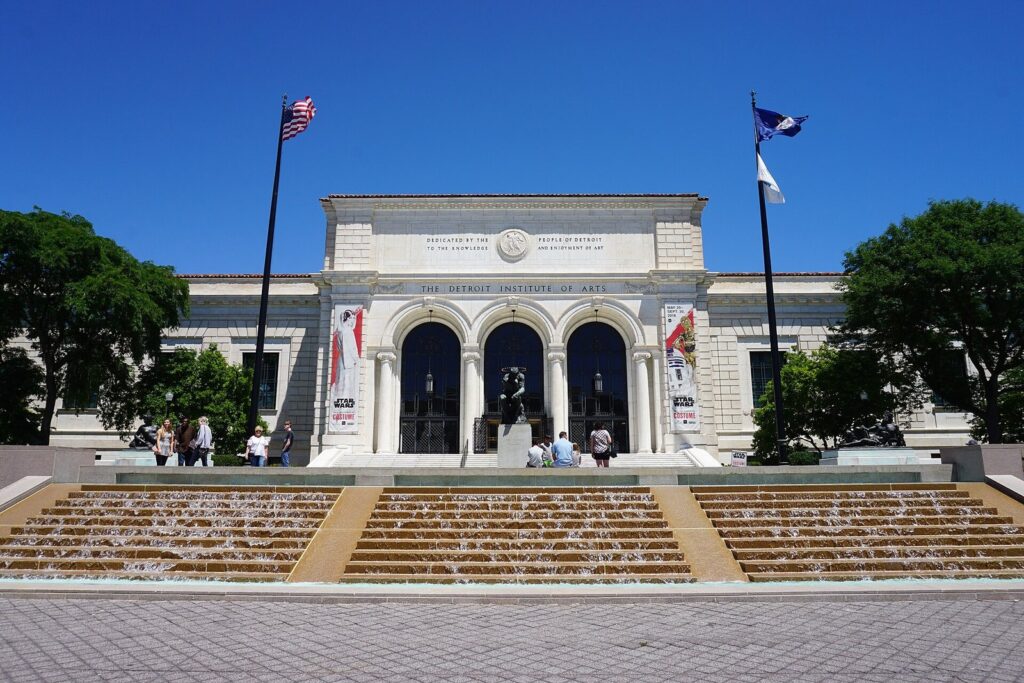
The DIA is one of the country’s great art museums, and its centerpiece is Diego Rivera’s Detroit Industry, a room of murals painted in 1932-33 that shows the city’s auto plants in extraordinary detail. The collection runs from ancient art to contemporary work, including one of Vincent van Gogh’s self-portraits. General admission is free for residents of Wayne, Oakland and Macomb counties, whose property taxes support the museum; everyone else pays $20 for adults, $10 for seniors and college students and $8 for ages 6 to 17, with special exhibitions at $30 for adults (2026). Hours are Tuesday to Thursday 9 a.m. to 4 p.m., Friday 9 a.m. to 9 p.m., and Saturday and Sunday 10 a.m. to 5 p.m.; it’s closed Mondays. Since March 2025, some second-floor galleries have been temporarily closed for improvements, so check which galleries are open if you’re coming for a particular work.
The Charles H. Wright Museum of African American History
A few blocks east at 315 East Warren Avenue, the Charles H. Wright Museum is one of the largest museums of African American history in the country. Its long-running core exhibition, And Still We Rise, traces the journey from Africa through slavery, emancipation and the Great Migration to Detroit and beyond, and its rotating exhibitions in 2026 have included The Art of Elizabeth Catlett. Confirm hours and admission before you go.
More in Midtown and New Center
- The Detroit Historical Museum: the city’s story, from its French founding in 1701 to the auto age, with recreated old streets that kids enjoy.
- The Detroit Public Library’s main branch: a grand Italian Renaissance-style building across Woodward from the DIA.
- The Museum of Contemporary Art Detroit: changing contemporary exhibitions in a former car dealership.
- The Fisher Building: in New Center, at the north end of the QLine, an Art Deco landmark with a lavishly decorated arcade.
Corktown and Michigan Central Station
Corktown, just west of downtown, is Detroit’s oldest neighborhood, named for the Irish immigrants from County Cork who settled it. Today it’s one of the city’s liveliest dining and drinking districts, and its landmark is Michigan Central Station, the vast Beaux-Arts train station that stood empty for decades and became a symbol of the city’s decline.
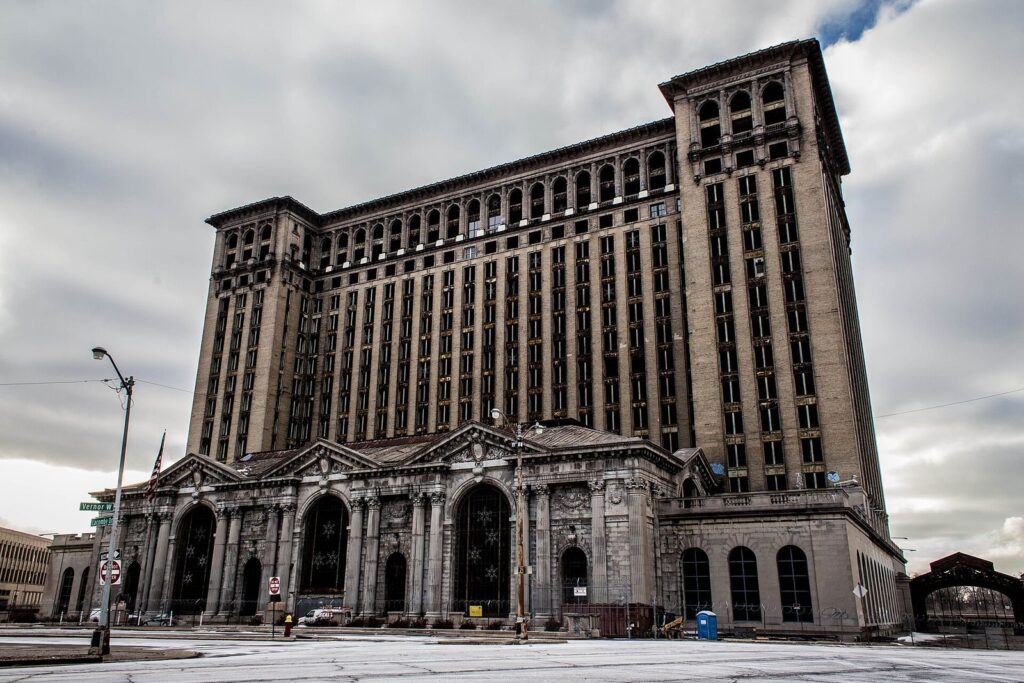
Ford bought the station and reopened it in June 2024 after a six-year restoration, and it’s now the center of a technology and innovation campus. Visitors can walk into the restored lobby daily from 8 a.m. to 5 p.m., and Detroit History Tours runs 90-minute guided tours for more of the story. Next door, the old Book Depository reopened in 2023 as Newlab, a technology hub. Parking at the Bagley Mobility Hub costs $5 per 30 minutes, up to $15 a day (2026), or ride in from downtown.
After the station, walk Corktown’s Michigan Avenue for restaurants and bars, and continue into Southwest Detroit, where Mexicantown’s taquerias and bakeries along Bagley Street are some of the best cheap eating in the city.
Eastern Market
Eastern Market, northeast of downtown, is one of the oldest and largest public markets in the country, a district of open-air sheds, food shops, meat and cheese markets, restaurants and warehouses covered in murals. Saturday is the day to go: the Saturday Market runs year-round from 6 a.m. to 4 p.m., with farmers, food vendors, flowers and crafts filling the sheds. From June through September there’s also a Sunday Market, 10 a.m. to 4 p.m., focused on makers and artisans, and a Tuesday Market from 9 a.m. to 3 p.m.
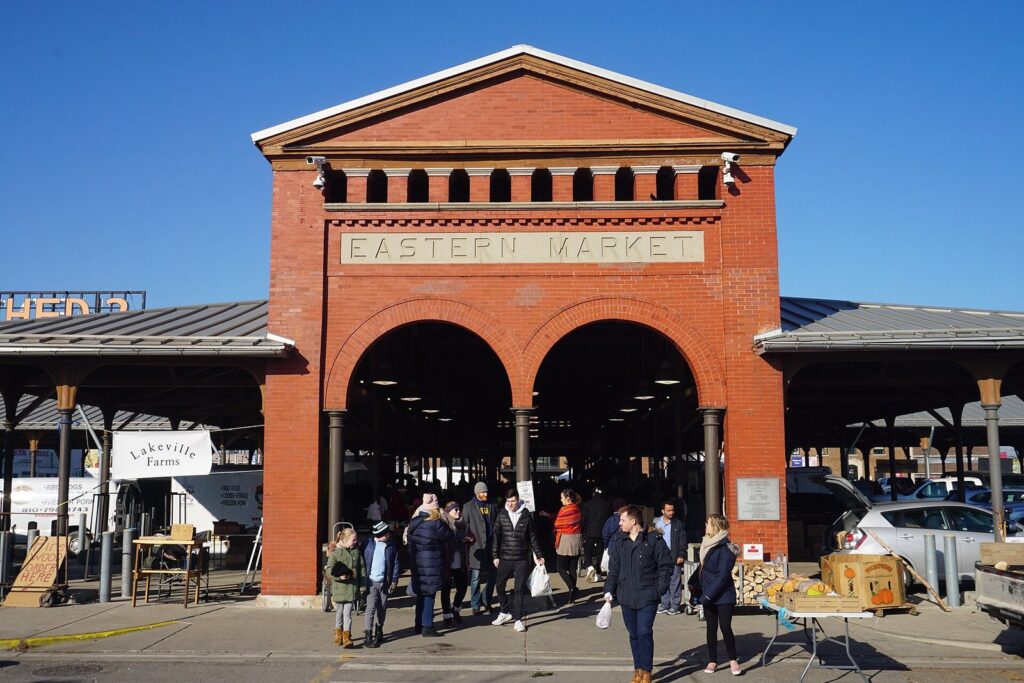
- Go early. The best produce and the smallest crowds come before 10 a.m.; by late morning the sheds and parking fill.
- Look up. The district’s walls are covered in large murals, many painted during the annual Murals in the Market festival; walk the side streets to see them.
- Eat there. The market’s restaurants and food vendors make it an easy breakfast or lunch stop.
- Bring bags. A sturdy tote or a small cart makes the morning easier if you’re buying.
Belle Isle
Belle Isle, a 982-acre island park in the Detroit River, larger than New York’s Central Park, is where Detroiters go to breathe. It’s been managed as a Michigan state park since 2014, so cars need a Recreation Passport: $12 a day or $42 a year for non-residents, or $15 for Michigan residents added at plate renewal (2026). Walking or biking in over the MacArthur Bridge is free.
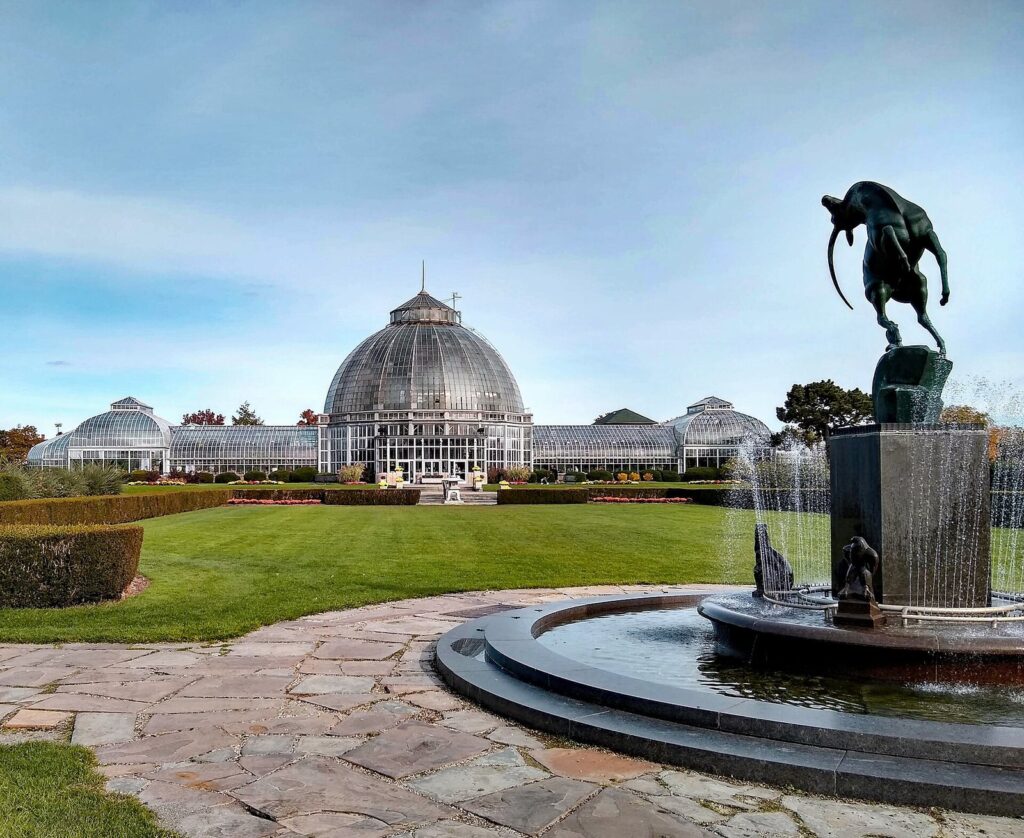
- The Belle Isle Aquarium: a historic aquarium in a green-tiled hall, open Thursday to Sunday, 10 a.m. to 4 p.m., with free admission and a $5 donation encouraged.
- The Anna Scripps Whitcomb Conservatory: a domed glass conservatory full of palms, ferns, cacti and orchids, with formal gardens outside. Check its current days and hours.
- The Giant Slide: a summer classic, ridden on burlap sacks; seasonal.
- The beach: a Detroit River swimming beach, busy on hot summer days. Swim only in designated areas, check posted conditions and flags, and remember that river currents are strong.
- The James Scott Memorial Fountain: an ornate marble fountain facing downtown, with one of the best skyline views in the city.
- The Dossin Great Lakes Museum and the Nature Center: the region’s maritime history, and a small nature center with trails.
One currency note: the Detroit Grand Prix no longer races on Belle Isle. It moved to downtown streets in 2023, so summer weekends on the island are calmer than they used to be.
Motown and New Center
Is the Motown Museum open in 2026?
Partly. The Motown Museum’s guided tours of Hitsville U.S.A., the house at 2648 W. Grand Boulevard where Berry Gordy’s label recorded its early hits, have been paused since January 20, 2026, while the museum builds its Hitsville NEXT expansion, a $75 million, multi-phase project that will grow the campus to nearly 50,000 square feet. The museum expects to reopen for tours in spring 2027. In the meantime, the campus store, Motown Mode, is open in person and online, and the museum’s plaza and the famous Hitsville U.S.A. sign on the house make a worthwhile stop for a photo and a moment on the spot where the Motown sound began. Check the museum’s site for events and the reopening date.
More music Detroit
Detroit’s music story runs well beyond Motown: jazz clubs, the techno scene celebrated at Movement each May, the Detroit Symphony Orchestra at Orchestra Hall in Midtown, and the Fox, the grand 1928 movie palace where Motown revues once played. For the city’s music history, pair a stop at Hitsville with an evening at one of the live-music venues downtown or in Midtown.
Dearborn and The Henry Ford
Dearborn, the home of the Ford Motor Company, sits just west of Detroit, about 20 minutes from downtown without traffic, and it’s home to The Henry Ford, one of the biggest history attractions in the Midwest. It’s really three experiences, sold separately:
| The Henry Ford (2026) | Adult price online | What it is |
|---|---|---|
| Henry Ford Museum of American Innovation | $34-36 | A huge indoor museum of American invention: cars, trains, planes, and objects like the bus Rosa Parks rode, the chair Abraham Lincoln was sitting in when he was shot and the limousine John F. Kennedy rode in |
| Greenfield Village | $37-39 | An outdoor village of historic buildings, including Thomas Edison’s Menlo Park lab and the Wright brothers’ bicycle shop, with working farms, craftspeople, a steam train and Model T rides; seasonal |
| Ford Rouge Factory Tour | $24 | A bus trip from the museum to Ford’s Rouge complex, with a walkway above the F-150 assembly line |
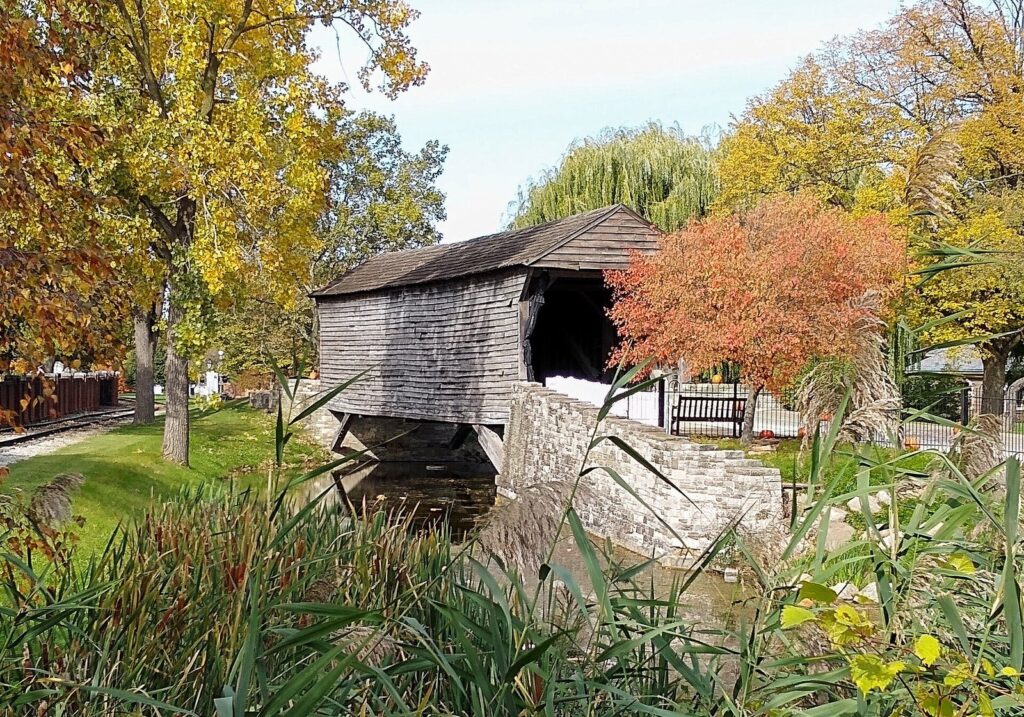
Online prices vary by date. Seniors 62 and over get 10% off, youth 5 to 11 get 25% off, children 4 and under are free, and each online order adds $10 parking and a $4 service fee (2026). Doing the museum and the village in one day is exhausting; most visitors pick one per day or combine the museum with the factory tour. Greenfield Village is seasonal, open roughly from spring to fall with special holiday evenings in December, so check dates before planning around it.
Dearborn is also the heart of one of the largest Arab American communities in the country. The Arab American National Museum tells that story, and the restaurants, bakeries and markets along Warren and Michigan avenues are among the best reasons to come to Dearborn hungry.
Ann Arbor
Ann Arbor, about 45 minutes west of downtown Detroit, is a lively college town built around the University of Michigan. Michigan Stadium, the “Big House,” seats more than 107,000 on fall football Saturdays, the largest stadium in the country. Beyond game days, walk the Diag and the campus museums, including the University of Michigan Museum of Art, browse the shops and restaurants of Main Street and Kerrytown, and wander Nichols Arboretum along the Huron River. In July, the Ann Arbor Art Fair fills downtown’s streets. It’s an easy half-day or full-day add-on to a Detroit trip.
Football Saturdays change everything. When Michigan plays at home, traffic backs up on the approaches to the stadium, hotels across the region fill and downtown Ann Arbor is packed with fans in maize and blue. If you’re not going to the game, pick another day for your visit, and if you are, book lodging months ahead and plan to arrive early.
Black history in Detroit
Detroit’s Black history runs deep, and much of it can be seen on a short itinerary. Before the Civil War, the city was one of the last stops on the Underground Railroad, a crossing point to freedom in Canada just across the river. The Gateway to Freedom International Memorial at Hart Plaza marks that history, facing a companion monument on the Windsor side, and Second Baptist Church downtown was a station on the route. The Charles H. Wright Museum in Midtown tells the wider story, from Africa to Detroit, and Hitsville U.S.A. marks the house where Motown turned Detroit’s young Black musicians into international stars.
The city’s Black neighborhoods also shaped its culture. Black Bottom and Paradise Valley, east of downtown, were the heart of Black business and nightlife until they were cleared for urban renewal and freeway building in the mid-20th century. Rosa Parks spent most of her later life in Detroit, Aretha Franklin grew up singing in her father’s church here, and the Monument to Joe Louis, the boxing champion better known as The Fist, stands downtown. For deeper context, pair the Wright Museum with a guided history tour.
Detroit’s architecture
Detroit built some of the country’s finest early skyscrapers when car money was pouring in, and many survive. Downtown, the Guardian Building’s banking hall is a riot of Art Deco tile and color, and the Penobscot, Buhl and David Whitney buildings show off the ambition of the 1910s and 1920s. In New Center, the Fisher Building’s gilded arcade was built by the Fisher brothers of Fisher Body fame. Michigan Central Station, the 1913 Beaux-Arts giant restored by Ford, is the city’s comeback landmark.
The city also has important modern architecture. Lafayette Park, just east of downtown, holds the largest collection of buildings by Ludwig Mies van der Rohe anywhere, a leafy 1950s and 1960s neighborhood of glass-walled towers and townhouses. Minoru Yamasaki, the architect of New York’s original World Trade Center, designed several buildings on Wayne State’s campus in Midtown. Several local groups run architecture walking tours downtown, and they’re one of the best ways to see building interiors that are otherwise easy to walk past.
More Detroit neighborhoods worth a visit
- Hamtramck: a small, dense city surrounded by Detroit, once heavily Polish and now home to large Bangladeshi and Yemeni communities, with Polish bakeries and restaurants that come into their own on Paczki Day.
- Southwest Detroit and Mexicantown: taquerias, bakeries and markets along Bagley and West Vernor, and views of the Ambassador Bridge.
- Indian Village and the West Village: streets of grand early-20th-century homes on the east side, near the approach to Belle Isle.
- Boston-Edison: a historic district of mansions built by the city’s early auto and business elite.
- The Grosse Pointes: lakeshore suburbs east of the city, with mansions along Lake Shore Road and the Edsel and Eleanor Ford House.
- Ferndale and Royal Oak: lively inner suburbs north along Woodward, known for restaurants and bars; Royal Oak is home to the Detroit Zoo.
Detroit with kids
Detroit is a better family destination than its reputation suggests. The Henry Ford Museum and Greenfield Village are the big days out, with trains, cars, a working farm and Model T rides. The Michigan Science Center in Midtown is built for hands-on learning, and the Detroit Historical Museum’s re-created old streets are a hit with younger kids. On Belle Isle, the free aquarium, the nature center, the Giant Slide in summer and the beach can fill a day. Downtown, the People Mover is an easy thrill for small children, Campus Martius has an ice rink in winter and a sandy urban beach in summer, and a Tigers game at Comerica Park, with its Ferris wheel and carousel inside the ballpark, is a classic summer night. The Detroit Zoo in Royal Oak, just north of the city, rounds out a family trip.
Getting around Detroit
Is the People Mover free?
Yes. The Detroit People Mover, the elevated train that loops around downtown, is fare-free for all riders, and so is the QLine streetcar, which runs up Woodward Avenue from downtown through Midtown to New Center. Together they cover most of the places a first-time visitor wants to see between the river and the DIA. The People Mover’s loop, with stations at the Renaissance Center, Greektown, Huntington Place, Grand Circus Park and more, is also a free way to see downtown from above.
Is downtown Detroit walkable?
Downtown and Midtown are very walkable, and Corktown is a short ride away. Downtown’s core, from the riverfront to Grand Circus Park, is a 15- to 20-minute walk, and the QLine handles the longer run up Woodward. You’ll want a car, a rideshare or a bike for Belle Isle, Eastern Market on a busy Saturday, Dearborn and Ann Arbor.
- Rideshare: widely available and the easiest way to cover longer distances or get home at night.
- Bikes: the MoGo bike-share system has stations across downtown, Midtown, Corktown and the riverfront, and the RiverWalk and Dequindre Cut make great bike routes.
- Buses: DDOT (city) and SMART (suburban) buses cover the metro area.
- Parking: downtown has plenty of garages and lots, but prices jump on game and event days. Park in a staffed garage when you can, and never leave valuables visible in the car.
- From the airport: Detroit Metropolitan Airport is about 20 miles southwest of downtown, roughly half an hour without traffic.
- By train: Amtrak’s Wolverine service connects Detroit’s station in New Center with Chicago.
Is Detroit safe for visitors?
For visitors sticking to the main areas, Detroit is generally as safe as other big American cities, with the same need for common sense. Downtown, Midtown, Corktown, the riverfront and Eastern Market are busy, well-lit and full of people, especially during the day and on event nights. The problems visitors most often run into are car break-ins, so don’t leave anything visible in a parked car, and empty streets late at night, so take a rideshare rather than walking long stretches after dark. Neighborhoods vary a lot across a large city, and outside the main visitor areas it pays to know where you’re going. Events like games, concerts and festivals have a heavy police and security presence.
Detroit events calendar, 2026-27
| Event | Dates | Where |
|---|---|---|
| America’s Thanksgiving Parade (the 100th) | Thursday, November 26, 2026 | Woodward Avenue |
| Detroit Auto Show | January 14-24, 2027 (public show January 16-24) | Huntington Place |
| NCAA Men’s Final Four | Saturday, April 3 and Monday, April 5, 2027 | Ford Field |
| Movement electronic music festival | May 29-31, 2027 | Hart Plaza |
| Chevrolet Detroit Grand Prix | June 4-6, 2027 | Downtown streets |
| Woodward Dream Cruise | August (check the 2027 date) | Woodward Avenue, Ferndale to Pontiac |
| Detroit Jazz Festival | September 3-6, 2027 (Labor Day weekend) | Downtown |
Two currency notes: the Detroit Auto Show is back in January, where it moved in 2025 after running in September in 2022 and 2023 and skipping 2024, and the Grand Prix is downtown, not on Belle Isle. The 100th Thanksgiving Parade is a milestone year, so expect big crowds along Woodward and book downtown rooms early. The Detroit Jazz Festival is free, and the Final Four will fill every hotel in the region, so book early for early April 2027.
What is there to do in Detroit at night?
- A show: the Fox, the Fillmore, the Detroit Opera House and the Detroit Symphony Orchestra at Orchestra Hall.
- A game: the Tigers in summer, the Lions in fall, the Red Wings and Pistons in winter, all downtown.
- Live music and jazz: clubs and bars across downtown, Midtown and Corktown, from jazz to techno.
- Casinos: three downtown casinos, with restaurants and entertainment.
- The riverfront: an evening walk on the RiverWalk, with the lights of Windsor across the water.
- Dinner and drinks: Corktown’s Michigan Avenue, downtown’s bars and Midtown’s restaurants stay busy into the evening.
Sports in Detroit
Detroit is one of the few American cities with all four major pro teams playing downtown, within walking distance of each other and of most downtown hotels. The Tigers play baseball at Comerica Park from spring into September, the Lions play football at Ford Field from September into winter, and the Red Wings and Pistons share Little Caesars Arena from fall to spring. Detroit City FC, the city’s pro soccer club, plays at Keyworth Stadium in Hamtramck, with some of the loudest crowds in town. On game days, walk or take the People Mover or QLine rather than driving: parking prices jump, and traffic around the stadiums crawls before and after games. Buy tickets from the teams’ own sites or official resale platforms, and check bag policies before you go.
Detroit on a budget
Detroit can be a cheap city break if you plan around its free and low-cost highlights. Transit downtown and along Woodward is free on the People Mover and QLine. The RiverWalk, Centennial Park, the Dequindre Cut, Campus Martius, Michigan Central’s lobby and Eastern Market cost nothing to explore, and the Belle Isle Aquarium asks only for a donation. If you live in Wayne, Oakland or Macomb county, the DIA is free. For The Henry Ford, buy online, since prices vary by date, and pick one attraction per day rather than paying for everything at once. Eat well and cheaply at coney diners, Mexicantown taquerias, Dearborn’s bakeries and Eastern Market, and save on hotels by avoiding big game, convention and festival weekends, when rates spike.
What is free to do in Detroit?
- Walk the Detroit RiverWalk, Centennial Park and the Dequindre Cut.
- Ride the People Mover and the QLine, both fare-free.
- Walk into Michigan Central Station’s restored lobby (daily 8 a.m.-5 p.m.).
- Browse Eastern Market on a Saturday.
- Visit the Belle Isle Aquarium (donation encouraged) and walk or bike onto Belle Isle.
- See the DIA free if you live in Wayne, Oakland or Macomb County.
- Hang out at Campus Martius Park and Hart Plaza, and catch free festivals like the Detroit Jazz Festival.
- Look at the Guardian Building’s lobby and the murals around Eastern Market.
Where to stay in Detroit
| Area | Best for | Trade-offs |
|---|---|---|
| Downtown | First-timers: walk to Campus Martius, the riverfront, sports and theaters, with the People Mover at your door | Highest prices on game, concert and convention nights |
| Midtown | Museum lovers: the DIA and the Wright Museum on foot, with the QLine downtown | Quieter at night; fewer hotels |
| Corktown | Food and nightlife, and a short hop to Michigan Central | Few hotels; a ride to most sights |
| Dearborn | The Henry Ford and Dearborn’s food scene | You’ll drive into Detroit |
| Airport and suburbs | Early flights and lower rates | A drive to everything |
Hotel prices in Detroit follow the calendar: they spike for the Auto Show, big games and concerts, the Thanksgiving parade, the Final Four and festival weekends, and ease on quiet weeknights and in late winter. For a first visit, staying downtown saves the most time, because you can walk to dinner, the riverfront and the People Mover and leave the car in the garage.
Detroit food: pizza, coneys and more
- Detroit-style pizza: the square, thick-crust pizza baked in steel pans, with cheese caramelized to a crisp at the edges and sauce ladled on top, was created in 1946 at Buddy’s, then an east side bar. You’ll find it all over the metro area.
- Coney dogs: Detroit’s signature is the coney island, a natural-casing hot dog topped with beanless chili, yellow mustard and chopped onions, served at coney diners across the city and suburbs.
- Middle Eastern food in Dearborn: some of the best in the country, from bakeries to grills.
- Mexicantown: tacos, bakeries and family restaurants in Southwest Detroit.
- Greektown: Greek restaurants on Monroe Street.
- Paczki: the jam-filled Polish doughnuts that sell by the thousands in Hamtramck on Paczki Day, before Lent.
- Eastern Market: breakfast and lunch among the sheds on a Saturday.
Crossing the river to Windsor
Windsor, Ontario, sits directly across the Detroit River, and it’s one of the few places where you look south into Canada. The crossing got easier in 2026: the Gordie Howe International Bridge opened to traffic on July 27, 2026, with a car toll of US$5.75 or C$8 (25% off with an electronic pass), and its toll-free walking and biking path opened on August 5, 2026. The Detroit-Windsor Tunnel runs from downtown, and the older Ambassador Bridge is still in use.
- Documents: everyone needs a passport, NEXUS card or other accepted border document, including walkers and cyclists on the new bridge, who clear customs.
- What to do: Windsor’s riverfront parks have the best view of the Detroit skyline, and the city’s restaurants make an easy evening out.
- Know the rules: Ontario’s drinking age is 19, and duty-free limits apply when you come back.
- Allow time: border waits vary with the time of day and events; check them before you go.
How many days do you need in Detroit?
Two days covers the essentials; three lets you add Dearborn at a comfortable pace, plus Belle Isle or Windsor.
- Day 1, downtown and Midtown: the RiverWalk and Centennial Park in the morning, Campus Martius and the Guardian Building, a People Mover loop, then the QLine to the DIA and the Wright Museum. Dinner downtown.
- Day 2, Dearborn: the Henry Ford Museum and the Ford Rouge Factory Tour, or Greenfield Village in season, with dinner in Dearborn.
- Day 3, Detroit’s neighborhoods: Eastern Market on a Saturday morning, Michigan Central Station and Corktown for lunch, Belle Isle in the afternoon, and Windsor or a show in the evening.
Detroit in December
December is one of Detroit’s busiest and most festive months. The season opens with America’s Thanksgiving Parade on Woodward, which celebrates its 100th parade on November 26, 2026, followed by the lighting of the giant Christmas tree at Campus Martius, where the ice rink stays busy all winter. Holiday markets pop up downtown, Greenfield Village holds its ticketed holiday evenings in Dearborn, and the theaters schedule holiday shows. Christmas week is one of the peak weeks of the year downtown, so book hotels and restaurant tables early. Dress for real cold, and use the People Mover to hop between downtown stops without long walks in the wind.
What is the best month to visit Detroit?
Late May through September is the best stretch for most visitors: outdoor festivals, the RiverWalk and Belle Isle at their best, baseball at Comerica Park and Greenfield Village fully open. September adds the free Detroit Jazz Festival and fewer crowds. December is the city’s other peak, with the ice rink and Christmas tree at Campus Martius, holiday markets and Greenfield Village’s holiday evenings, and Christmas week is one of the busiest weeks of the year downtown. January brings the Auto Show but cold weather; February and March are the quietest and cheapest months.
Weather and what to pack
Detroit has four distinct seasons. Summers are warm and often humid, with occasional thunderstorms, and they’re the best time for the riverfront, Belle Isle and outdoor festivals. Fall is mild and colorful into October. Winters are cold and frequently gray, with snow and wind off the river, though Detroit gets far less snow than Michigan’s lake-effect belts to the west and north. Spring is changeable, with chilly rain as likely as sunshine. Whatever the season, bring comfortable walking shoes, since the best way to see downtown and Midtown is on foot, plus a rain jacket. From December to March, add a proper winter coat, a hat and gloves.
A half day or a layover
With only four to six hours, stick to downtown. Take a rideshare from Detroit Metropolitan Airport, about half an hour away without traffic, walk a stretch of the RiverWalk, loop downtown on the free People Mover, stop at Campus Martius and the Guardian Building, and eat a coney or a square of Detroit-style pizza before heading back. With a little more time and on a day the museum is open, add the QLine up Woodward to the DIA.
What to skip
Skip planning a Motown Museum tour before spring 2027. Tours are paused for construction. Visit the store and see Hitsville from the plaza instead.
Skip driving downtown on game nights if you can. Parking prices jump and traffic crawls; take the People Mover or QLine, or a rideshare.
Skip The Henry Ford museum and Greenfield Village on the same day. Each deserves most of a day.
Skip showing up for the Grand Prix on Belle Isle. It’s downtown now.
Skip leaving bags in the car. Car break-ins are the most common problem visitors face.
Skip Eastern Market on a weekday if it’s your only chance. Saturday is the real market; weekday visits find the sheds mostly empty.
Frequently asked questions
What is Detroit best known for?
Detroit is best known as the Motor City, the birthplace of the American auto industry, and as the home of Motown Records and techno. It’s also known for the Detroit Institute of Arts and Diego Rivera’s Detroit Industry murals, The Henry Ford in Dearborn, Detroit-style pizza and coney dogs, and its pro sports teams, all playing downtown.
Is downtown Detroit walkable?
Yes. Downtown’s core, from the riverfront to Grand Circus Park, is about a 15- to 20-minute walk, with Campus Martius, the RiverWalk, the theaters and the stadiums close together. The fare-free People Mover loops downtown, and the fare-free QLine runs up Woodward to Midtown and New Center. You’ll need a car or rideshare for Belle Isle, Dearborn and Ann Arbor.
How many days do you need in Detroit?
Two days covers downtown, the riverfront, Midtown’s museums and a day in Dearborn at The Henry Ford. Three days lets you add Eastern Market on a Saturday, Michigan Central Station and Corktown, Belle Isle, and an evening in Windsor or at a show, at a comfortable pace.
What is free to do in Detroit?
The RiverWalk, Centennial Park and the Dequindre Cut, the People Mover and QLine, Michigan Central Station’s restored lobby, Eastern Market’s Saturday market, walking or biking onto Belle Isle, the Belle Isle Aquarium (donation encouraged), Campus Martius and Hart Plaza, and free festivals like the Detroit Jazz Festival. The DIA is free for Wayne, Oakland and Macomb county residents.
Is the Motown Museum open in 2026?
Partly. Guided tours of Hitsville U.S.A. have been paused since January 20, 2026, during the museum’s $75 million Hitsville NEXT expansion, and are expected to resume in spring 2027. The Motown Mode store is open, and you can still see the famous house and its sign at 2648 W. Grand Boulevard from outside.
Is the People Mover free?
Yes. The Detroit People Mover, the elevated train that loops around downtown, is fare-free for all riders, and the QLine streetcar along Woodward Avenue is free too. Between them they connect the riverfront, downtown, Midtown’s museums and New Center. Check service hours before planning a late ride, since neither runs around the clock.
What is there to do in Detroit at night?
See a show at the Fox, the Fillmore or the Detroit Opera House; hear the Detroit Symphony Orchestra; catch a Tigers, Lions, Red Wings or Pistons game downtown; find live jazz or techno; try one of the three downtown casinos; or walk the RiverWalk with Windsor’s lights across the water. Corktown and Midtown are good for dinner and drinks.
What is the best month to visit Detroit?
June through September is best for most visitors, with festivals, the riverfront and Belle Isle at their best, baseball and Greenfield Village in full swing. September adds the free Detroit Jazz Festival and thinner crowds. December is the other peak, with Campus Martius’s rink and tree and holiday markets.
Sources and verification
Everything on this page was checked on September 23, 2026 against the organizations listed below. The guide is compiled from their published information and claims no first-hand visits.
- The Henry Ford: admission (2026 prices, discounts and parking)
- Detroit Institute of Arts: visit (admission, the tri-county rule and hours)
- Michigan Central: visit (lobby hours, tours and parking)
- Motown Museum (tour pause, store and Hitsville NEXT)
- Eastern Market (market days and hours)
We also used the Belle Isle Conservancy for aquarium hours, the Charles H. Wright Museum, the Detroit Riverfront Conservancy, the Michigan DNR for Recreation Passport prices, event organizers for 2026-27 dates and the bridge authority’s published tolls for the Gordie Howe International Bridge.
Michigan Tourism Guide is an independent publication. It is not affiliated with Pure Michigan or any agency or business named here.
Photo credits
- Detroit skyline from the RiverWalk (featured image): photo by TheWxResearcher, Wikimedia Commons (CC0)
- Campus Martius Park: photo by RuralResurrection, Wikimedia Commons (CC BY 4.0)
- Detroit Institute of Arts: photo by Michael Barera, Wikimedia Commons (CC BY-SA 4.0)
- Michigan Central Station (2013): photo by Bartosz Brzezinski, Wikimedia Commons (CC BY 2.0)
- Eastern Market, Shed 2: photo by Michael Barera, Wikimedia Commons (CC BY-SA 4.0)
- Anna Scripps Whitcomb Conservatory: photo by P. Hughes, Wikimedia Commons (CC BY-SA 4.0)
- Greenfield Village covered bridge: photo by P. Hughes, Wikimedia Commons (CC BY-SA 4.0)