Michigan has a campsite for almost every kind of camper, and the hard part is knowing which system you’re dealing with. There are 103 state parks and recreation areas, most with campgrounds you reserve online; more than 140 rustic state forest campgrounds, mostly first-come, first-served, on lakes and rivers across the north; three national forests; two national lakeshores and Isle Royale; hundreds of private campgrounds and camp resorts; and free dispersed camping on public land if you follow the rules. Camping in Michigan works best when you match the system to your trip: reserve early for a beach site in July, or head for a state forest campground in September and take your pick.
The short answer: book Michigan state park campsites on the DNR’s reservation site, where the window opens six months to the day before arrival; expect $26 to $45 a night for a modern site plus a Recreation Passport on your vehicle (non-residents $12 a day or $42 a year in 2026). For quieter, cheaper camping, rustic state forest campgrounds are $20 a night and mostly first-come, first-served, and dispersed camping on state land is free with a posted registration card. July is the peak; September is the best month.
Fees, booking rules and camping regulations below were checked on September 23, 2026 against the Michigan DNR, the National Park Service and the US Forest Service. Rules change, and some details come from the agencies’ own summaries, so confirm anything critical with the campground before you go.
On this page: Which system to use · Regions · How to book · What it costs · Rules · Best state parks · National lakeshores · State forest campgrounds · National forests · Free camping · Backpacking · Paddle-in · Fishing · Beach and waterfront · RV camping · Cabins and yurts · Private campgrounds · With kids · With dogs · Accessible camping · U.P. camping · Seasons · Bugs and gear · Etiquette · What to skip · FAQ
Camping in Michigan: which system should you use?
| Where | Cost (2026) | What you get | How to book | Best for |
|---|---|---|---|---|
| State parks and recreation areas (103) | $26 to $45 a night for modern sites, plus a Recreation Passport | Electric sites, showers and flush toilets at modern campgrounds; many near beaches | MiDNRReservations.com, up to 6 months ahead | Families, beach trips, first-timers |
| State forest campgrounds (140+) | $20 a night for most sites, plus a Recreation Passport | Rustic: vault toilets, hand pumps, no electricity; always on a lake or river | Mostly first-come, first-served; a few reservable | Quiet, cheap camping; paddlers and anglers |
| National forest campgrounds (Huron-Manistee, Hiawatha, Ottawa) | Set by each campground | Rustic to semi-modern, often on lakes and rivers | Recreation.gov or first-come, depending on the campground | Woods and water, fewer crowds |
| National lakeshores and Isle Royale | Pictured Rocks drive-in sites $25 a night | Rustic campgrounds near the big-name scenery | Recreation.gov, up to 6 months ahead | Sleeping Bear, Pictured Rocks and backpacking trips |
| Private campgrounds and camp resorts | Set by each business | Full hookups, pools, planned activities, cabins | Directly with the campground | RVs, families wanting activities |
| Dispersed camping on state land or national forest | Free | No facilities at all | No reservation; post a DNR camp registration card on state land | Self-sufficient campers who want solitude |
Most visitors should start with a state park for the first trip, then graduate to state forest and national forest campgrounds for more space and less noise. If you want a pool, a playground and a hayride, book a private camp resort. If you want to be alone, go dispersed, with a full water jug and a plan for your trash.
Michigan camping by the numbers
- 103 state parks and recreation areas, plus 140-plus state forest campgrounds and nearly 1,000 boating access sites, all covered by the Recreation Passport.
- 3 national forests: the Huron-Manistee, the Hiawatha and the Ottawa.
- 9 campgrounds and 357 sites at Sleeping Bear Dunes (including the island sites, closed in 2026), 3 drive-in campgrounds at Pictured Rocks and 36 campgrounds on Isle Royale.
- 188 sites at Tahquamenon’s Lower Falls campground and 65 backcountry sites in the Porcupine Mountains.
- 6 months: the DNR’s booking window for campsites, cabins and yurts.
Camping regions at a glance
| Region | State parks to know | Federal land | From Detroit / Chicago |
|---|---|---|---|
| Lake Michigan shore | Warren Dunes, Holland, Grand Haven, Hoffmaster, Silver Lake, Ludington | Huron-Manistee (near Ludington and Manistee) | About 2 h 45 to 3 h 45 / 1 h 30 to 4 h |
| Northwest Lower | Interlochen, Traverse City, Leelanau, Petoskey, Young, Fisherman’s Island | Sleeping Bear Dunes | About 4 to 4 h 30 / 5 to 5 h 45 |
| Northeast Lower and the Straits | Tawas Point, Higgins Lake, Hartwick Pines, Wilderness, Straits | Huron-Manistee (Au Sable country) | About 2 h 45 to 4 h 30 / 5 to 6 h 30 |
| Southeast and the Thumb | Holly, Pinckney, Waterloo, Sterling, Port Crescent, Lakeport | None | About 45 min to 2 h 30 / 3 h 30 to 6 h |
| Eastern and central U.P. | Tahquamenon Falls, Brimley, Muskallonge Lake, Fayette, Indian Lake | Hiawatha; Pictured Rocks | About 5 to 6 h 30 / 6 to 8 h 30 |
| Western U.P. and the Keweenaw | Porcupine Mountains, McLain, Fort Wilkins | Ottawa; Isle Royale | About 9 to 10 h / 7 to 8 h |
Drive times are free-flow estimates from downtown Detroit and Chicago. Friday afternoon traffic heading north on I-75 and US-131 in summer, and Sunday traffic heading home, can add an hour or more. Four western U.P. counties (Gogebic, Iron, Dickinson and Menominee) run on Central time, an hour behind the rest of Michigan, which matters when you’re racing a campground’s check-in time.
How far in advance can you book Michigan state park campsites?
State park campsites, cabins, yurts, lodges and harbor slips can be booked up to six months to the day before your arrival date on MiDNRReservations.com or by phone at 1-800-447-2757. New dates open at 8 a.m. on weekdays and 9 a.m. on weekends, and there’s a non-refundable reservation fee of $8 online or $10 by phone. Reservations can’t be changed or canceled more than five months before arrival, so don’t book speculatively. Pavilions have a longer, 12-month window.
How to get a site for a summer weekend
- Be online the moment the window opens. For a July Saturday arrival at a popular beach park, the best sites can be gone within minutes of the window opening six months earlier. Set a reminder for the day and time, and log in to your account ahead of time.
- Arrive midweek. Sunday-to-Thursday stays are far easier to book than weekends, and the campground is quieter too.
- Have a backup park. If Grand Haven or Holland is full, a nearby inland park or a state forest campground may have space the same weekend.
- Watch for cancellations. Plans change, and sites open up in the final weeks before a date; check back often, especially early in the week.
- Consider the shoulder season. Late May, June weekdays and September have far more availability and often better weather for camping.
A Recreation Passport is separate from the camping fee: your campsite reservation doesn’t include vehicle entry, so buy the Passport with your Michigan plate renewal or, as a non-resident, online or at the park.
No reservation? First-come strategies
If you didn’t book six months ahead, you still have options. Most state forest campgrounds and some national forest campgrounds are first-come, first-served: arrive on Thursday or early Friday for a summer weekend, follow the self-registration instructions posted at the entrance, and have a second campground in mind nearby. State parks sometimes have same-week cancellations, especially Sunday to Thursday. And outside July and August, many campgrounds have open sites on short notice.
How to choose a campsite
The reservation map shows every site, and a few minutes with it pays off. Waterfront and end-of-loop sites are the most private and the first to go. Shade matters more than you’d think in July, and sun matters in May and September. Sites near the toilet and shower building are convenient with kids but see foot traffic all night; sites next to the playground are loud until dark. Check the site length and whether it’s a pull-through if you’re towing, whether it has 30- or 50-amp service, and whether the loop allows generators. Where a campground has a separate walk-in or tent-only loop, it’s usually the quietest place in the park.
What camping in Michigan costs
| Item | 2026 cost |
|---|---|
| Recreation Passport (required on every vehicle at state parks and state forest campgrounds) | Residents $15 a year with plate renewal; non-residents $12 a day or $42 a year (through December 31) |
| State park modern and semi-modern sites | $26 to $45 a night, depending on the park and hookups (rates set August 1, 2025) |
| State forest campground sites | $20 a night for most |
| DNR reservation fee | $8 online, $10 by phone, non-refundable |
| Pictured Rocks drive-in campgrounds | $25 a night |
| Pictured Rocks backcountry | $15 per trip plus $5 per person per night |
| Dispersed camping on state land | Free, with a posted camp registration card |
| Pets at some DNR lodgings | For example, $10 a night per pet at the Porcupine Mountains’ Kaug Wudjoo Lodge |
For a non-resident family camping a week at state parks, the fixed costs are the $42 annual Recreation Passport, which beats daily passes from the fourth day, and the nightly site fee. Firewood, ice and a camp store run are the other costs to budget for. National lakeshore campgrounds don’t need a Recreation Passport, but they do need the lakeshore’s own $25 weekly vehicle pass.
What a two-night weekend costs
| Where you camp | Two nights of site fees (2026) | Also required | Before food and gas |
|---|---|---|---|
| State park, modern or semi-modern site | $52 to $90 | $8 online reservation fee; Recreation Passport | About $60 to $98, plus the Passport |
| State forest campground | $40 at most campgrounds | Recreation Passport | About $40, plus the Passport |
| Pictured Rocks drive-in campground | $50 | $25 lakeshore vehicle pass, good for 7 days | About $75, plus any Recreation.gov booking fee |
| Dispersed site on state land | Free | A camp registration card, posted at the site | $0 |
The Recreation Passport is the swing cost. Michigan residents usually have it already from their plate renewal ($15 in 2026), so a state park weekend costs them little more than the site. Non-residents pay $12 a day or $42 for the calendar year. After that, the real spending is food, gas, firewood and ice, and on most family trips at least one run to the camp store.
Michigan camping rules
State parks and state forest campgrounds share a set of rules that trip up newcomers.
- Quiet hours run from 10 p.m. to 8 a.m. in state parks, and that includes generators and radios.
- Stay limits: during peak season (May 15 to September 15), the maximum stay is 15 nights, after which you need a five-night break before returning to the same state park. State forest campgrounds and dispersed camping on state land also cap stays at 15 nights.
- Checkout is by noon in state parks.
- Dogs must be on a 6-foot leash and under control; they’re welcome in campgrounds and on trails but not on designated swim beaches.
- Firewood: buy it locally, at the campground or nearby, rather than bringing it from home; moving firewood spreads the insects and diseases that kill trees.
- Food and bears: black bears live across the northern Lower Peninsula and the U.P. Store food, coolers and trash in a hard-sided vehicle or a bear-resistant box, never in your tent.
- Fires go in the fire ring, and are never left unattended; check for burn bans in dry spells.
- Generators: some campgrounds set aside generator-free loops, like the west loop at the Porcupine Mountains’ Presque Isle campground; check before you pick a site.
What is the best state park for camping in Michigan?
There’s no single best, because the best camping depends on whether you want a beach, a forest, a river or a view. These are the standouts by region.
Southwest and West Michigan
The Lake Michigan shore has the most popular, and hardest to book, state park campgrounds in Michigan. Grand Haven State Park’s campground sits right on the sand beside the pier and the channel, which makes it one of the most sought-after reservations in the state. Holland State Park has two campgrounds, one by the Lake Michigan beach and a larger one across the road on Lake Macatawa, both close to Big Red. Warren Dunes, near Sawyer, has a big wooded campground behind its dunes and the best pet beach on the coast. P.J. Hoffmaster, near Muskegon, puts you in wooded dunes, Ludington State Park has campgrounds between Lake Michigan and Hamlin Lake, and Silver Lake has camping next to the dunes.
Northwest Lower Michigan
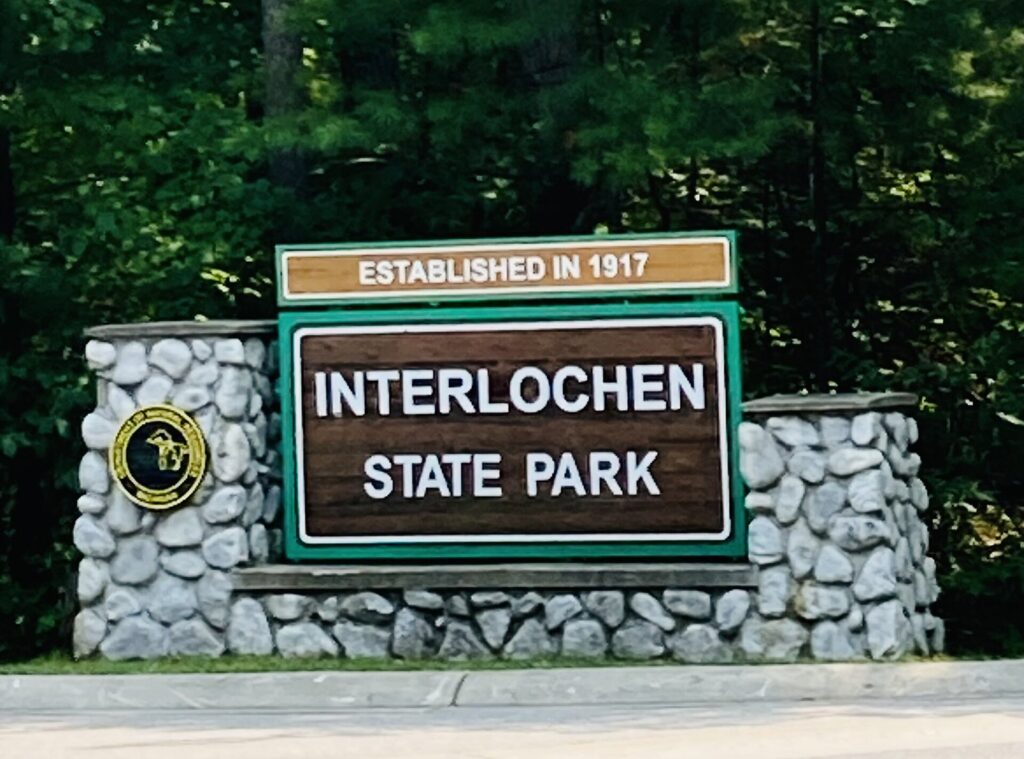
Interlochen State Park, southwest of Traverse City between Duck Lake and Green Lake, dates to 1917, making it one of Michigan’s oldest state parks, and it has a large campground under tall pines. Traverse City State Park is the convenient city option on East Grand Traverse Bay. Leelanau State Park, at the tip of the Leelanau Peninsula near the Grand Traverse Lighthouse, is small and rustic. Around Little Traverse Bay, Petoskey State Park has two campgrounds in the dunes behind its beach, Young State Park sits on Lake Charlevoix near Boyne City, and Fisherman’s Island State Park south of Charlevoix is rustic and quiet.
Northeast Michigan and the Straits
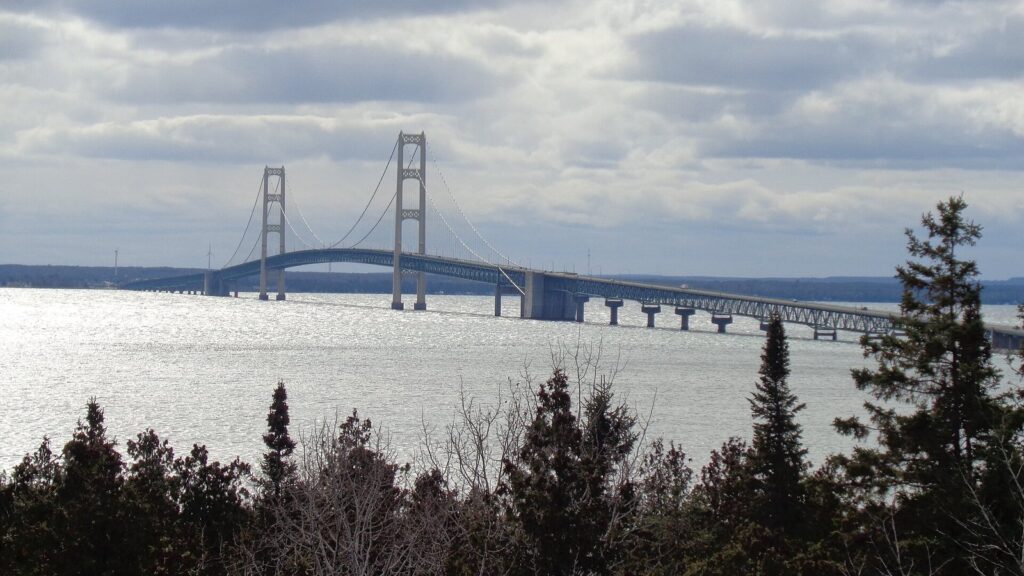
The Lake Huron side is quieter. Tawas Point State Park has camping on a sandy spit with a lighthouse and some of the best bird-watching in the state. North and South Higgins Lake state parks sit on one of Michigan’s clearest inland lakes, and Hartwick Pines State Park near Grayling has a campground beside one of the Lower Peninsula’s largest stands of old-growth pine. At the Straits, Wilderness State Park, west of Mackinaw City, is a dark-sky preserve with rustic cabins and wild shoreline, and Straits State Park in St. Ignace has campsites with a view of the Mackinac Bridge.
Southeast Michigan and the Thumb
Metro Detroit’s campers head for the big recreation areas: Holly, Pinckney and Waterloo, with lakes, trails and hundreds of sites within an hour of the city. Sterling State Park in Monroe is Michigan’s only state park on Lake Erie, and Port Crescent State Park, at the tip of the Thumb on Saginaw Bay, has a beach campground and is one of the state’s six dark sky preserves. Lakeport State Park, north of Port Huron, sits on Lake Huron.
The Upper Peninsula
The U.P.’s state park campgrounds are bigger on scenery and smaller on crowds. Tahquamenon Falls has the Lower Falls campground (188 sites, a short walk from the falls) and two campgrounds at the river mouth near Paradise. The Porcupine Mountains have the modern Union Bay campground on Lake Superior, the 50-site rustic Presque Isle campground near the waterfalls and 65 backcountry sites. Muskallonge Lake State Park sits between an inland lake and the Lake Superior agate beaches, Fayette Historic State Park has camping beside a restored iron-smelting town, and Brimley State Park, near the Soo, sits on Whitefish Bay. In the Keweenaw, McLain State Park faces Lake Superior sunsets and Fort Wilkins Historic State Park is in Copper Harbor.
Camping at the national lakeshores and Isle Royale
Michigan’s two national lakeshores and its island national park have their own campgrounds, booked on Recreation.gov rather than the DNR’s site, and they don’t take the Recreation Passport; you pay the park’s own entry fee.
- Sleeping Bear Dunes: the park counts nine campgrounds and 357 sites, including those on the Manitou Islands, which are closed for all of 2026. On the mainland, D.H. Day near Glen Arbor and Platte River near Honor are the main campgrounds. Entry is $25 per vehicle for seven days.
- Pictured Rocks: three rustic drive-in campgrounds, Little Beaver Lake (8 sites), Twelvemile Beach (36) and Hurricane River (21), at $25 a night, open May 15 to October 15, reservable six months ahead. The backcountry has 13 camping areas, bookable year-round, at $15 per trip plus $5 per person per night; food must be kept in a hard-sided vehicle or the park’s metal boxes.
- Isle Royale: 36 campgrounds on a roadless island, reached by ferry or seaplane; the park is closed from November 1 to April 15.
State forest campgrounds
Michigan’s 140-plus state forest campgrounds are the quieter, cheaper alternative to the state parks: small, rustic campgrounds across the U.P. and the northern Lower Peninsula, every one of them on a lake or a river. Expect vault toilets, a hand-pump well, a fire ring and a picnic table at each site, and no electricity or showers. Most are first-come, first-served, with a self-registration post at the entrance; a few can be reserved on MiDNRReservations.com. Most sites are $20 a night, and you’ll need a Recreation Passport on your vehicle. The peak-season stay limit is 15 nights.
They’re ideal for paddlers, anglers and anyone who wants a quiet lake without a crowd, and outside summer weekends you can often choose your site. Arrive early on Friday in July and August, bring your own water container and firewood bought locally, and plan to pack out trash where there are no dumpsters.
One currency note for the northeast Lower Peninsula: the ice storm of late March 2025 closed 19 state parks, 54 state forest campgrounds and 162 boating access sites across 12 northern counties at first. The parks had all reopened by July 2025, but roughly 250 miles of forest roads in the northeast Lower Peninsula were reported still closed in March 2026. Check the DNR’s closures list before you drive to a rustic campground in that corner of the state, and have a backup in mind.
Camping in Michigan’s national forests
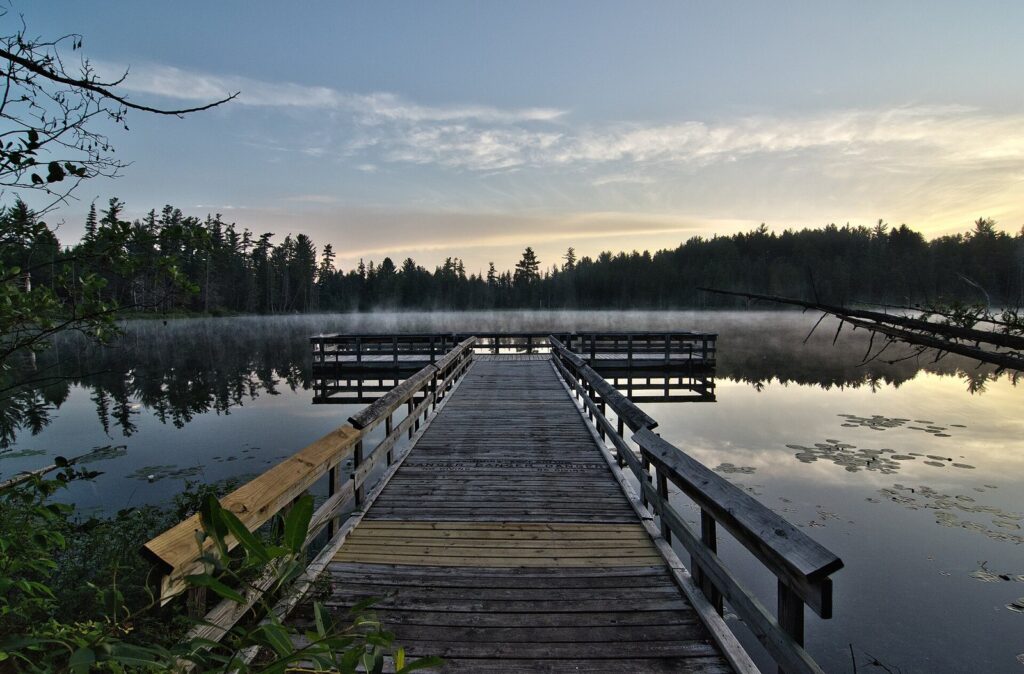
Three national forests cover much of northern Michigan: the Huron-Manistee in the northern Lower Peninsula, the Hiawatha in the eastern and central U.P., and the Ottawa in the western U.P. They have developed campgrounds, from rustic to semi-modern, many on lakes and rivers, and some take reservations on Recreation.gov while others are first-come.
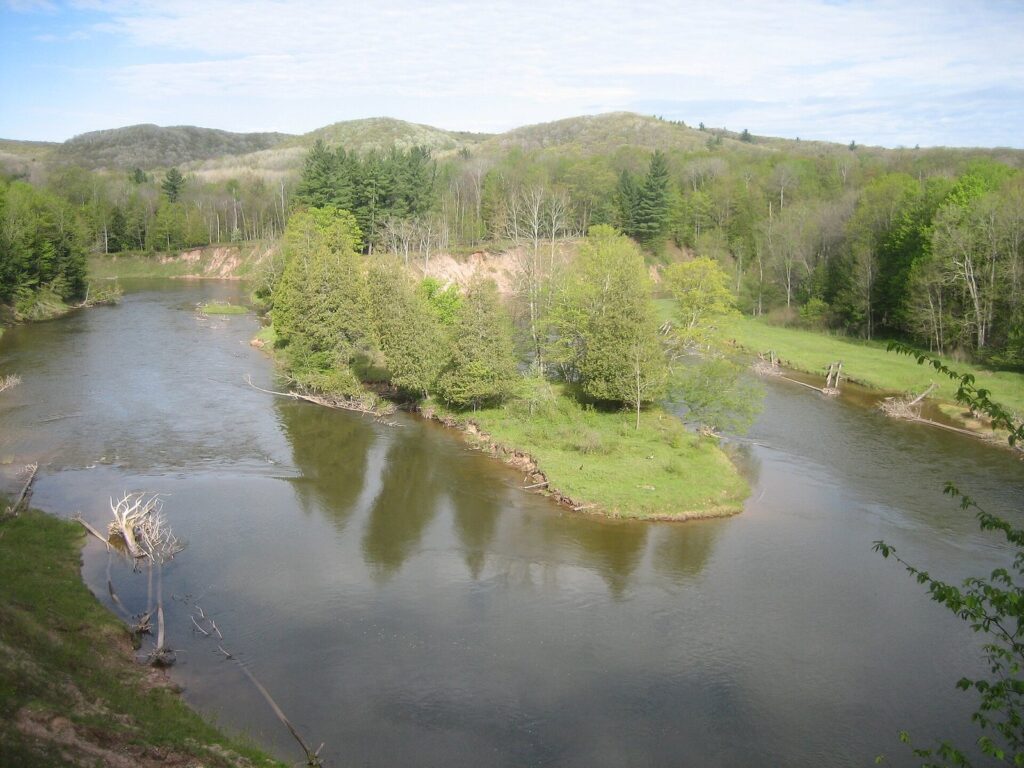
Dispersed camping, pitching a tent away from developed campgrounds, is allowed across much of the national forests and costs nothing. On the Huron-Manistee, no fee or permit is needed for dispersed camping, though parts of the forest restrict camping close to lakes and streams. A common rule is that you can camp in one spot for up to 16 days, then must move at least five miles; the Ottawa uses that rule, and so do the Upper Manistee River backcountry sites, which require reservations on Recreation.gov from Memorial Day through Labor Day weekend. The Hiawatha has many established dispersed sites with fire rings along its forest roads. Check with the forest’s ranger district for local rules and fire restrictions before you go.
Where can you camp for free in Michigan?
Free camping is legal in Michigan in two main places, and both come with rules.
On state land
You can camp for free on state-owned land outside state parks, recreation areas, state forest campgrounds and state game areas, as long as you fill out a DNR camp registration card and post it prominently at your campsite for the whole stay (not on your vehicle, and not nailed to a tree). You can’t camp within one mile of a designated state forest campground, and the maximum stay is 15 nights. You must pack out all your trash, and violations can bring fines of up to $500. There are no facilities, so bring water, a way to deal with human waste, and a plan for bears.
In the national forests
Dispersed camping in the national forests is also free, with the 16-day, five-mile rule common and some areas closed or restricted; see above. Use existing sites and fire rings where you find them, camp on durable ground, and stay well back from water and trails.
Can you camp anywhere in Michigan state forests? No: not in the developed state forest campgrounds without paying, not within a mile of one, and only with the registration card posted. Private land is off limits without permission, and many popular shorelines and trailheads are posted against camping.
Backpacking and hike-in camping
For campers who’d rather carry their camp, Michigan has some of the best backcountry in the Midwest, and each area has its own permit system.
- Porcupine Mountains: 65 numbered backcountry sites with fire rings, reservable six months ahead and up to 72 hours before arrival; pick up the permit in person, hang food at least 12 feet up and bury waste well away from water and trails. Dispersed winter camping is allowed once there’s snow on the ground.
- Pictured Rocks: 13 backcountry camping areas along the Lakeshore Trail, reservable year-round at $15 per trip plus $5 per person per night, with food stored in the park’s metal boxes.
- Isle Royale: 36 campgrounds on a roadless island, reached by ferry or seaplane.
- Tahquamenon Falls: three reservable backcountry sites near the North Country Trail, 1 to 5 miles from parking.
- National forests and state land: dispersed camping along trails and rivers, following the local rules above.
Backcountry trips in the U.P. mean bugs in June, cold nights even in summer and bears year-round. Carry a water filter, a bear bag or canister, a paper map and a way to call for help where there’s no signal.
Paddle-in and river camping
Some of Michigan’s best camping is reached by canoe or kayak. The Au Sable, Manistee and Pere Marquette rivers in the northern Lower Peninsula are classic multi-day canoe-camping rivers, with state forest campgrounds and national forest sites along their banks; on the Upper Manistee, the backcountry sites need a Recreation.gov reservation from Memorial Day to Labor Day weekend. In the U.P., the Tahquamenon River offers 17 miles of paddling from the Lower Falls to the state park’s Rivermouth campgrounds, and the inland lakes of the Porcupine Mountains have backcountry cabins with a boat included. Liveries on the popular rivers rent boats and run shuttles; check each river’s camping rules, which often limit where you can pitch a tent along the bank.
Fishing from camp
Every state forest campground sits on a lake or river, which makes Michigan one of the best states for a camp-and-fish trip. Expect bass, pike and panfish on the inland lakes, trout in the northern streams and walleye, pike and muskie in bigger rivers like the Tahquamenon. Anglers 17 and older need a Michigan fishing license; the DNR’s 2026 figures are $76 for a non-resident all-species annual license and $10 for 24 hours, sold online. Some lakes have special regulations, so check the rules for the water you’ll fish.
Beach and waterfront camping
Waterfront sites are Michigan’s most coveted camping. The best-known beach campgrounds include Grand Haven State Park, right on the sand; Holland State Park by the Lake Michigan beach and on Lake Macatawa; Ludington State Park between Lake Michigan and Hamlin Lake; Tawas Point on Lake Huron; the Porcupine Mountains’ Union Bay campground, with some sites on the Lake Superior shore, and the Presque Isle walk-in sites on the high bank above the lake; Pictured Rocks’ Twelvemile Beach campground on the bluff above the sand; and Brimley State Park on Whitefish Bay.
Can you camp on the beach in Michigan? Not on the sand itself in state parks or national lakeshores: you camp at designated sites, many of which sit just behind the beach. The public can walk the Great Lakes shoreline below the ordinary high-water mark, but that right doesn’t extend to pitching a tent there. For waterfront sites, book the day the six-month window opens, and check the beach flags before swimming: at state parks, double red flags close the water.
RV camping
Michigan’s state parks are RV-friendly, with electric sites at modern campgrounds (some with 50-amp service and a few with full hookups), dump stations and pull-through sites at larger parks; Tahquamenon’s Lower Falls and Rivermouth campgrounds, for example, have pull-throughs and 50-amp sites. State forest campgrounds are rustic and often tight for big rigs, so check site lengths before you go. Private RV parks fill the gaps, many of them on lakes or near the beach towns, with full hookups, laundry and Wi-Fi. For winter RV camping, a few state park loops stay open year-round, such as Tahquamenon’s Hemlock loop, but water is often shut off; carry your own.
Camper cabins, yurts and lodges
If you don’t own a tent, Michigan’s state parks rent a range of roofed options: rustic cabins, camper cabins, yurts and a few full lodges, all booked on the same six-month window. Rustic cabins and yurts typically have bunks, mattresses, a table and a wood stove or heat, but no running water or linens; bring bedding, lights and water. The Porcupine Mountains’ backcountry cabins sleep two to eight and come with a boat on the inland lakes, and its Kaug Wudjoo Lodge sleeps 12; Tahquamenon Falls’ lodge sleeps eight. Many cabins and yurts are pet-friendly, sometimes for a nightly fee. For a more comfortable roof, glamping domes, bell tents and treehouses are covered in our guide to where to stay in Michigan, from resorts to cabins.
Private campgrounds and family camp resorts
Private campgrounds range from quiet lakeside RV parks to full-blown family camp resorts with pools, water slides, mini golf and planned activities every weekend. Yogi Bear’s Jellystone Park Camp-Resort in Frankenmuth, which marked its 50th season in 2026, is a good example: cabins, cottages, RV sites and tent sites, a full summer activity schedule and fall theme weekends, including Halloween weekends with trick-or-treating around the campground, pumpkin painting and campsite decorating contests. The state’s private campground association, Camp Michigan, lists many others.
Choose a camp resort when the kids want activities and you want hookups, laundry and a store; choose a state park when you want the beach, the trails and the scenery. Camp resorts usually book directly, often with minimum stays over holiday weekends.
Camping with kids
State parks are made for family camping: short walks to the beach, playgrounds at many modern campgrounds (both of Tahquamenon’s modern campgrounds have them), and seasonal naturalist programs at parks like Tahquamenon and the Porcupine Mountains. For a first trip, pick a modern campground with showers within an hour or two of home, book two nights rather than one, and choose a site near, but not next to, the restrooms. Pack more warm clothes than you think, bug spray for June, a headlamp for every child and a few rainy-day games. Quiet hours start at 10 p.m., so plan campfire time early. If the kids want a full activity schedule, a private camp resort with a pool and weekend events may be the better first taste.
A first family camping weekend
Pick a modern state park campground within two hours of home and book a Friday and Saturday night the day the window opens. Arrive Friday afternoon to set up in daylight, then keep dinner simple. Spend Saturday at the beach or on an easy trail, with a naturalist program if the park runs one, and save the campfire and s’mores for early evening, before quiet hours. Pack up Sunday morning, leave the site clean and stop for lunch on the way home. If it rains, a camper cabin or yurt makes a good fallback.
Camping with dogs
Dogs are welcome at most Michigan campgrounds on a 6-foot leash and under control, but not on designated swim beaches. A few state parks set aside pet-friendly shoreline, including Warren Dunes north of the northernmost swim buoy, Young State Park east of its boat launch and a pet beach at Wilderness State Park. Many state park cabins and yurts accept pets, sometimes for a nightly fee, and most private campgrounds take dogs with their own rules. Bring a tie-out, water and shade, pick up after your dog, keep it quiet, and never leave it alone at the site.
Accessible camping
Many state park campgrounds have ADA-only campsites and accessible toilet and shower buildings; Tahquamenon Falls, for example, has accessible sites at both modern campgrounds, accessible fishing at the Rivermouth and a track chair, an all-terrain wheelchair, visitors can borrow free. The Porcupine Mountains’ Tiny Quill House in Union Bay Campground has a ramp, and there’s an accessible fishing pier at the Union Bay launch. Rustic state forest campgrounds and backcountry sites generally aren’t accessible. Use the reservation site’s accessibility filter, and call the park to confirm the surface, slope and distance to facilities for any site you’re considering.
Camping in the Upper Peninsula
The U.P. is where Michigan camping gets wild. The eastern U.P. has Tahquamenon Falls, Brimley and the Hiawatha National Forest’s campgrounds along Lake Superior and the inland lakes. The central U.P. has Pictured Rocks’ three drive-in campgrounds and backcountry, Hiawatha campgrounds near Munising such as Bay Furnace on Lake Superior, and Muskallonge Lake. The western U.P. has the Porcupine Mountains, the Ottawa National Forest and the Keweenaw’s state parks, plus Isle Royale for backpackers.
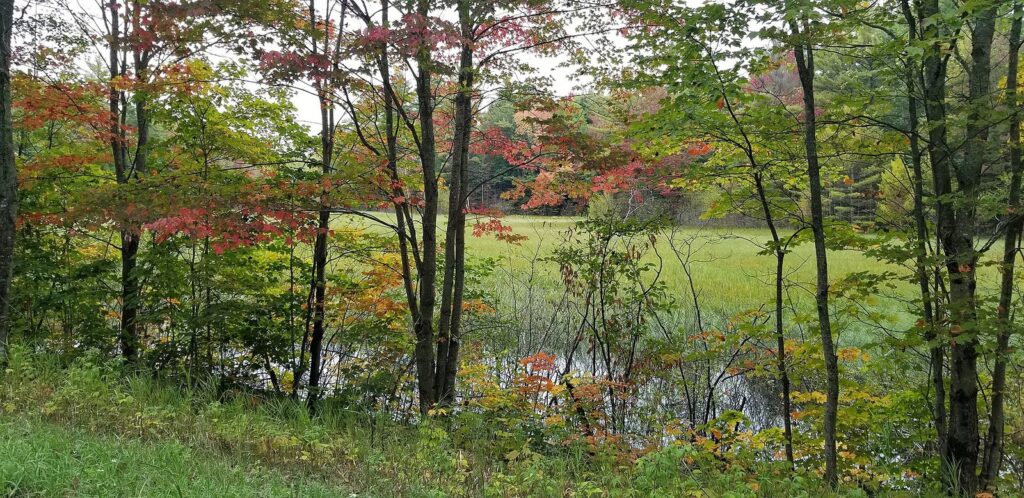
Plan for distance, bugs and bears. Services are far apart, so arrive with food, fuel and water; black flies and mosquitoes are fierce in June and early July; and black bears are common, so store food properly. Cell service is patchy. September, with color starting in the western U.P. in the last week of the month, is the best month to camp here.
When is camping season in Michigan?
| Season | What to expect |
|---|---|
| Spring (April to May) | Many campgrounds open from mid-April to late May, the U.P. and the north last; cold nights, muddy sites, few people; black flies arrive late in May |
| Summer (June to August) | Peak season, with July the busiest month; every campground open; book state park sites six months ahead; bugs worst in June |
| Fall (September to October) | The best camping: warm days, cool nights, no bugs, fall color and open sites; Halloween campouts on October weekends; many campgrounds close in October |
| Winter (November to March) | A few state park loops, cabins and yurts stay open; dispersed winter camping in some parks after snowfall; water often shut off |
Fall deserves a special mention. September has the weather of summer without the crowds or the bugs, and October brings color and the Halloween campout tradition, when private camp resorts and many state park campgrounds hold themed weekends with decorated sites and trick-or-treating for kids. Book those weekends early; they’re the busiest of the fall.
Fall camping
September and early October may be the best camping of the year. The bugs have mostly died down, the beaches empty out after Labor Day, and campgrounds that were full all summer have open sites midweek. In the U.P., color usually starts in mid to late September and peaks during the first three weeks of October, beginning in the west and the interior and spreading east and toward the shorelines, according to UP Travel’s weekly reports. Nights can drop below freezing, so pack a sleeping bag rated for it. Watch the closing dates: Pictured Rocks’ three drive-in campgrounds close on October 15, while Tahquamenon’s Hemlock loop stays open all year. Peak-color weekends are the exception to easy booking, so reserve those like a July Saturday.
Winter camping
Winter camping in Michigan is quiet, cold and more common than you’d think. A few state park loops stay open with limited facilities, such as the Hemlock loop at Tahquamenon’s Lower Falls campground, whose shower building stays open year-round, and some parks allow hike-in or dispersed camping after snowfall, including the Porcupine Mountains, where campers register at park headquarters from December to mid-May. Rustic cabins and yurts are the easier way in: many have wood stoves, and in the Porkies firewood is provided in winter. Plan for below-zero nights in the U.P., bring a real winter sleeping bag and a pad, keep water from freezing, and tell someone your plans.
Weather and safety
Great Lakes weather can turn quickly. Summer thunderstorms build fast on hot afternoons, so pick a site away from dead trees and leaning limbs, stake tents well, and head for a car or building when you hear thunder. At the beach, watch the flags and learn how rip currents work, and remember that Lake Superior stays cold enough to cause cold shock even in August. Black bears live across the north: store food properly and never feed wildlife. Check for ticks after hikes, and keep a first-aid kit and a way to call for help, since cell coverage is patchy in the north woods.
Bugs, weather and what to bring
- Bug protection: repellent, a head net and long sleeves for June and early July, especially in the north and the U.P.; check for ticks daily.
- Warm layers: even July nights near Lake Superior can drop into the 40s and 50s; bring a warm sleeping bag and a fleece.
- Rain gear and a tarp: Great Lakes weather changes fast, and summer thunderstorms are common.
- Water: rustic campgrounds have hand pumps, but dispersed sites have nothing; carry water or a filter.
- Bear-safe storage: a hard-sided cooler kept in the car, or a bear canister for backcountry trips.
- Local firewood: buy it where you burn it.
- Offline maps: cell service fades in the north woods.
A Michigan camping checklist
- Shelter: a tent with a full rainfly, a footprint or ground tarp, extra stakes for sand and wind, and a second tarp to rig over the picnic table.
- Sleep: a bag rated at least 10 degrees below the coldest night you expect, a sleeping pad, which matters as much as the bag on cold ground, and a pillow.
- Kitchen: a stove and fuel, a lighter and matches, a pot and a pan, a cooler with ice, a water jug, a wash basin with biodegradable soap, and trash bags.
- Clothing: a warm layer and a rain jacket in every season, a hat for cold nights, water shoes for the beach and a spare pair of dry socks.
- Light and power: a headlamp for each person, a lantern, and a battery bank if your site has no electricity.
- Safety and paperwork: a first-aid kit, a paper map, your reservation confirmation and the Recreation Passport on your vehicle.
Camping etiquette
- Respect quiet hours (10 p.m. to 8 a.m. in state parks), and keep music and generators down at all times.
- Stay on your site. Don’t cut through other campsites to reach the beach or restrooms.
- Leave no trace: pack out what you pack in, pick up micro-trash, and never burn trash in the fire ring.
- Keep a clean camp so bears, raccoons and gulls don’t learn to raid it.
- Put fires dead out with water before bed and before you leave.
- Check out on time (noon in state parks) so the next campers can set up.
What to skip, and what to do instead
Skip showing up at a popular state park in July without a reservation. Book six months ahead, or head for a state forest campground.
Skip bringing firewood from home. Buy it locally to avoid spreading tree pests.
Skip June in the U.P. if bugs ruin your trip. September is warmer than you’d think and nearly bug-free.
Skip the Manitou Islands in 2026. They’re closed all season; camp at Sleeping Bear’s D.H. Day or Platte River campgrounds instead.
Skip dispersed camping without the paperwork. Post the registration card on state land, stay more than a mile from state forest campgrounds and follow the 15-night limit.
Frequently asked questions
Where can you camp for free in Michigan?
On state-owned land outside state parks, recreation areas, state forest campgrounds and game areas, as long as you post a DNR camp registration card at your site, stay more than one mile from a state forest campground and stay no more than 15 nights. Dispersed camping in the Huron-Manistee, Hiawatha and Ottawa national forests is also free, with local rules such as a 16-day limit.
How far in advance can you book Michigan state park campsites?
Six months to the day before your arrival, on MiDNRReservations.com or by phone at 1-800-447-2757. New dates open at 8 a.m. on weekdays and 9 a.m. on weekends, and a non-refundable $8 online or $10 phone reservation fee applies. Popular beach parks in July can fill within minutes of the window opening, so be ready. Changes and cancellations aren’t allowed more than five months before arrival.
Do you need a Recreation Passport to camp in a Michigan state park?
Yes. A Recreation Passport is required on every vehicle entering a state park or state forest campground, and it’s separate from your camping fee. Michigan residents pay $15 a year with their plate renewal; non-residents pay $12 a day or $42 a year in 2026. National lakeshore campgrounds use their own entry passes instead.
What is the best state park for camping in Michigan?
For a beach, Grand Haven State Park’s campground on the sand is the classic, with Holland, Ludington and Tawas Point close behind. For woods and a lake, Interlochen, one of the oldest parks in the system, and Hartwick Pines are favorites. In the U.P., Tahquamenon Falls and the Porcupine Mountains’ Union Bay campground are the standouts, and Straits State Park has views of the Mackinac Bridge.
Can you camp anywhere in Michigan state forests?
Not quite. Outside the developed campgrounds, you can camp for free on state forest land if you post a DNR camp registration card at your site, stay more than one mile from any state forest campground and stay no more than 15 nights. You can’t camp in state parks, recreation areas or game areas outside designated sites, and private land needs permission.
When is camping season in Michigan?
Most campgrounds open between mid-April and late May and close in October, with the U.P. and the far north opening last. July is the peak month, and September is the best: warm days, cool nights and no bugs. A few state park loops, cabins and yurts stay open all winter for cold-weather campers, and fall Halloween campouts fill up early.
Can you camp on the beach in Michigan?
Not on the sand itself in state parks or national lakeshores, but many campgrounds sit just behind the beach: Grand Haven State Park’s sites are on the sand, and the Porcupine Mountains, Tawas Point and Pictured Rocks’ Twelvemile Beach have sites steps from the water. Book those sites the day the six-month reservation window opens.
Sources and verification
Everything on this page was checked on September 23, 2026 against the organizations listed here. This guide is compiled from those sources; it doesn’t claim first-hand visits.
- Michigan DNR: reservation policies, plus its camping rules, rates and Recreation Passport pages
- Michigan DNR: state forest campgrounds, plus its dispersed-camping FAQ and registration card
- US Forest Service: Huron-Manistee camping and cabins
- National Park Service: Pictured Rocks and nearby campgrounds, plus Sleeping Bear Dunes’ camping pages
- MiDNRReservations.com
Also checked: the DNR’s Porcupine Mountains and Tahquamenon Falls park pages; Recreation.gov listings for the Upper Manistee River backcountry sites; Frankenmuth Jellystone Park’s 2026 activities; and Camp Michigan’s campground directory.
Michigan Tourism Guide is an independent publication. It is not affiliated with Pure Michigan or any agency or business named here.
Photo credits
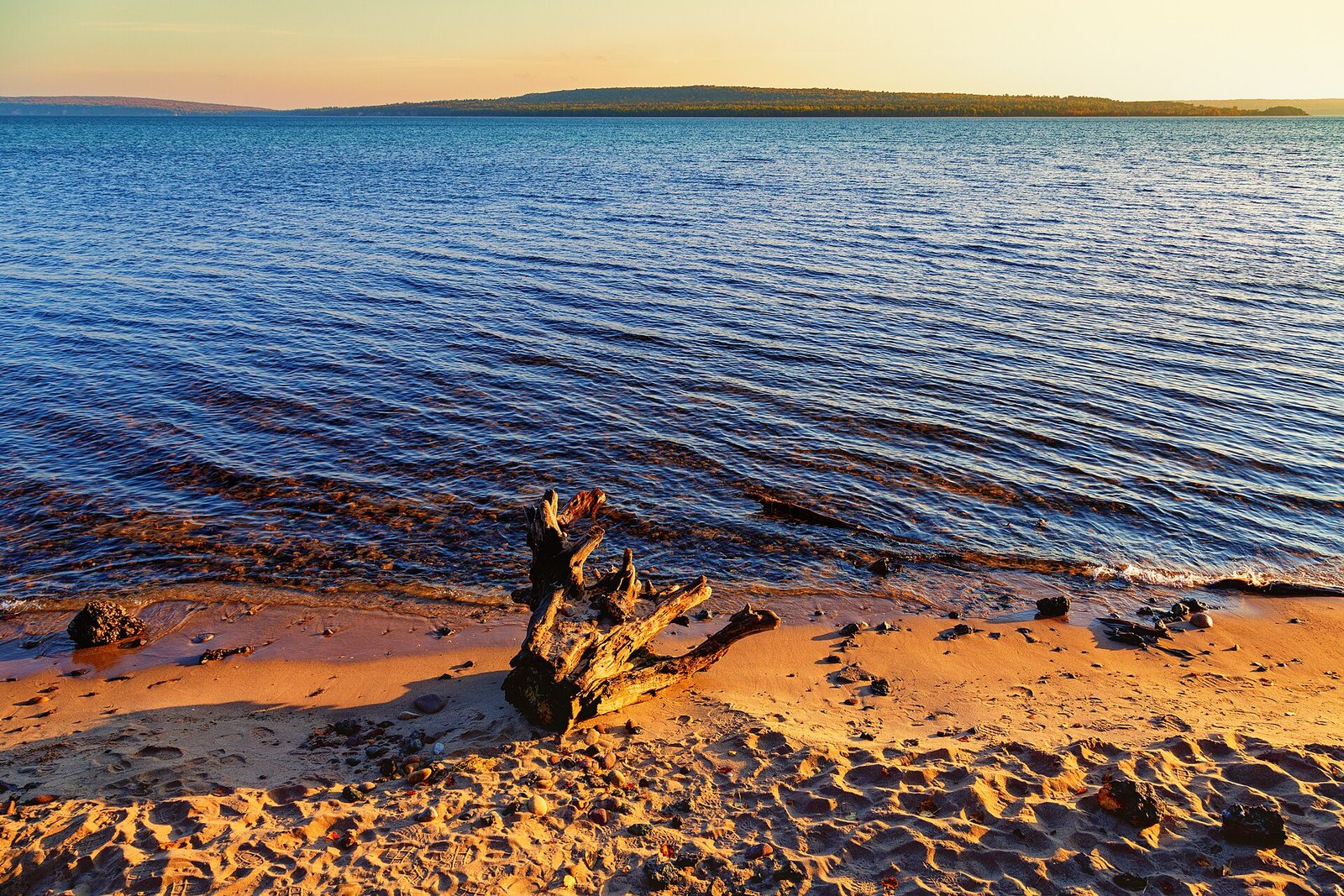
- Lake Superior beach at Bay Furnace Campground, Hiawatha National Forest (featured image): photo by Tony Webster, Wikimedia Commons (CC BY 2.0)
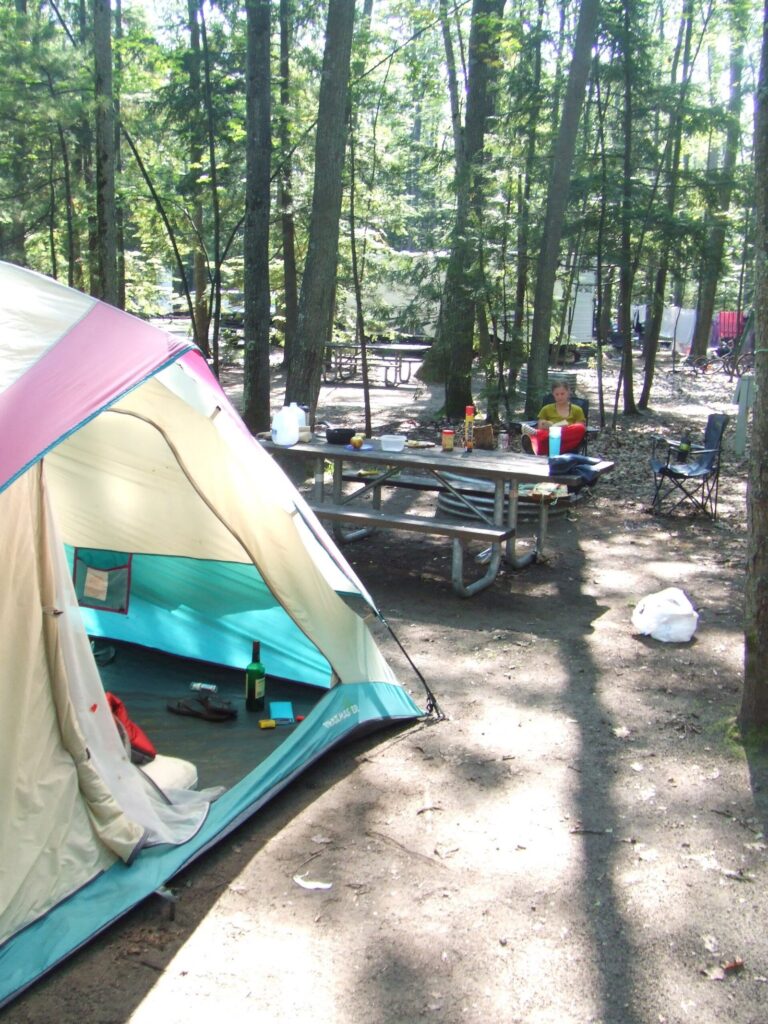
- Campsite at Interlochen State Park: photo by Elizabeth Skene, Wikimedia Commons (CC BY-SA 2.0)
- Interlochen State Park entrance sign: photo by HesioneHushabye, Wikimedia Commons (CC0)
- Mackinac Bridge from Straits State Park: photo by Notorious4life (talk) (Uploads), Wikimedia Commons (CC0)
- Bright Lake, Hartwick Pines State Park: photo by dailyinvention from Auburn Hills, United States, Wikimedia Commons (CC BY 2.0)
- Manistee River: photo by Eric Schmuttenmaer from Wheaton, USA, Wikimedia Commons (CC BY-SA 2.0)
- Fall color near Pete's Lake Campground, Hiawatha National Forest: photo by usfs_Eastern_Region, Wikimedia Commons (public domain)